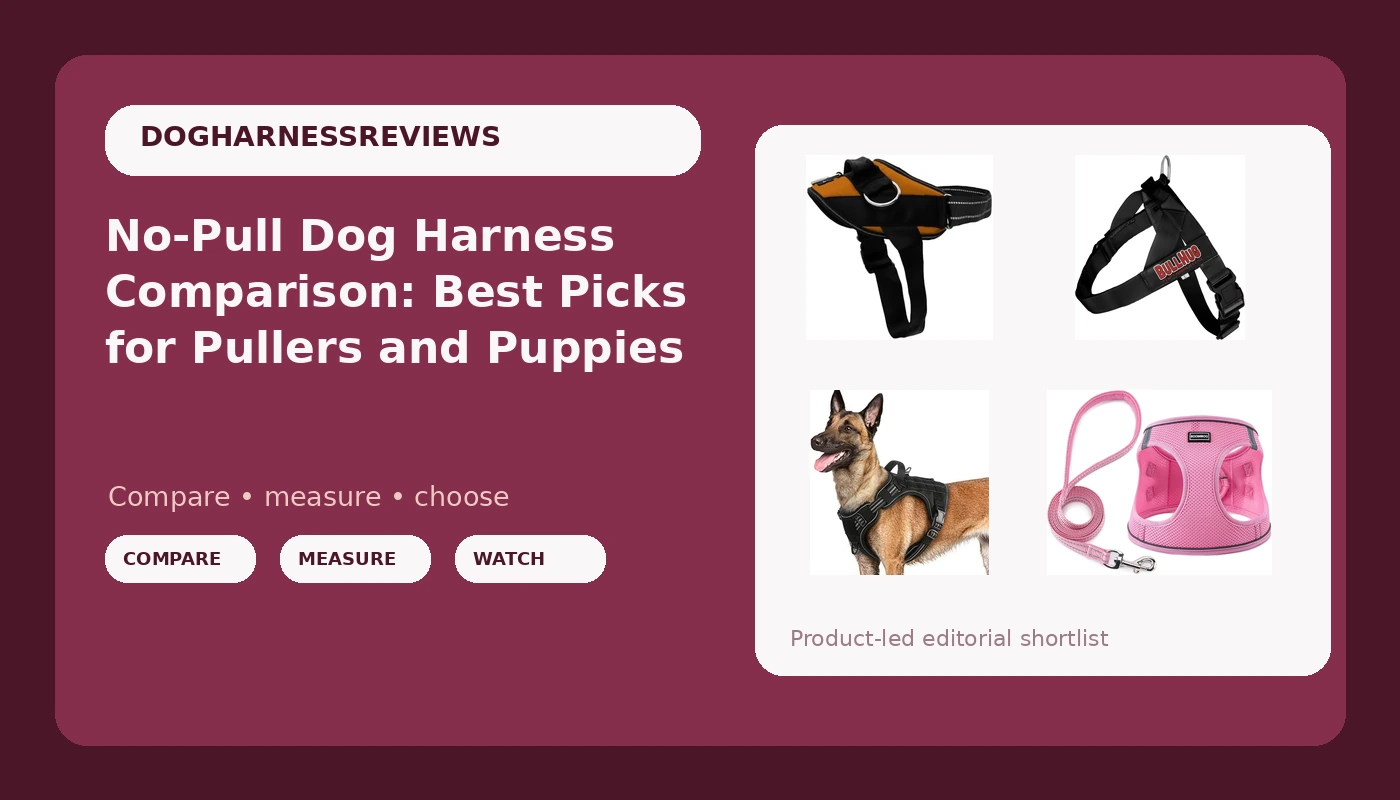
I have fitted harnesses on more than 3,000 dogs over eight years of shelter work and private training, and the same conversation happens at least twice a week: someone bought a no-pull dog harness, the pulling never stopped, and now they believe no-pull harnesses are a marketing trick. Almost every time, the harness was the wrong shape for the dog, or the leash was clipped to the wrong ring, or the size was chosen from a weight chart instead of a chest measurement. This no-pull dog harness comparison covers four harnesses that do four different jobs: a step-in puppy vest with a leash included, a small no-pull vest, a harness cut for broad-chested breeds, and a tactical vest built for large dogs. None of them is a magic cure for pulling. Each one is the right answer for a specific dog, and at least one of them is the wrong answer for most dogs.
I say this as someone who likes harnesses. A harness takes pressure off the throat and the cervical spine, which is the single biggest injury reduction in everyday dog walking in my lifetime. What a harness does not do is teach a dog to stop pulling. It gives you leverage and it protects the neck. The training is still your job, and the harness is the tool that makes the training possible without your dog choking himself hoarse on the way to the park.
For most owners with a dog that actually pulls, the rabbitgoo Tactical Dog Harness is the pick in this group, because it is built for the body type that pulls hardest and it advertises a no-pull attachment point. For a puppy or a tiny dog, the step-in vest with the leash set is the honest buy. The other two only make sense for a specific chest shape, and I will tell you exactly which one.
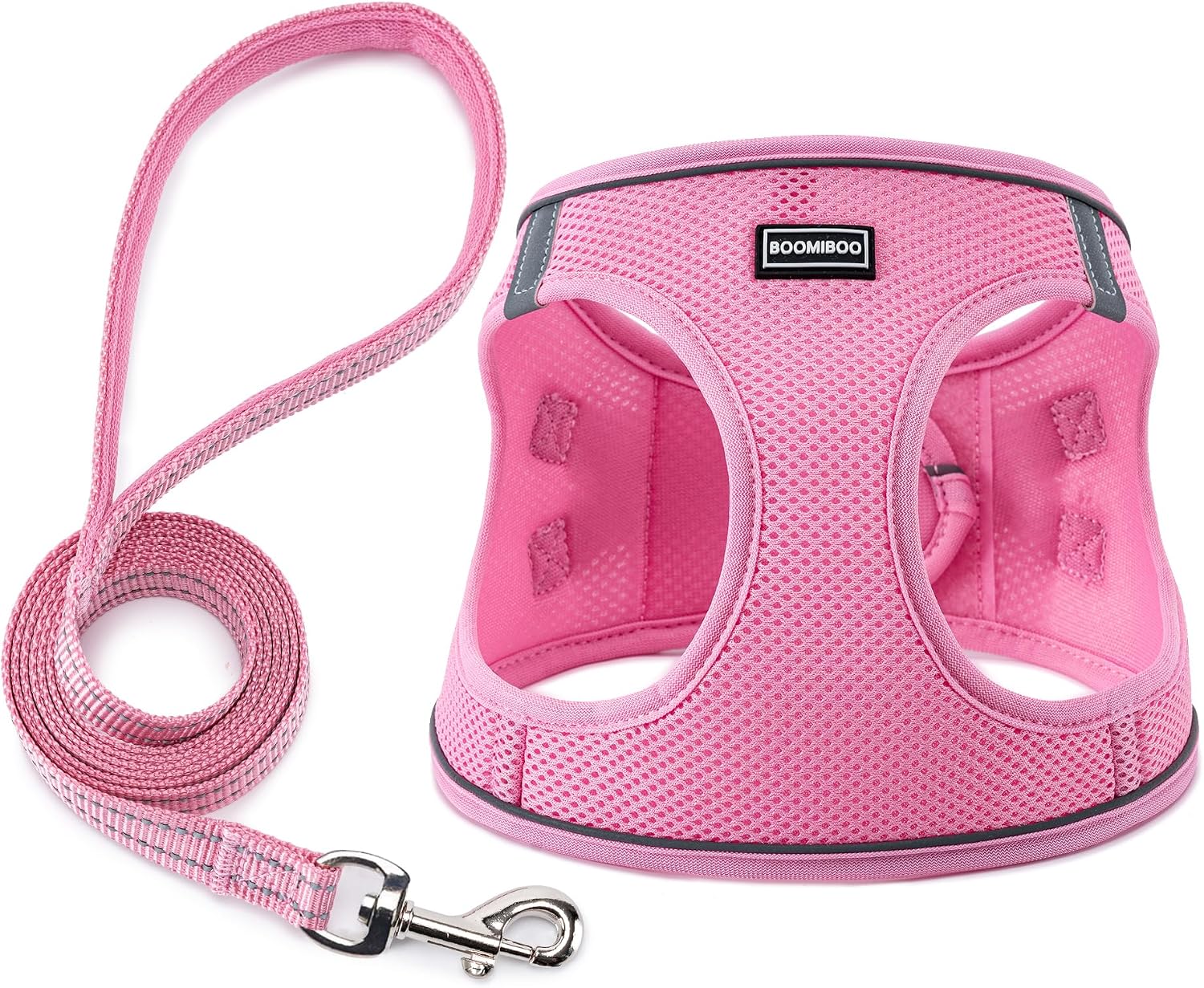
Dog Harness with Leash Set, Step-in Adjustable Puppy Pet Vest, Pink XS
Cheapest way to get a puppy used to wearing gear, and the leash is included
Back-clip only, so it does nothing about pulling once your puppy grows into one
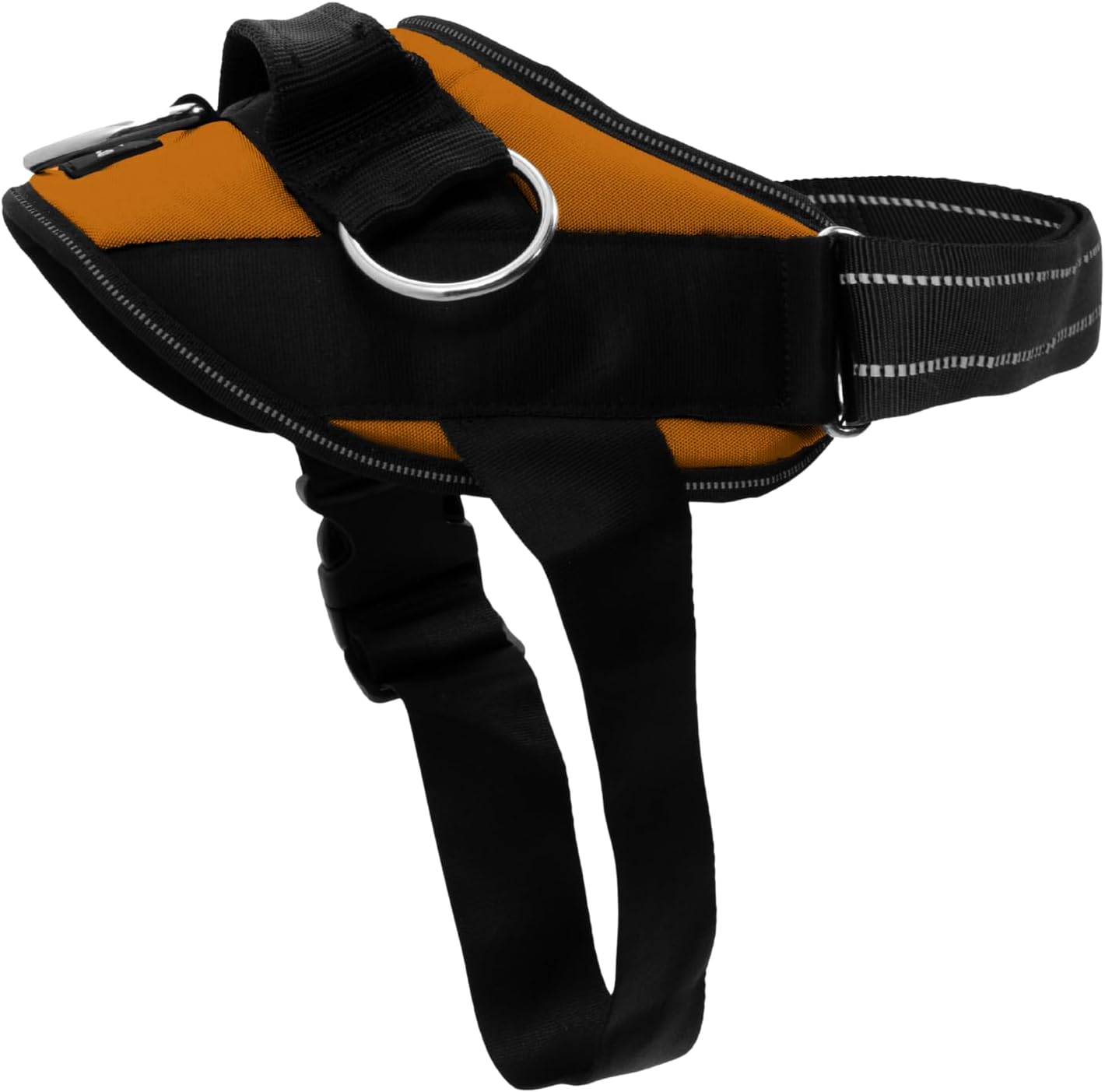
ShawnCo Essential Dog Harness, No-Pull Pet Vest (Sunset Orange, XS)
Real no-pull geometry in a tiny size, which is rare
XS only, and small straps leave no room for a sloppy fit

BULLHUG Adjustable Dog Harness, No Pull, No Choke, for English Bulldogs, French Bulldogs, Pugs and Broad-Chested Breeds (Black, Medium)
Cut for a wide chest and a short back, so straps stop riding into the armpits
A shape that good is a shape that fits fewer dogs, and this one is not for deep-chested breeds
rabbitgoo Tactical Dog Harness for Large Dogs, No Pull Service Pet Vest
Built for large dogs, spread across the chest, sold as a no-pull vest
Tactical styling adds bulk, and a back-clip puller in a big vest is still a sled dog setup
Prices and availability were captured from Amazon Creators API and may change.
How I judge a harness before it goes on a dog
Fit is 80% of the outcome. A perfect harness on the wrong dog rubs, twists, and teaches the dog that gear is uncomfortable. I check the same five things every time.
The neck opening has to clear the shoulders without hanging loose. If the harness slides down when the dog lowers his head to sniff, it will end up under the armpit on the first walk. The chest strap should sit behind the shoulder blades, not across the front of them, because a strap over the shoulder joint restricts the front leg swing and creates a rub point within a week.
I want two fingers of slack under every strap and no more. Loose straps chafe because they move; tight straps chafe because they press. There is a narrow band of correct, and that is why adjustability matters more than padding.
Hardware is the part that fails. I have seen plastic buckles explode on a leash-pop, and I have bent plastic D-rings with my thumb. On a dog over 40 pounds, I want metal where the leash attaches. Strap webbing matters too: wider webbing spreads load, but wide webbing on a small dog is stiff and digs in. Padding that shifts after a month is worse than no padding at all, because a lump of foam in the wrong place rubs a raw spot.
And the attachment point decides everything. A back clip is a walking clip. A front clip is a training clip. If your dog pulls, the leash goes on the front, and the harness has to be shaped so that ring sits at the sternum and not off to one side.
The step-in puppy vest: cheap, simple, and honest about what it is
The step-in puppy vest with the leash set is the first harness I hand to a new puppy owner. The dog steps in, you clip it on the back, and you are done in four seconds. Nothing about that design fixes pulling, and nothing about it claims to. What it does is put gear on a puppy before the puppy has opinions, which is the entire point of socialization.
For a tiny breed or a young puppy, a light vest like this is genuinely the right call. Heavy tactical webbing on a four-pound puppy is absurd, and a step-in cut means you are not wrestling a wriggling dog into a neck hole. The included leash matters more than it sounds: matching hardware means one less thing to buy, and the leash clip will fit the ring it was designed for.
My criticism is the back clip. It gives you zero mechanical advantage, so the day your puppy starts lunging at a jogger, this harness becomes a handle you are pulling against rather than a tool that redirects. That is fine for a six-month window. It is not fine as a permanent walking harness for a dog who pulls, and the plastic hardware is the first thing I would watch on a dog approaching 40 pounds. If you are buying this one, buy it for the puppy stage, not for the next ten years.
The small no-pull vest: the right idea in the smallest size
Small dogs pull too, and the harness industry mostly ignores them. Most no-pull harnesses start at a size that swallows a Yorkie, which is why the ShawnCo Essential no-pull vest in XS is worth a look. It brings the same front-clip thinking as the big-dog harnesses to a body that actually needs it, and the front attachment is what turns a small dog's forward pull into a sideways redirect instead of a choke.
Here is the problem with XS: the straps are narrow, so the fit window is narrow too. On a large dog, an inch of error is invisible. On a 12-pound dog, an inch of error means the chest strap is sitting on the shoulder joint or the neck opening is loose enough to slide. Measure the chest girth at the widest point behind the front legs, measure it again, and then order. Do not trust the weight range alone.
The other thing I would check on any small harness is the leash ring itself. A plastic front ring on a determined little dog will deform over time, and once it deforms, the leash pulls at an angle and the redirect stops working. Metal is the spec I want, and it is the first thing I check on any harness under 20 pounds.
Broad-chested breeds need a different cut
English bulldogs, French bulldogs, and pugs are not small versions of a Labrador. Their chest is wide, their back is short, and their neck-to-chest depth is shallow. A standard harness on that body type either sits too low across the sternum or rides up into the throat, which is exactly the pressure a harness is supposed to eliminate.
The BULLHUG adjustable harness is cut for that body, and the "no pull, no choke" framing is the right promise for it. A wide chest needs a wide chest panel and a short back strap, because a long back strap on a short dog slides forward. It also has to be adjustable in more places than a standard harness, since broad-chested dogs vary enormously from one to the next. Two bulldogs of the same weight can differ by three inches of chest girth.
The trade-off is real and I will not pretend otherwise. A harness shaped for a broad chest is a poor fit for a deep-chested dog like a greyhound or a Doberman, because the chest panel that spreads load on a bulldog collapses on a narrow ribcage and the straps end up doing all the work. This is a harness you buy because of your dog's shape, not because of the brand on the label. And like every no-pull harness in this group, it is a leverage tool: the front attachment redirects, and the training still has to happen.
Large dogs and the tactical vest
The rabbitgoo tactical harness is the one I would put on a 70-pound dog who pulls. It is built for large bodies, which sounds like marketing until you have watched a medium harness stretch across a big chest and start cutting into the front legs. The tactical category also usually brings a top grab handle, and a handle is a legitimate piece of safety equipment. It is how you hold a dog steady at the vet, help him into the car, and keep him from launching at a reactive dog across the street.
Two warnings. First, the tactical label is styling as much as function, and bulk is a cost. Extra panels and webbing add weight and warmth, which matters for a thick-coated dog in a Portland summer. Second, and more important, a back clip on a big puller is a sled dog setup. The dog leans into it, the harness spreads the load, and you get dragged more comfortably than before. If the vest advertises a no-pull attachment, use that ring on the walks where your dog is most likely to pull, and use the back ring for casual sniffy walks where he is not.
What none of these four will do for you
None of them is a crash-tested car harness. That is a separate category with published testing standards, and I want people to stop clipping a walking harness into a seatbelt and calling it a safety system. A walking harness and a car harness are two different products, and most dogs need both.
None of them replaces training. A front-clip harness buys you control while you teach loose-leash walking, and if you never teach it, you will own a very well-engineered pulling machine. I love that harnesses reduce neck injuries. I do not love that people skip the training because the harness "fixed" the pulling. It redirected it.
None of them is sold in one size that fits everything, and none of them should be. If a listing tells you a single size fits all dogs, close the tab.
Which harness for which dog
Puppy under six months, or a dog under 10 pounds who does not pull: the step-in vest with the leash set. Cheap, light, and the leash is included.
Small dog who genuinely pulls: the ShawnCo no-pull vest in XS, after you measure the chest girth twice.
Bulldog, pug, or any broad-chested, short-backed dog: the BULLHUG, because the cut is the feature and no amount of adjusting fixes a shape mismatch.
Large dog who pulls, or a dog who needs a handle for car exits and vet visits: the rabbitgoo tactical vest, with the leash on the front attachment.
And if your dog is between sizes, size up only if the harness has enough adjustment to take it in. A harness that is too large slides, and a sliding harness rubs.
What I am watching next
Metal hardware is going to become standard below $30 within two years. The factories are already upgrading, and the plastic-buckle era is ending whether the brands admit it or not. I expect the car-harness segment to grow fastest of all, because the moment safety ratings get published the way they are published for child seats, every walking harness in this comparison becomes a partial solution.
The training-community brands will keep their lead, because reputation in this category is built on fit and hardware, not on photos. The Instagram brands will fade with the trend cycle, and the dogs who wore them will still be pulling.