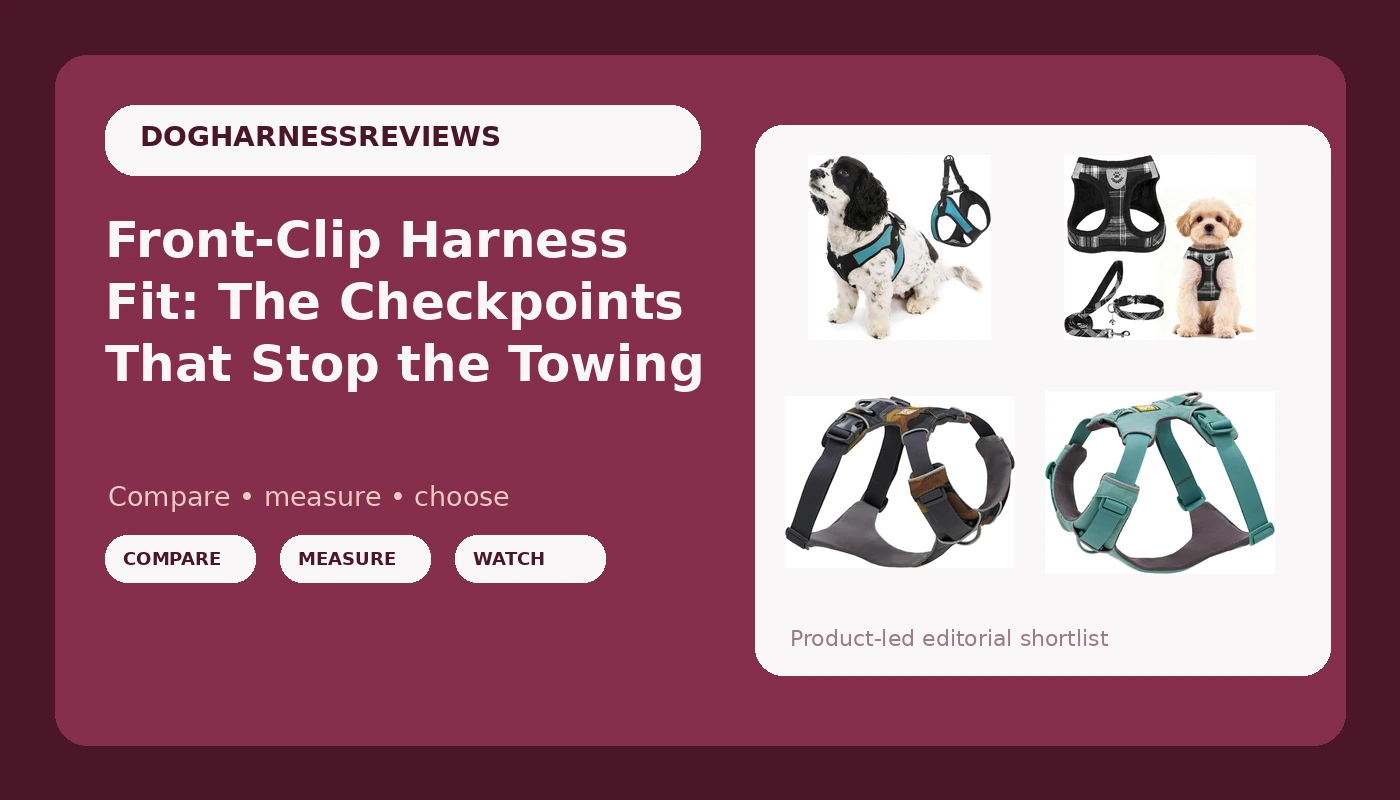
Most people buy a harness because walking the dog stopped being enjoyable, and most of them buy the wrong one for the wrong reason. A no-pull dog harness fit is not a brand decision. It is a geometry decision. The chest strap has to sit on the sternum, the girth strap has to clear the shoulder, and the leash attachment has to sit somewhere that redirects forward motion instead of rewarding it. Get those three things right on a modest harness and it will outperform a badly fitted expensive one every single walk. Get them wrong and you have bought a very nice piece of nylon that your dog will lean into like a sled dog.
Related: Dog Harness Fit Points: Where the Straps Should Actually Sit →
Quick answer
For a dog that pulls, start with a chest harness that offers a front attachment, and measure your dog rather than guessing a size. The Ruffwear Front Range in Medium is the training-grade default among the four options here, the Gooby Escape Free is the step-in choice for small dogs that back out of gear, and the PUPTECK set is the simplest way to get a harness, collar, and leash in one purchase. Two of the four listings are the same Ruffwear harness in different colorways, so that particular comparison comes down to color rather than function.
Four useful options
| Model | Best fit | What stands out |
|---|---|---|
| Ruffwear Front Range Dog Chest Harness, Moonlight Mountains, Medium | Dogs that lean into the leash | Chest harness from a training-community brand, Medium size |
| Gooby Escape Free Easy Fit Dog Harness, Step-in, Turquoise, Small | Small dogs that back out of gear | Step-in entry, Small size, turquoise |
| PUPTECK Dog Harness, Collar and Leash Set No Pull for Small Medium Sized | First-time buyers starting from nothing | Harness, collar, and leash in one set |
| Ruffwear Front Range Dog Chest Harness, River Rock Green, Medium | The same dog, a different color | Identical model to the Moonlight Mountains listing |
The training-grade chest harness: Ruffwear Front Range Dog Chest Harness, Moonlight Mountains, Medium
A chest harness puts the attachment points on the chest and the back instead of around the throat. That matters enormously for a dog that surges forward. A front attachment lets you redirect forward drive sideways rather than pulling back against it, and redirection is a far easier conversation than a tug of war. This listing is fixed as a Medium, so the size is decided by the listing rather than by wishful thinking. Medium is a real fit band, and a dog sitting on the edge of it will do better in the size that matches its girth measurement than the size that matches its weight. The reason the training community keeps coming back to this model is not marketing. It is that the harness holds its shape, the hardware survives a leash pop, and the fit points stay where you set them.
The step-in for small dogs that back out: Gooby Escape Free Easy Fit Dog Harness, Step-in, Turquoise, Small
Step-in harnesses solve one very specific problem: the dog that drops its head, backs away, or folds itself in half the moment you try to slip a loop over its ears. With a step-in, the dog places its paws in the openings and you bring the straps up around the body. For a nervous or undersocialized dog, that is faster, quieter, and less confrontational than wrestling a head loop on at the front door. This listing is a Small in turquoise, and Small is a genuine constraint rather than a suggestion. The fit points on a twelve-pound dog are nothing like the fit points on a fifty-pound one, and a harness built for a small frame will not have the strap width or the hardware for a large one. Measure the girth behind the front legs and compare it to the size chart before you commit.
The complete starter set: PUPTECK Dog Harness, Collar and Leash Set No Pull for Small Medium Sized
This set is the practical answer for someone who just adopted a dog and owns nothing yet. It is listed as a harness, collar, and leash set, sized for small to medium dogs, and described as no-pull. Buying the pieces together removes one decision from a week that is already full of them, and a matched set means the collar and the leash are already sized to work with the harness rather than against it. The trade-off is the same one that shows up in every all-in-one kit. You get a complete setup rather than a specialized one, and a determined puller may outgrow the harness's leverage before it outgrows the size. Treat it as a starting kit, then replace the harness alone once you know how your dog actually walks on a leash.
The same harness in the other colorway: Ruffwear Front Range Dog Chest Harness, River Rock Green, Medium
Before you compare these two Ruffwear listings side by side, know that they are the same harness. Same model, same Medium size, same chest design, same brand. The only difference is the colorway, Moonlight Mountains versus River Rock Green. That makes the decision aesthetic and nothing more, so pick the one that hides mud better, or the one that matches the leash you already own. There is no performance argument to make between them. One thing worth weighing: lighter and brighter colorways tend to fade faster than dark ones after a winter of rain, mud, and repeated washing, so if you care how the harness looks in year two, that is a legitimate tiebreaker. Neither color will make the fit better.
Prices and availability may change. Product images, names, and retailer links are matched to verified listings. No current price, rating, stock status, or measured result is stated here without current evidence.
What a no-pull harness actually does
A no-pull harness does not stop pulling. It changes the leverage so that pulling becomes less rewarding and easier to interrupt. The mechanics are simple once you see them. On a back-clip harness, a dog that leans forward pulls with its whole body weight, and the harder it pulls, the more the harness settles into a comfortable position against its chest. That is why a back-clip harness on a determined puller feels like a sled dog setup, and why the dog seems to get stronger the longer you walk. A front attachment rotates the chest toward you when the leash goes tight. The dog is not choked and not hurt. It is simply turned, and that turn is the moment you mark and reward. The harness buys you a fraction of a second of attention. You still have to use it, and that is the part most people skip.
The five fit points that decide the outcome
Fit is the majority of the outcome, and fit is measurable. Before you judge any harness on a walk, check these five points in this order.
- Girth behind the front legs. Measure the deepest part of the chest, right behind the front legs, and compare it to the size chart. Weight tells you almost nothing about which size fits.
- Shoulder clearance. The girth strap should sit behind the shoulder blade, not across it. If the strap crosses the shoulder, the dog's stride shortens and the harness will rub on long walks.
- Sternum position for the front ring. The front attachment should land on the chest plate, roughly where a necktie knot would sit. If it drifts toward the throat, the leash will ride up and the harness will pull sideways instead of steering.
- Strap width against body weight. Narrow webbing digs in on a heavier dog. Wider webbing spreads the same load, which matters more as the dog gets stronger, not less.
- Hardware inspection. Flex every buckle and every attachment ring with your hands before the first walk. If a buckle flexes or a ring bends under thumb pressure, it is not going to survive a real correction on a real dog.
Before you check out
- Measure the girth, then measure it again with the dog standing rather than sitting. A sitting measurement reads short and will send you a size down.
- Buy for the dog you have now. A harness that fits a puppy at four months will be useless at eight, and a loose harness is worse than a tight one because it shifts under load.
- Run the two-finger test under every strap. Two fingers should slide under with light resistance and no pinching.
- Check that the leash attachment does not end up under the armpit when the dog lowers its head. An attachment that sits in the armpit will chafe within a mile.
- Rinse the harness after muddy walks and inspect the stitching and hardware monthly. Salt, grit, and repeated washing are what kill harnesses, not the dog.
Which option should you choose?
Choose the Ruffwear Front Range Dog Chest Harness in Moonlight Mountains, Medium when you have a dog that leans into the leash and you want the training-grade default that most trainers hand to a client. Choose the Gooby Escape Free Easy Fit Dog Harness, Step-in, Turquoise, Small when your dog is small and backs away from anything that goes over its head, because step-in entry removes that fight entirely. Choose the PUPTECK Dog Harness, Collar and Leash Set when you have just brought a dog home and need a harness, a collar, and a leash in a single purchase to start walking tomorrow. Choose the Ruffwear Front Range Dog Chest Harness in River Rock Green, Medium when the Front Range is already the right answer and you simply prefer that color.
One honest caveat: size and color are the only differences I can point to between these listings, and fit is the variable that decides whether any of them works. A harness in the wrong size will fail no matter which of these four you buy, so treat the size chart as the most important page on any product listing.
The bottom line
Buy the fit first and the harness second. Measure your dog's girth, pick the size that matches, and choose a front attachment if your dog pulls. The Ruffwear Front Range is the model to start with for a serious puller, the Gooby step-in solves the small dog that evades a head loop, and the PUPTECK set gets a new owner walking on day one. The two Ruffwear colorways are the same harness, so decide that one with your eyes. Then do the work: mark the moment the leash goes slack, reward it, and repeat. The harness makes that moment possible. It does not make it happen.