Most harnesses fail on the dog, not on the shelf. I have fitted more than 3,000 dogs over eight years of shelter work and my own training business here in Portland, and the pattern never changes. An owner buys a harness, cranks the straps down until the webbing bites, watches the dog drag them across the street anyway, and blames the product.
A correct no-pull dog harness fit is 80 percent of whether the gear does anything at all. The front clip only redirects a dog if it sits on the sternum and stays there. A loose chest strap turns a training tool into a necklace. A tight one rubs the armpit raw inside a week, and then the dog hates the harness, and then you have two problems instead of one.
This is the fitting procedure I run on every dog that comes through my door, in order, plus the two harnesses I point people toward when they ask what to buy. The whole thing takes about fifteen minutes. It is the cheapest training you will ever do.
Why you should trust me
Eight years at a shelter working reactive and pulling dogs, then a training business where harness fitting is half the intake. I keep a shelf of more than 30 harnesses that have been washed repeatedly, yanked on, and worn by my own two German shepherds. I look at strap webbing, buckle metal, and how long padding stays where it was sewn before it shifts and starts rubbing. I care about one outcome: does the dog stop pulling, and does the harness survive the dog that wears it.
What a no-pull harness actually does
A front-clip harness works by physics, not magic. The leash attaches at the chest. When the dog surges forward, the strap across the chest tightens and turns the dog's front end back toward you. You get a half second where the dog is facing you instead of the squirrel. That half second is your entire training window, and it only exists if the clip is sitting in the right place.
A back-clip harness does the opposite. It gives the dog a solid anchor point at the shoulders, which is exactly what a sled dog wants. On a 70-pound dog that pulls, a back-clip only setup is a sled dog setup. Back clips are fine for a dog that already walks politely, and they are the right attachment for a car tether. They are not the tool for a dog that takes you for a walk.
Some harnesses add a martingale ring at the chest, which tightens slightly when the dog pulls and releases when they do not. That is a useful feature, but it only works when the chest strap is adjusted snug.
The harness does not train the dog. It buys you a half second to reward the dog for choosing to stay with you. Skip the reward and you have bought an expensive leash attachment.
How I judge a harness before it goes on a dog
Four fit points decide everything: the neck opening, the chest strap, the girth strap behind the ribs, and the shoulder clearance. If a harness cannot be adjusted independently at three of those four, it will fit some dogs and fight the rest.
After fit, I look at hardware. Front clips should be metal. I have bent plastic D-rings with my thumb, and a bent ring is a leash that pops off at the worst possible moment. Buckle quality is the whole product. Plastic buckles are acceptable on small dogs. On anything over 40 pounds, I want metal or nothing.
Strap webbing matters more than people think. Thin, stiff webbing digs in. Wide webbing distributes load but can bunch at the chest if the harness has no padding there. Padding that shifts after a month is worse than no padding, because it creates a hard seam right where the dog's leg swings.
Here are the two harnesses I hand people most often, and who each one is actually for.
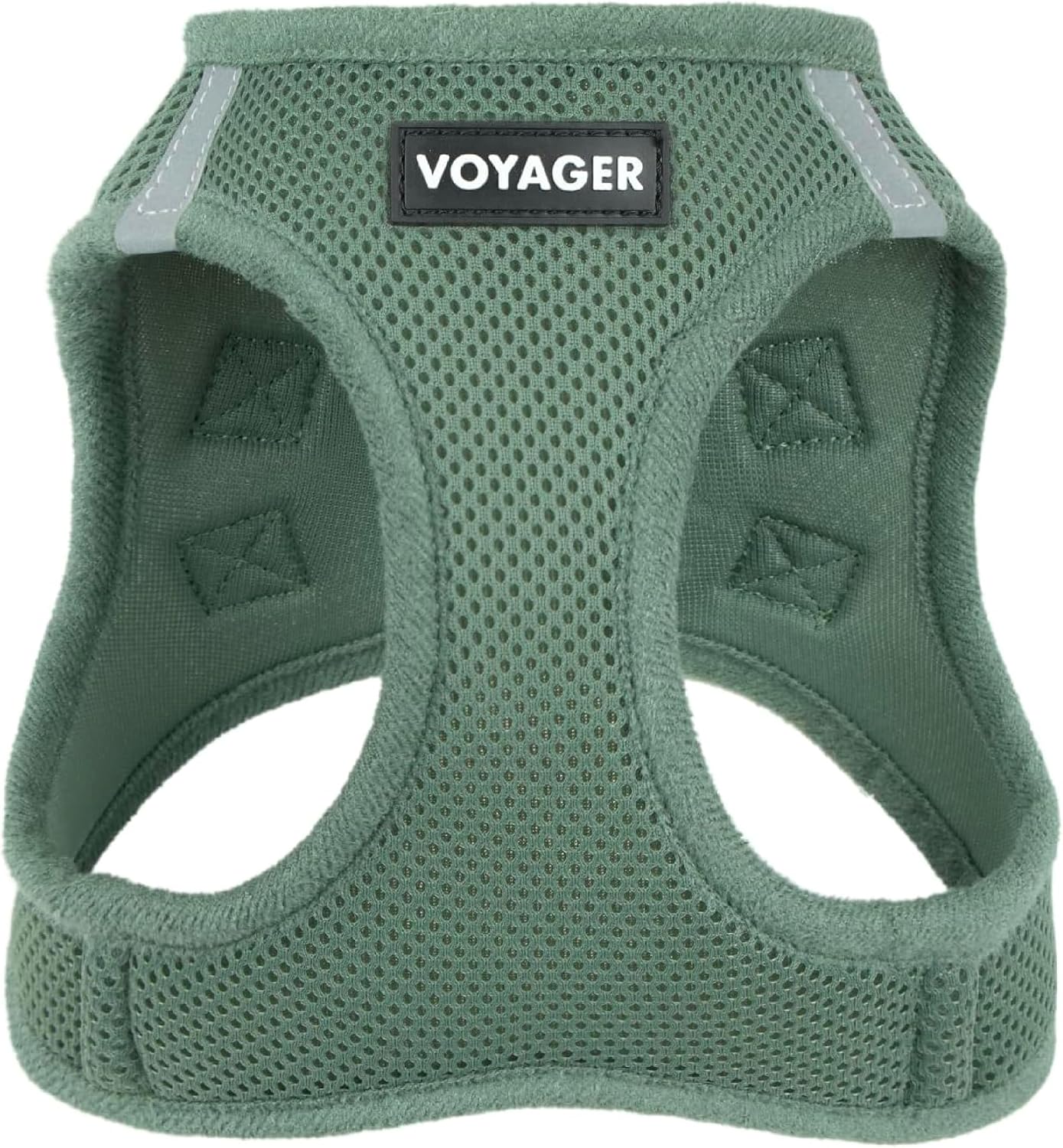
Budget pick: Voyager Step-in Air Dog Vest Harness - Moss Green, Medium
 Visit on Amazon →
This is the harness I recommend to the owner of a small or medium dog that already walks reasonably well and just needs something soft, light, and fast to put on. The step-in design is the selling point here. The dog steps into the vest, you bring it up over the shoulders, and you are done. For a wiggly dog under 25 pounds, that is worth more than any feature on a spec sheet.
The vest style spreads pressure across the chest rather than concentrating it on two thin straps, which is the right call for a dog with a delicate throat or a collapsing trachea history. The moss green color holds up better than the pale pastels that go gray after one Pacific Northwest winter, which matters if you are the kind of person who wants to buy this once.
Flaws but not dealbreakers: This is not the harness for a dog that pulls. The step-in format is built for comfort and speed, not for load management on a hard-charging dog. If your dog hits the end of the leash every walk, keep reading.
A verified pattern I see in reviews of step-in vests generally: owners of senior dogs and puppies love them, owners of young strong dogs outgrow them fast.
Small dogs, senior dogs, and any dog that already walks on a loose leash will be happy here. Check your girth measurement against the size chart before you order, because step-in harnesses have less adjustment range than strap harnesses.
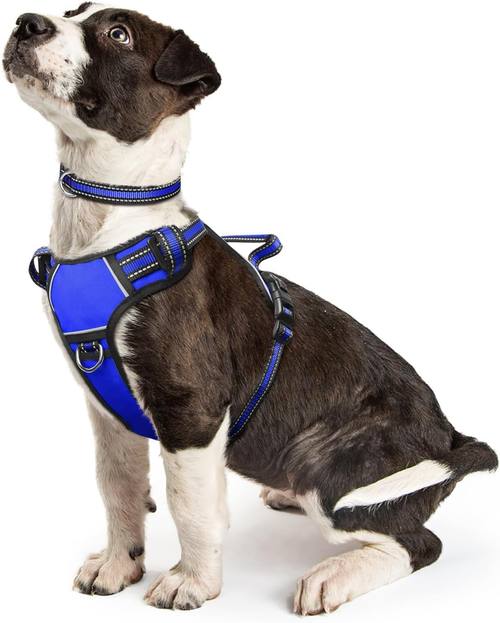
Our pick for dogs that pull: WINSEE Dog Harness No Pull, Pet Harnesses with Dog Collar, Adjustable Reflective Oxford Outdoor Vest, Front/Back Leash Clips for Small, Medium, Large, Extra Large Dogs, Easy Control Handle for Walking
 Visit on Amazon →
This is the one I start with for a dog that pulls. It has both a front and a back leash clip, and that combination is what makes it useful across the whole training arc. You start on the front clip for the redirect, and once the dog walks politely, you can move to the back clip for a normal walk or for a car tether. One harness, two jobs.
The adjustable straps mean it can be fitted at the neck, chest, and girth independently, which is the single most important thing on this list. The reflective trim and the oxford outer are both practical for early morning and evening walks, which is when most people walk their dogs in winter. The easy control handle on the back gives you a grab point when you need to hold a dog steady at the vet or at a busy intersection. It also comes with a matching collar, which saves you a second purchase.
The size range runs from small through extra large, which is rare for a harness that also does front-clip work. Most front-clip harnesses stop at medium because the manufacturers assume only little dogs pull. They are wrong. My German shepherds pull. Big dogs pull harder.
Flaws but not dealbreakers: A harness with this much adjustment takes longer to fit the first time, and the straps need rechecking after the first few walks as the webbing settles. That is not a defect, it is how adjustable gear behaves. Do the fit check below twice in the first week.
Anyone with a dog that pulls, from a 20-pound terrier to a 90-pound shepherd, should start here. Buy it one size up if your dog is between sizes, then tighten the chest strap down.
The fit check, step by step
Do this on a flat floor, not on a walk. Have treats in your pocket. The dog should be standing, not sitting, because sitting changes the shape of the rib cage.
Step one: Measure the girth. Run a soft tape around the widest part of the rib cage, right behind the front legs. That number is your starting point on any size chart. If you do not have a soft tape, use a piece of string and measure the string against a ruler. Do this before you order anything, not after.
Step two: Put the harness on loose. Do not tighten anything yet. Let the dog wear it around the living room for two minutes with a treat or two so the hardware noise and the feeling of straps becomes normal.
Step three: Adjust the chest strap first. The chest strap is the one that crosses the front of the chest. On a front-clip harness, this is the strap the leash clip rides on. Set it snug enough that the clip sits on the sternum, the flat bone in the middle of the chest, and not off to one side.
Step four: Adjust the girth strap. This is the strap behind the ribs. Snug it until you can slide two fingers flat under it, and no tighter. Two fingers is the rule for every strap on the harness. If you can fit four, it is too loose. If you can barely fit one, it is too tight.
Step five: Check the neck opening. The neck straps should sit above the shoulder blades, not across the throat. If the harness slides down toward the throat when the dog lowers their head, the neck straps are too loose.
Step six: Run the range of motion test. Ask the dog for a sit, then a down, then a treat toss across the room. Watch the shoulder. The front leg should swing without the harness edge catching the armpit. If you see the strap cutting into the leg when the dog reaches forward, the chest strap is too low or too long.
Step seven: Do a load test at a slow walk. Clip the leash to the front ring and walk ten steps. Then stop and let the dog hit the end of the leash gently. If the harness rotates sideways or the chest strap slides toward one armpit, it is too loose. Reset and repeat.
Recheck every strap after the first three walks. Webbing stretches, fur compresses, and a harness that fit on day one rarely fits the same on day four.
Sizing when your dog lands between sizes
Go up, then tighten. It is always easier to take up slack than to add it. A harness that is too small cannot be adjusted out, and the return shipping is your problem, not the seller's.
Measure, do not guess by breed. A lean 55-pound dog and a stocky 55-pound dog do not wear the same size. Girth in inches is the only number that matters, and every listing puts that number in the chart.
For a deep-chested dog like a shepherd or a greyhound, expect to need a harness with independent chest and girth adjustment. Fixed-shape vests slide forward on a deep chest, which is how front clips end up under the armpit.
The first week: gear plus training
The harness buys you a half second. Spend it.
When the dog hits the end of the leash and turns back toward you, mark that moment with a word and hand over a treat at your knee. You are teaching one thing: pulling gets you nowhere, turning toward me gets you paid. Do that ten times per walk for a week.
Keep the leash loose when you can. A tight leash tells the dog to pull against pressure, which is the opposite of what you want. If the leash is always tight, shorten the walk and lower the distraction level until the dog can think.
Do not leave the harness on all day. Take it off after walks so the fur and skin under the straps get air. Harnesses worn 24/7 cause rub marks, and rub marks turn into a dog that backs away when the harness comes out.
Five fit mistakes I see every week
- The front clip sits under the armpit instead of on the sternum. This happens when the chest strap is too long. Shorten it.
- The girth strap is loose enough to rotate. A rotating harness is a rubbing harness.
- The neck opening is set so wide that the whole harness slides backward when the dog pulls.
- Plastic hardware on a dog over 40 pounds. This is the one I will not compromise on.
- Padding that has shifted to one side of its channel, leaving a hard seam against the leg. If it moves, it rubs.
Other styles and why they are not the answer here
Back-clip only harnesses are fine for dogs that already walk well, and they are the right choice for a car tether. They are not a no-pull solution, and no amount of padding changes that.
Head halters work on a different principle and require their own slow introduction. That is a separate article, and if you use one, the harness still does the walking.
One-size harnesses should not exist. A harness that claims to fit everything from a chihuahua to a lab fits neither well, and fit is the whole game.
Retractable leashes are not harness gear. They teach a dog to pull to get more leash, which is the exact behavior you are trying to remove.
What this costs you
Both harnesses above sit in the affordable band, and you can check the current Amazon price on each listing without leaving this page. Compare that against one private training session and the math is not close.
The real cost is the fifteen minutes of adjustment and the week of rewarding the turn. That part is free, and it is the part that decides whether the harness works.
Buy the right harness, fit it like it matters, and reward the dog for choosing you. That is the whole method. The gear just holds the door open.