A no pull dog harness fit is the difference between a walk you look forward to and a walk you survive. I see it every week in Portland: an owner buys a front-clip harness, straps it on loose and low, watches the dog drag them down the block anyway, and then tells me the harness does not work. The harness is rarely the problem. The fit is the problem, the leash attachment point is the problem, and nobody ever showed them where the straps are actually supposed to sit.
This is the routine I run with clients and their pullers, in order, with the spots I check by hand. It works on a front-clip vest like the PHOEPET No Pull Dog Harness Medium Reflective Front Clip Vest with Handle, and it works on a step-in like the Voyager Step-in Air Dog Vest Harness, as long as you match the harness to the job the dog actually has. A polite twelve-pound dog and a seventy-pound dog who leans into the leash do not need the same gear, and pretending otherwise is how people end up with three harnesses in a closet and a dog who still pulls.
Nothing here replaces training. The harness buys you control while you teach the dog what you want. Without the fitting steps below, all you have done is make the pulling more comfortable for the dog.
Why you should trust me
I am a certified dog trainer in Portland, Oregon. I spent eight years at a shelter working almost exclusively with reactive dogs and hard pullers, and I have fitted harnesses on more than 3,000 dogs since then through my own training business. I keep a shelf of over 30 harnesses that I have washed, yanked on, and handed to clients, plus two German shepherds of my own who have worn most of them.
What that shelf taught me is boring and consistent. A harness is a training tool, not a fashion accessory. If it does not help you stop the pulling, it is a fancy collar. Fit is about 80 percent of the outcome, and the best harness in the world fails on a dog it does not fit. Buckle quality is most of the rest. I have watched a plastic buckle let go on a leash pop, and I do not recommend plastic hardware for dogs over 40 pounds. Front clip or nothing for a real puller.
How I picked and how I tested
The two harnesses below are not a ranked list of everything on the market. They are the two I keep coming back to for the two most common situations clients bring me: a medium or large dog who pulls, and a small dog who needs a harness that goes on in seconds.
When I evaluate any harness, I look at four things. Strap webbing width, because thin webbing digs in when a dog hits the end of the leash. Buckle material, because that is the part that fails. Where the front clip sits once the harness is on the dog, because a clip that lands under the armpit is worse than no front clip at all. And whether the padding stays where it was sewn after a month of wear and washing, because padding that shifts rubs raw spots, and shifted padding is worse than none.
Both of these get judged against those four checks before I put them in front of a client. What I will not do is quote you today's price, because prices move. Check current Amazon price at the link under each harness.
The two harnesses I start most clients on
You need two different things from these harnesses. One is a control tool for a dog who pulls. The other is a light walking harness for a small dog. Do not swap them.
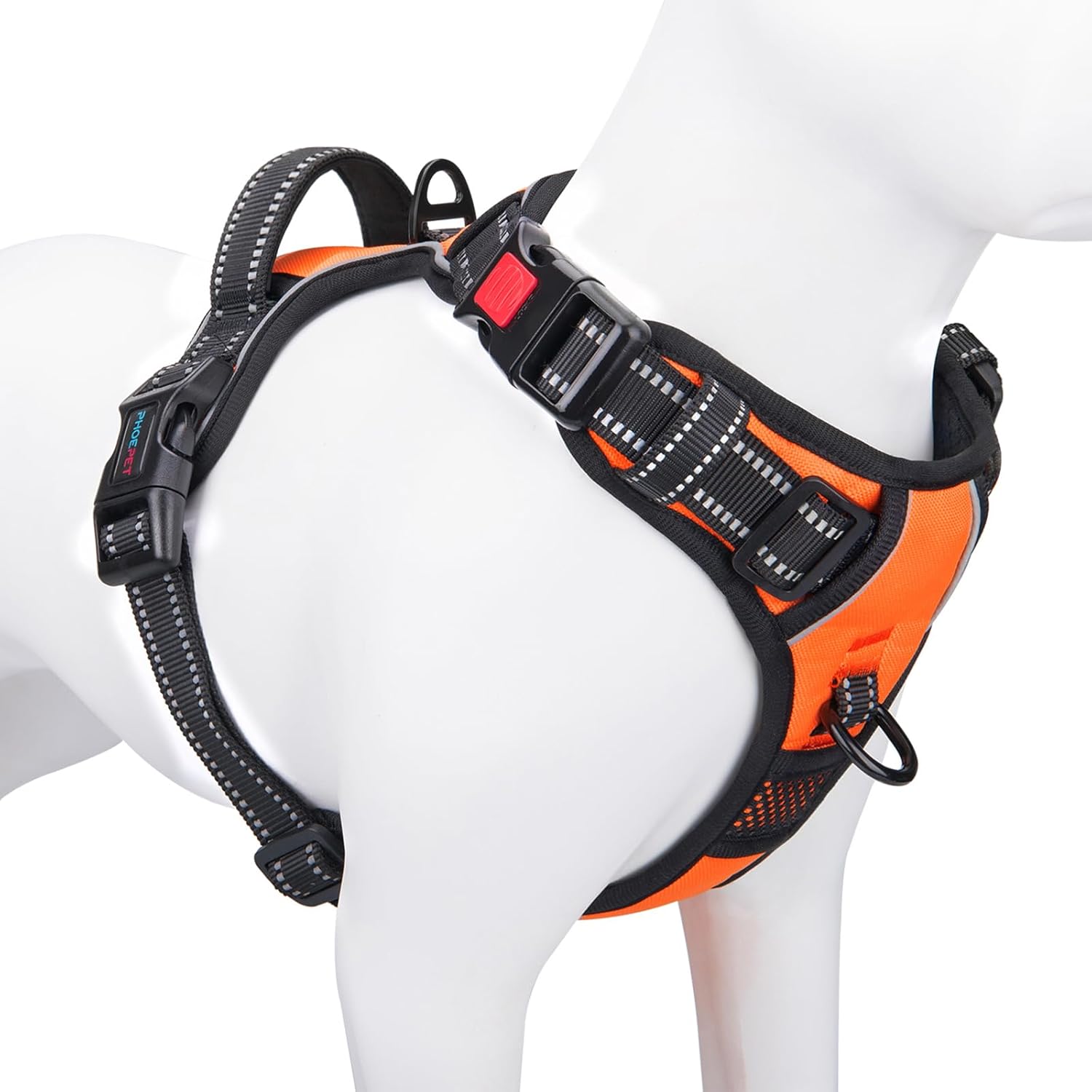
Best for the dog who pulls: PHOEPET No Pull Dog Harness Medium Reflective Front Clip Vest with Handle
 Visit on Amazon →
This is the harness I hand to the owner of a medium or large dog that leans into the leash. Three features do the work. A front clip, which redirects the dog's forward momentum sideways instead of letting them tow you down the street. A vest cut that spreads pressure across the chest instead of across the throat. And a handle on the back, which I use constantly: steadying a dog at a curb, holding them while a bicycle goes past, helping an older dog into the car when their hips are not what they were.
The reflective detail matters more here than people expect. From October through April, most client walks in the Pacific Northwest happen in the dark or in rain, and reflective trim on the chest is the difference between a driver seeing the dog and a driver seeing nothing.
This one is a medium, so measure your dog's girth before you order instead of guessing from weight. If your dog lands between two sizes, size up and tighten the straps down, because a harness that is too small cannot be adjusted bigger. Check current Amazon price.
Flaws but not dealbreakers: A front clip only works when the chest strap is fitted level and snug. Leave it loose and the whole vest rotates, the clip slides back under the armpit, and the dog gets leverage instead of losing it. That is the single most common fit failure I see on every front-clip harness, including this one, and it is a fitting problem, not a design problem.
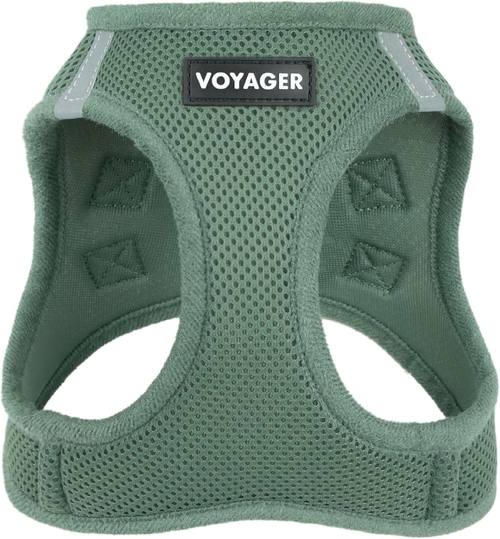
Best for small dogs and quick on and off: Voyager Step-in Air Dog Vest Harness - Moss Green, Small
 Visit on Amazon →
Small dogs are a different job, and this is a step-in vest: the dog puts their front feet in, you close it up, done. No threading a leg through a loop while a wiggling dog backs away from you. In this size and color it is the harness I suggest to owners of small breeds who want one piece of gear by the door and a dog dressed in under ten seconds.
My honest rule: a step-in harness is a walking harness for a small dog that mostly walks politely. If your twelve-pound terrier is a genuine puller who coughs and chokes at the end of the leash, put them in a front-clip harness instead, even though it looks like more harness than the dog needs. That is not a knock on this one. It is the difference between a control tool and a convenience tool, and you should know which one you are buying.
Small is a size, not a fit. Weigh and measure your dog, then take the extra two minutes to snug the girth strap so the vest sits flat on the chest. Check current Amazon price.
Flaws but not dealbreakers: Step-in harnesses live and die by strap adjustment, because there is less of them to work with. If it rides up onto the throat or slides down toward the elbows, it is too loose. Fix the straps before you decide you bought the wrong harness.
The fit points I check by hand
Before you touch a buckle, know the four points that decide whether any harness works.
- The girth strap. The one that runs behind the front legs, across the widest part of the rib cage. This is the strap that holds the harness on the dog. Too loose and everything above it rotates.
- The chest or sternum strap. On a front-clip vest, this should run level across the breastbone. If it angles up toward the throat, the harness is the wrong size or the wrong adjustment.
- The shoulder opening. The harness should not restrict the shoulder. Put the dog in a sit, then a down, then a walk, and watch whether the straps bind.
- The armpits. Check them with your fingers after every walk for the first week. Redness or rubbed hair there means something is loose, twisted, or sitting too low.
The eight-step fitting routine
Step one: Measure the girth first. Run a soft tape around the widest part of the rib cage, right behind the front legs, and write the number down. Do not measure the neck. Do not guess from weight. Weight tells you nothing about the shape of the chest.
Step two: Start with every strap loosened. Loosen all of them before the harness goes near the dog. It is much easier to tighten a harness into the right shape than to fight a snug one onto a wiggling dog.
Step three: Snug the girth strap. Tighten until you can slide two fingers under the strap and no more. Then have the dog lower their head to sniff the ground. If the girth strap slides down toward the elbows, tighten it one more notch.
Step four: Level the chest strap. On a front-clip vest, the chest strap should sit horizontally across the breastbone, not up on the throat and not down under the ribs. Adjust both sides by the same amount so the harness stays centered instead of pulled to one side.
Step five: Set the front clip at the sternum. The clip should sit on the point of the chest, between the shoulders. A clip that ends up under the armpit rubs, gives the dog leverage, and turns a no-pull harness into a very expensive coat.
Step six: Check shoulder clearance. Sit, down, walk, turn. Watch the strap closures at the shoulder. If they bunch or the vest pulls sideways when the dog turns, the chest strap is too tight or the girth is too loose.
Step seven: Load test it with your hand. Hook two fingers through the leash attachment and pull gently sideways and forward, the way the dog will. If the harness rotates on the body, fix the girth strap before you go outside. This takes ten seconds and saves you a bad walk.
Step eight: Walk five minutes and recheck. Come home, check the armpits, check for twisting, and re-snug anything that has shifted. Refit again after two weeks on a puppy and after every growth spurt, because a harness that fit in March may not fit in June.
One more thing that belongs to the fitting conversation: use a flat six-foot leash, not a retractable one. A retractable leash teaches the dog that pulling pays out more line. That is the opposite of everything the fitting routine is trying to accomplish.
Common fit mistakes and how to fix them
The harness is twisted. Lay it flat on the floor before it goes on the dog and make sure no strap is folded over. A twisted strap concentrates pressure on one narrow strip of skin, which is how rubs happen.
The clip sits under the armpit. Usually the harness is one size too big or the girth strap is too loose. Tighten the girth, then shorten the chest strap on both sides evenly.
The girth strap is loose because the owner is being kind. A loose harness is not comfortable. It rotates, chafes, and puts pressure in the wrong places. Snug is kind.
Padding has shifted. Check the padding placement after every wash. Padding that has migrated is worse than no padding, because it creates a hard edge that rubs.
One-size claims. Any harness sold as a single universal size is being sold to a shelf, not to a dog. Dogs are shaped like dogs, not like boxes.
Plastic buckles on big dogs. My line in the sand. Under 40 pounds on a dog that walks politely, fine. On a seventy-pound shepherd, I want metal.
Buying for the puppy they will be. Fit the dog in front of you now and plan to buy again. Puppies change shape fast, and a harness bought for the adult dog slides around on the puppy.
What does not belong in this guide
Back-clip harnesses on dogs over 40 pounds that pull. A back-clip harness on a strong puller is a sled dog setup, and no amount of padding changes the physics. It is fine for a dog who walks on a loose leash, and wrong for the dog this article is about.
Retractable leashes, for the reason above. Head halters, which work for some dogs but are a different tool with a different learning curve and belong in their own guide. Prong collars and shock collars, which are a different philosophy and not something I review or recommend, ever.
And the Instagram harness brands. They are selling photographs. When the trend cycle moves on, the replacement strap you need in two years will not exist, and the training-community brands will still be shipping parts. Buy a harness you can still get parts for.
What this all costs
Both harnesses here sit in the budget tier, which is where I do most of my recommending. I do not print prices in this guide because they move week to week, so Check current Amazon price at the link under each harness before you decide.
What actually costs you money is buying three harnesses because the first two were fitted wrong. The cheap harness fitted correctly beats the expensive one fitted badly, every time. Fitting costs nothing but twenty minutes, and refitting a growing puppy costs nothing at all.
Beyond the harness, budget for one flat six-foot leash. That is the whole kit. You do not need a second harness for walking, and you do not need a car harness on top of it unless you are actually doing car safety, which is a separate purchase and a separate article.
Bottom line
Fit is the job. Measure the girth, level the chest strap, put the front clip on the sternum, check the armpits after every walk for the first week, and refit as the dog changes. Do that and a budget front-clip vest does more for your shoulder than a premium harness with a loose girth strap ever will.
Then go teach the dog something, because the harness is holding the line, not doing the training. Fit it right, walk it right, and the pulling gets quieter every week.