Most people buy a no-pull dog harness, strap it on the dog, and then spend three months getting dragged to the same fire hydrant. The harness usually is not the problem. The fit is. A no-pull dog harness fit that puts the front clip below the breastbone, or leaves the girth strap loose enough to spin, turns a steering tool into a fancy collar with extra steps.
I'm Tomás. I've fitted harnesses on more than 3,000 dogs, most of them at a shelter where "pulls like a freight train" was the default setting, and I run a training business in Portland, Oregon now. I keep a shelf of 30-plus harnesses in my garage and I care about three things: strap webbing, buckle hardware, and where the fit points land on the dog.
Here's what the packaging never tells you. A front-clip harness works on physics, not magic. When the dog surges forward, the leash pulls sideways across the chest, and the dog's own momentum turns him back toward you. That only happens if the clip sits at the sternum and the straps stay where you put them. Fit it right and an inexpensive harness beats a premium one that slides around.
Why you should trust me
Eight years at a shelter taught me that a harness is a training tool, not a fashion accessory. If it does not stop pulling, it is a collar with extra steps. I have watched plastic buckles burst on a leash pop, I have seen padding shift after a month and rub a raw spot into a shepherd's armpit, and I have bent plastic D-rings with my thumb.
My bias, stated up front: front clip or nothing for a dog that pulls. A back-clip harness on a 70-pound dog that lunges is a sled dog setup, and the dog is the sled. I also think fit is 80% of the outcome. The best harness on the market fails on a dog it does not fit.
I do not review prong or shock collars. Different philosophy, different conversation.
How I pick and judge a harness
I judge a harness the way I fit one: hardware first, shape second, padding last.
Hardware means metal where it matters. The leash attachment rings should be metal, not molded plastic, and the buckle should have some heft to it. I have had clients bring me harnesses where the D-ring straightened out under a pulling dog, and that is a safety problem, not a style problem.
Shape means the chest strap and the girth strap are separate adjustments. A harness sold in one size with no adjustability is a costume. A harness where the chest strap and the girth strap move independently is a tool, because most dogs are not built to a single measurement.
Padding is the last thing I look at, not the first. Padding that shifts after a month is worse than no padding, because it bunches into the armpit and rubs. If the padding is not stitched down or shaped to the chest, it will migrate.
Colors fade. Fuchsia turns pink, then gray, after one Pacific Northwest winter. Buy for the fit and the hardware, and treat the color as a bonus.
Fit points: where a harness has to sit
Four places matter. If you only remember one thing from this article, remember these.
The chest strap crosses the front of the chest, above the breastbone and below the throat. On a front-clip harness, this strap is the steering wheel. It should sit high enough that it does not press on the windpipe and low enough that it does not slide down into the armpit.
The front clip sits at the center of the chest, roughly at the point of the sternum. This is the single most common failure I see. Owners loosen the chest strap because the dog "seems uncomfortable," the clip drops to belly level, and now the leash pulls backward instead of sideways. The harness still looks fine. It just does nothing.
The girth strap wraps behind the ribcage, not across the belly. If it slides forward into the armpit, it will rub. If it slides backward, the whole harness rotates.
The shoulder clearance is the gap between the strap and the front leg. You want the dog to be able to move the shoulder freely. Watch your dog walk. If the strap binds when the front leg reaches forward, the harness is sitting too far back.
The two harnesses I start most clients with
These are the two I reach for first when someone walks in with a pulling dog and a normal budget. One is a front-clip no-pull harness. The other is a step-in vest for dogs that do not pull hard, or for owners who want something they can put on in three seconds.
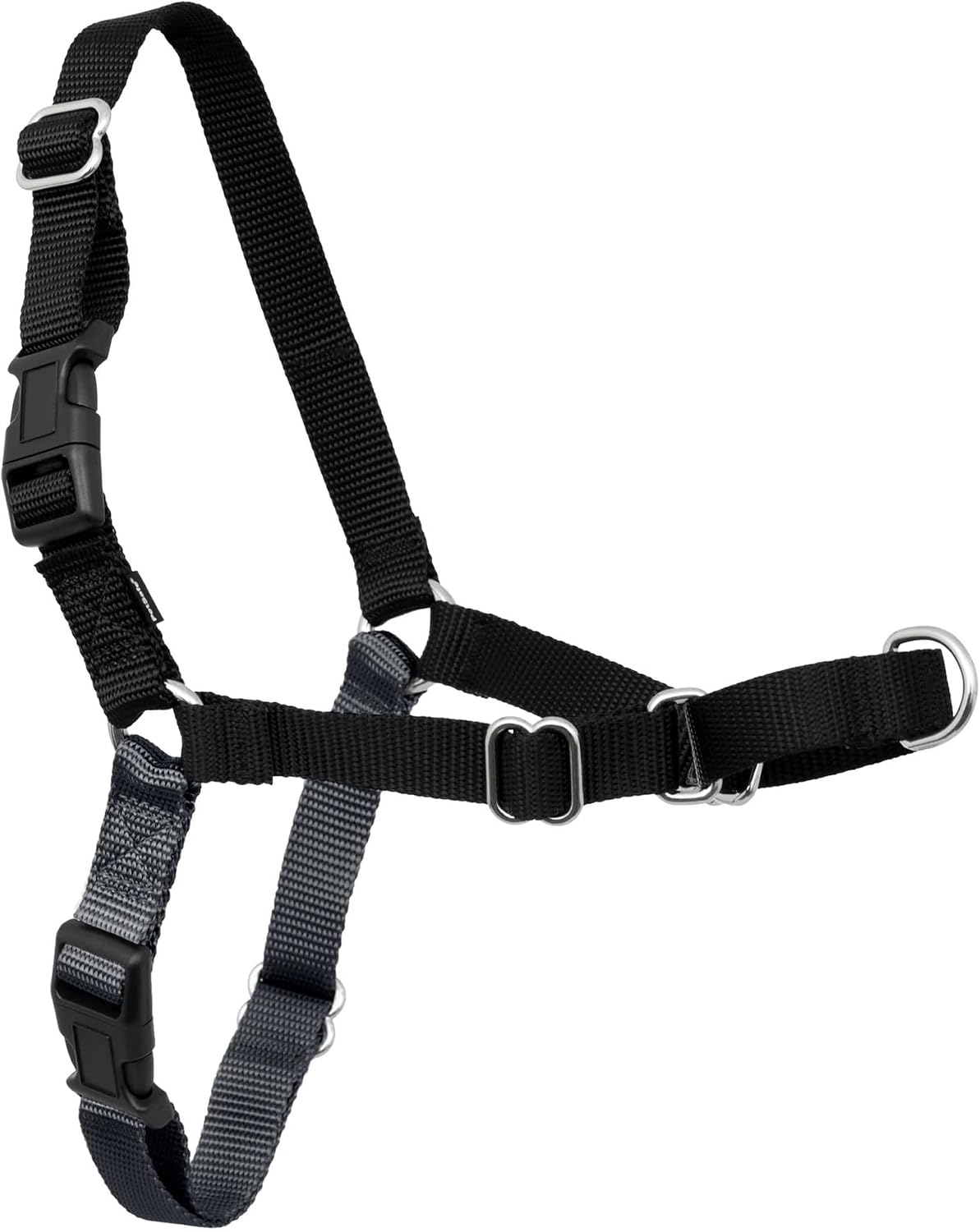
Our pick for pullers: PetSafe Easy Walk Harness, No Pull Dog Harness, Charcoal Gray, Medium/Large
 Visit on Amazon →
This is the harness I hand to most clients with a dog that pulls. The design is the whole point: the leash clips at the chest, the martingale loop on the front strap tightens slightly as the dog pulls, and the dog gets turned back toward the handler instead of leaning into the pressure. There is no back clip, which is a feature, not a limitation, because a back clip on a puller is an invitation to drag.
The chest strap and the girth strap adjust separately, which is what makes a real fit possible on a deep-chested dog or a dog with a broad ribcage. The hardware is the reason I keep recommending it: the front ring takes load without bending, and the buckles hold up to a leash pop from a dog that outweighs its owner.
Medium/Large covers a wide range, so measure your dog's girth before you order and check the size chart on the listing rather than guessing from the breed. Check current Amazon price before you commit, because this one goes in and out of stock.
Flaws but not dealbreakers: It is not a padded harness, and the webbing can rub a thin-coated dog on a long hike. If your dog has sensitive skin under the front legs, add a light fleece wrap or keep sessions short at first.
Anyone with a dog that lunges, spins, or leans into the leash should start here.
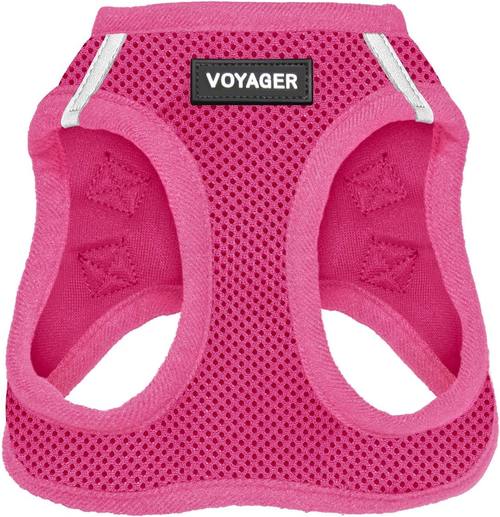
Step-in option: Voyager Step-in Air Dog Vest Harness - Fuchsia, Medium
 Visit on Amazon →
The Voyager is the harness I recommend when the dog does not pull hard and the owner wants something that goes on in one motion. The dog steps in, you lift the two sides, and the buckle closes. For a calm walker, a senior dog, or a small dog that mostly needs identification and a place to clip a leash, that speed matters, because a harness that takes two minutes to put on is a harness that gets skipped.
The air-mesh body breathes, which is more than I can say for the padded vests that turn into a sauna in July, and the step-in design keeps the straps off the throat. Medium fits a surprising range of dogs, but again, measure the girth and check the chart.
I want to be blunt about the limits: this is a back-clip vest. On a dog that pulls, it will not stop the pulling, and it can actually make it worse by giving the dog something to lean into. That is a design fact, not a knock on the product. Use it for the dog it fits, which is the dog that already walks politely.
Flaws but not dealbreakers: The attachment point is a back clip only, and the mesh is light duty. If your dog is a committed puller over 40 pounds, this is the wrong harness and you should be looking at the front-clip option above.
Owners of small and medium dogs who want a quick, breathable walking harness will get along with it fine. Check current Amazon price to see where it lands today.
How to fit a no-pull harness, step by step
Do this in the house, before the walk, with treats in your pocket.
Step one: Loosen everything. Start with all straps at their loosest setting. You cannot fit a harness that arrives tight.
Step two: Put the harness on and find the chest strap. The chest strap goes across the front of the chest, above the breastbone. The front clip should sit at the point of the sternum, level with or slightly above the point where the neck meets the chest.
Step three: Tighten the chest strap. Snug, not choking. Slide two fingers flat under the strap. If you can fit a whole hand, it is too loose. If the strap presses into the throat when the dog looks up, it is too high.
Step four: Set the girth strap. It sits behind the ribcage. Tighten until two fingers fit flat under it. Then check the front legs: the dog should be able to reach forward without the strap binding across the shoulder.
Step five: Check the clip height. This is the step everyone skips. Clip the leash on, stand in front of the dog, and apply light pressure. The clip should stay at the sternum. If it drops to the belly, tighten the chest strap. If it rides up to the throat, loosen the girth and recheck.
Step six: Test the spin. Gently rotate the harness side to side. It should resist. A harness that spins freely around the ribcage has no steering authority.
Step seven: Walk the hallway. Ten steps. Watch the shoulder. Watch for the strap sliding into the armpit. Watch the dog's ears, because a dog that is uncomfortable will tell you before you notice the rub.
Step eight: Recheck after ten minutes. Nylon webbing relaxes as it warms up against the dog. What fit in the kitchen may be loose by the end of the block. Tighten, then leave it alone.
The mistakes that undo a good fit
The most common one is buying for the chest and forgetting the neck. A harness that fits the ribcage but crowds the throat will make the dog hate the walk.
The second is leaving the chest strap loose because the dog seems more comfortable. He is more comfortable. He is also unsteered, because a loose front clip becomes a back clip the moment the dog pulls.
The third is a one-size harness with no independent adjustments. It will fit one body type well and everything else badly, and no amount of tugging changes the geometry.
The fourth is padding that traps fur. If you have a double-coated dog, check under the harness after every walk for the first two weeks. Mats form fast, and they form right where the strap sits.
When the harness is not the whole answer
A front-clip harness redirects pulling. It does not teach your dog to stop pulling. That work is leash handling and rewards, and it happens on the same walks.
The practical version: the moment the leash goes tight, stop walking. Wait for slack, then move forward. Reward the dog for being beside you, not for being dragged. The harness buys you the leverage to do that without hurting your dog's neck. That is the deal, and it is a good one, but only if you hold up your end.
If your dog is lunging, barking, or spinning at other dogs, get a trainer involved. A harness is gear. Behavior change is a program.
The competition and why it lost
Back-clip harnesses are the biggest category in the store and the wrong answer for a puller. They are comfortable, they are easy to put on, and they give a lunging dog a solid point to pull against. Great for a dog that already walks well. Bad for the dog this article is about.
One-size harnesses lose for the same reason a one-size shoe loses. Dogs are not built to a single girth measurement.
Budget harnesses with molded plastic attachment rings lose on hardware. I have seen those rings deform under a determined dog, and a deformed ring is a broken link in the only connection between you and your dog.
Car harnesses and crash-tested harnesses are a separate category and a separate article. Most dogs need two harnesses: a walking one and a car one. The industry pretends one does both, and it does not.
What this all costs
Both harnesses in this article sit in the affordable range, and the fitting is free. Check current Amazon price on each listing, because stock and pricing move around more than the products do.
The real math is not the purchase. It is the walk. A harness that fits and steers turns a 40-minute wrestling match into a 40-minute walk, and that happens five or six times a week, every week, for years. The five minutes you spend at the kitchen counter with two fingers under the girth strap is the highest-value five minutes in dog ownership.
Fit it once, check it monthly, and recheck it whenever your dog's coat blows out, because a German shepherd in July is a different shape than the same dog in January.
That is the whole job. Measure the girth, set the chest strap, keep the clip at the sternum, and let the harness do what you paid it to do.