Most step-in harnesses get fitted backwards. The owner cranks the chest strap until the dog looks like a parcel and leaves the girth strap loose, which is exactly the combination that lets a determined dog reverse out of the leg loops on a busy street. A no pull step-in dog harness is not a magic garment. It is webbing, two leg loops and a leash ring, and it only does its job when all three sit in the right place on that specific dog.
I fit harnesses for a living, and the fitting is the product. The same harness that fails on one dog walks perfectly on another because somebody took ninety seconds to move a strap. Here is the sequence I run on clients, the fit points I check with my fingers, and two step-in harnesses that stay in my rotation.
Why you should trust me
I am Tomás, a certified dog trainer in Portland, Oregon. I spent eight years at a shelter working the reactive and pulling cases, the dogs nobody volunteered to walk, and I have since fitted more than 3,000 dogs with harnesses through my own training business. I keep a shelf of 30-plus harnesses that I have washed, yanked on, and handed to my two German shepherds to destroy. I measure strap webbing width, I put my thumb on every buckle and push until something gives, and I track how long padding stays where it was sewn.
I do not sell harnesses. I fit them, and then I watch the dog walk.
What a step-in harness can and cannot do
A step-in is exactly what it sounds like. The dog puts one front paw into each leg loop, you lift the harness up the chest and close the strap across the back. It is the fastest design to put on a wiggly dog and the easiest to fit badly, because the whole thing hangs off two straps and one closure.
What it can do: keep pressure off the throat, stay on a dog that has learned to slip a collar, and turn a departure into a ten-second event instead of a wrestling match.
What it cannot do: train your dog. If the leash ring sits on the back of the shoulders, a dog that pulls will still pull, and the harness simply spreads the load across the chest instead of the neck. That is a genuine improvement, and it is not the same thing as teaching loose-leash walking. The harness buys you control while the training does the work. Skipping the training because the harness "fixed it" is how you end up with a five-year-old shepherd dragging you past a squirrel.
The fit points that decide everything
Four checks, in this order. Do them in the hallway before a leash ever gets clipped on.
Girth strap. It sits behind the ribcage, not across the middle of the back. Two fingers flat under the strap, no more. If you can slide a whole hand under it, the dog can back out of it.
Chest strap. It runs across the breastbone, above the point of the shoulder. It should not cross the throat and it should not sit so low that the dog steps on it mid-stride.
Leg loops. Two fingers under each loop where it passes the armpit. If the webbing digs in when the dog sits, it will rub a raw spot on a two-mile walk. If the loop swings loose, the dog will step out of it.
Leash ring. Centered on the back of the shoulders, not sliding off to one side. Put a hand on the ring and pull gently toward you. The whole harness should shift as one unit, not twist around the ribcage.
Get those four right and you have solved most of what people blame the product for.
Step-in harnesses I fit on clients
I keep two step-ins in the van because they cover the two situations I run into most: the dog that backs out of everything, and the owner who needs a leash in the same box.
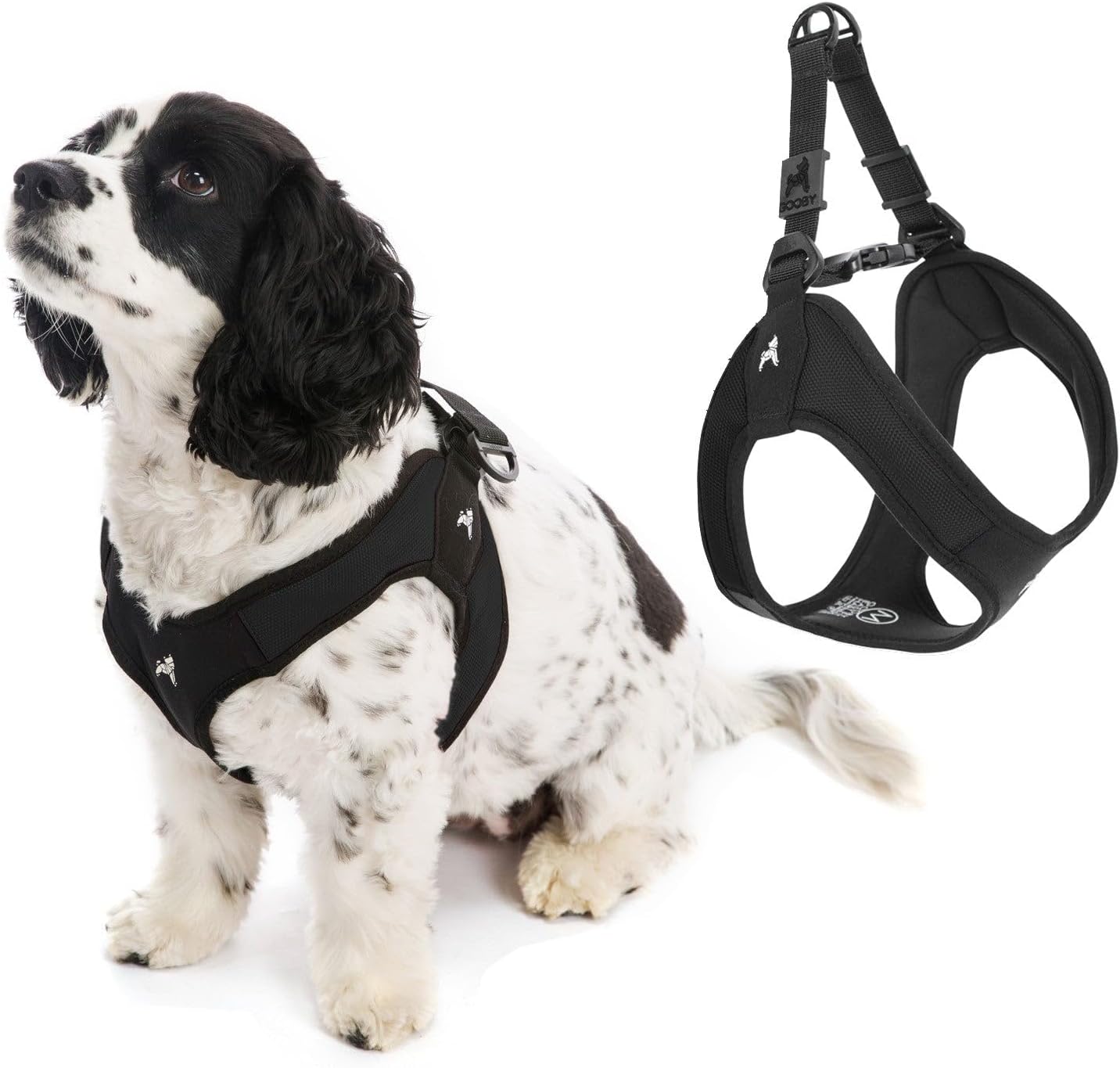
Best for the dog that backs out: Gooby Escape Free Easy Fit Dog Harness, Step-in, Black, Medium
 Visit on Amazon →
The escape-free part of the name is why this one lives in my van. Step-in harnesses have a reputation for being the easy-off design, and it is a fair reputation when the girth strap is loose. This one is built around the opposite priority, and it comes in a plain black that hides the mud and the trail dust. I fit it on the dogs that have already learned to reverse out of a cheaper harness, and the step-in entry means the dog is not standing still for a buckle session while a jogger goes by.
The Medium listing here is one size, and that matters. Before you order, put a soft tape around the widest part of the ribcage, right behind the front legs, and match it to the chart. A step-in harness that is one size too large at the girth is a harness the dog can leave.
Flaws but not dealbreakers: Black dyed webbing still grays out after a Pacific Northwest winter of wet walks, so expect the color to dull even if the stitching holds. And a step-in always takes two hands on a wiggly dog, because the paws go in first.
Anyone with a dog that has escaped a harness before should start here.
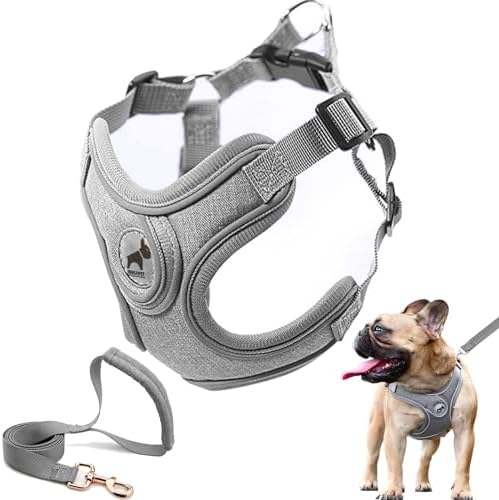
Best value if you need a leash too: Dog Harness with Leash Set, No Pull Adjustable Step in Pet Vest
 Visit on Amazon →
This is the one I hand to the owner who is standing in my parking lot with a collar, a rope leash from the hardware store, and a dog that pulls. It is a set, so the leash arrives with the harness and the hardware matches, which removes one shopping decision and one compatibility problem.
The "no pull" in the name is a marketing label, and I want to be blunt about that. No harness on the market teaches a dog anything. What an adjustable step-in vest does is give you a wide, padded contact area across the chest and a ring you can steer from, and that is a real tool for a 40-pound dog who leans. Adjustability is the feature that matters most here, because it lets you hit the two-finger girth fit on a dog that is between sizes on paper.
Flaws but not dealbreakers: I cannot judge buckle metal from a product photo, and neither can you. When the box arrives, put your thumb on the closure and push hard. If it flexes noticeably, use this on the dog that walks politely and buy the heavier build for the dog that lunges. Plastic on a hard puller over 40 pounds is the one thing I will not sign off on.
Anyone who wants the harness and the leash handled in one purchase, on a dog that is not actively launching at traffic, will be happy with this set.
How to fit a step-in harness, step by step
Step one: measure first. Soft tape around the widest part of the ribcage, right behind the front legs. Write the number down. Every step after this is faster when you have it.
Step two: loosen everything. Undo both the girth strap and the chest strap to their widest setting before the dog goes anywhere near it. Fitting a snug harness from a snug starting point is how you end up with a dog that hates the sight of it.
Step three: paws in. Set the harness on the floor, open the two leg loops, and guide one front paw into each. Treats on the floor keep the head down and the feet still.
Step four: lift and close. Bring the harness up the chest and close the strap across the back. It should land behind the ribcage, not on the small of the back.
Step five: set the girth. Tighten until two fingers slide flat under the strap. This is the fit that keeps the harness on.
Step six: set the chest strap. Tighten until the strap crosses the breastbone above the shoulder point. It should not touch the throat.
Step seven: test it. Two fingers under each leg loop. Then clip the leash and walk the dog ten steps in the hallway, then ask for a sit. If the webbing rides into the armpit on the sit, back the chest strap off one notch.
Step eight: recheck after two weeks. Webbing relaxes and dogs lose or gain a little coat weight with the seasons. The harness that fit in October is often a notch loose by December.
How to use it on a puller
Two rules I give every client.
First, know where the ring is. If the leash attachment is on the back, expect the dog to lean into it and pull harder for the first few walks, because a back attachment gives a big dog leverage. A harness with a front attachment changes the geometry: the dog's forward motion turns him back toward you. These are different tools, and the fitting steps above apply to both.
Second, never use the harness as a steering wheel. A leash-pop on any harness teaches a dog that pressure is just part of the walk. The harness holds the dog while you teach the behavior, and the behavior is what ends the pulling.
Mistakes I see in the parking lot
A loose girth strap with a tight chest strap, which is the escape recipe.
A harness worn over a thick winter coat in January and then worn the same way in June with a summer coat underneath. Check the fit every season.
Leg loops sitting in the armpit because the chest strap is too short. That is a rub spot waiting to happen.
Buying one harness for both walking and the car. A walking harness and a crash-tested car restraint are not the same product, and no step-in vest I have fitted doubles as both.
Ignoring the leash ring position and then blaming the harness for the pulling.
What this costs and what to do next
Both harnesses here sit in the range I recommend to clients, which is where the real winners live. You do not need to spend premium money to get a harness that stays on a dog, and you should be suspicious of any harness sold in a single size with no girth measurement on the listing.
Start with the tape measure. Then pick the harness that matches your dog's escape history and your need for a leash in the same box. Fit it in the hallway, check the four fit points, and walk ten steps before you commit to a route. If the harness shifts, you have a fitting problem, not a product problem, and ninety seconds with a strap usually fixes it.
That is the whole job. The harness does the holding. You do the training.