Related: Best Dog Harness for Small Dogs
I have fitted harnesses on more than 3,000 dogs, most of them at a shelter where the reactive ones came in with the leash already taut. I keep a shelf of thirty-odd harnesses at home that I have washed, yanked on, and handed to my own two German shepherds. So when someone tells me their no-pull dog harness does not work, I usually know the answer before I see the dog.
It is almost never the harness. It is the fit, or it is the expectation that a harness replaces training. A no-pull dog harness changes the physics of a walk. It does not change your dog's motivation, and a harness that sits wrong will either rub a raw spot or slide sideways the moment the leash goes tight.
The four harnesses below are the ones I keep coming back to for clients, and between them they cover the whole range: a small dog that needs something light, a medium dog in a padded vest, a dog that hates a fuss, and a big puller that needs real gear. What follows is how I fit them, what I check, and which one I would hand you if you told me your dog drags you down the block.
Best Overall for Pullers: Ruffwear Front Range Flex
If you have a strong dog that pulls, start here and stop shopping. Ruffwear is one of the training brands that earned its reputation instead of buying it, and this chest harness is built like gear rather than a costume. The chest attachment point is what matters. A leash on the chest turns your dog's forward drive into a gentle turn, so a hard pull becomes a redirect instead of a tug of war. That is the whole mechanic of no-pull, and it only works when the strap across the chest sits where it is supposed to sit.
The trade-offs are price and sizing. This is the most expensive harness in this group by a wide margin, and it comes in a Large/X-Large, which means it is aimed at the big end of the range. On a dog that sits between sizes you will spend your first week adjusting straps, and if the chest strap lands too low, down near the armpit, you will see chafing within a few walks. That is a fit problem, not a product problem, and it is the reason I measure before I recommend anything.
For a 70-pound shepherd with a big motor, this is the harness I reach for. For a 12-pound dog that walks nicely on a loose leash, it is more gear than you need.
Best Value Step-In: Voyager Step-In Air
The Voyager is the harness I hand to people on a tight budget, or to people who struggle with buckles. Step-in means the dog walks into it, you bring the panel up over the back, and you close it. For an older owner with arthritic hands, or a wiggly dog that will not hold still, that matters more than any spec sheet.
At this price you are getting a light vest, not a training tool. On a small dog that walks politely, it does its job for years. On a determined puller, the webbing and hardware are the weak point, and I would not trust it on a dog much over 40 pounds. The other thing to watch is the neck opening and the girth strap. Step-in harnesses depend on a snug fit around the chest, and if the girth is loose the whole thing rotates under load, which is exactly what you do not want when the leash goes tight.
The moss green color holds up better than most through a Pacific Northwest winter, which sounds like a small thing until you have watched three bright harnesses fade to gray by February.
Best for Small Dogs: Gooby Comfort X Head-In
The Gooby is the odd one in this group because it goes over the head instead of around the legs. The X-shaped front panel is designed to keep pressure off the throat, and the open design means there is very little fabric against the dog. For a small breed that overheats easily or mats under padding, that is a genuine advantage, and it is the harness I suggest when someone complains that their dog gets itchy under a vest.
Head-in harnesses are not for every dog. Some dogs panic when anything goes over their head, and forcing it turns every walk into a wrestling match. If your dog tolerates an overhead motion, this one goes on quickly, and the medium size fits a wide range of small and medium builds. If your dog backs away from anything over the head, choose a step-in instead and do not fight it.
The hardware is light, which is appropriate for the size of dog it is built for. This is not the harness I would put on a puller, and I would not pretend otherwise.
Best Padded Everyday Vest: Puppia Soft Vest
The Puppia Soft Vest is the most comfortable-looking harness here, and for a lot of small and medium dogs it is the right everyday choice. Step-in design, padded mesh, and a vest shape that spreads pressure across the chest rather than concentrating it on two thin straps.
Padding is a double-edged thing, and I say that as someone who has pulled apart a lot of padded harnesses. When it stays put, it prevents rubbing and the dog forgets the harness is there. When it shifts, it bunches and rubs in exactly the wrong place, and shifted padding is worse than no padding at all. Wash it, check the seams, and check that the padding still sits where it started. If it has migrated after a month of daily wear, the harness is finished for a dog that wears it every day.
This is a walking harness for a dog that pulls mildly or not at all. Pair it with training, not instead of it.
How I test a harness
Every harness that lands on my bench goes through the same three stages, and I have run them on more than thirty harnesses at this point.
The fit bench comes first. I fit the harness on three body types: a narrow-chested small dog, a deep-chested medium dog, and a broad-chested large dog. I check where the chest strap lands, whether the shoulder can move freely, and whether anything ends up in the armpit. That last one is the most common failure. A strap that rides into the armpit will rub a dog raw on a long walk, and no amount of padding fixes a strap that sits in the wrong place.
The walk test comes second. I take a reactive shepherd out on a busy Saturday, when the sidewalks are full of other dogs, strollers, and squirrels. That is where a harness proves itself or does not. I want to see whether the harness stays centered under a hard pull or rotates to one side. Rotation means the fit is wrong or the geometry is wrong, and both are disqualifying on a puller.
The buyer's chair comes last, and it is the stage that actually matters to most people. I sit down and ask what a normal owner with a normal dog and a normal budget should buy. The answer is rarely the most expensive harness and almost never the cheapest one.
The fit points that decide everything
Fit is roughly 80 percent of the outcome, and five points decide it.
Girth is the first. Measure around the widest part of the ribcage, right behind the front legs, with the tape snug but not tight. Do it twice, because dogs breathe and wiggle. Almost every sizing problem I see starts with a girth measurement taken too loose.
The two-finger rule is the second. You should be able to slide two fingers under any strap. One finger means it is too tight and will rub. Three or four fingers means it is loose enough to rotate, and a rotating harness on a puller is useless.
Sternum position is the third. The chest strap belongs across the flat of the chest, above the point of the shoulder. Too low and it interferes with the front legs. Too high and it rides up into the throat.
Shoulder clearance is the fourth. Watch your dog walk and trot. If the shoulder cannot extend fully, the harness is restricting movement, and a dog that cannot move naturally will pull harder, not less. This is where a vest style and a strap style feel very different on the same dog.
Armpit clearance is the fifth, and it is the one people miss. Slide a finger along the back edge of the harness where it meets the leg. If the strap sits in the crease, it will rub. No padding saves it.
The harness reference table
This is the table I keep for clients. Sizes listed are the sizes these specific harnesses come in, so match the size to the dog before you match the harness to the job.
| Harness | Best for | What stands out | Watch out for |
|---|---|---|---|
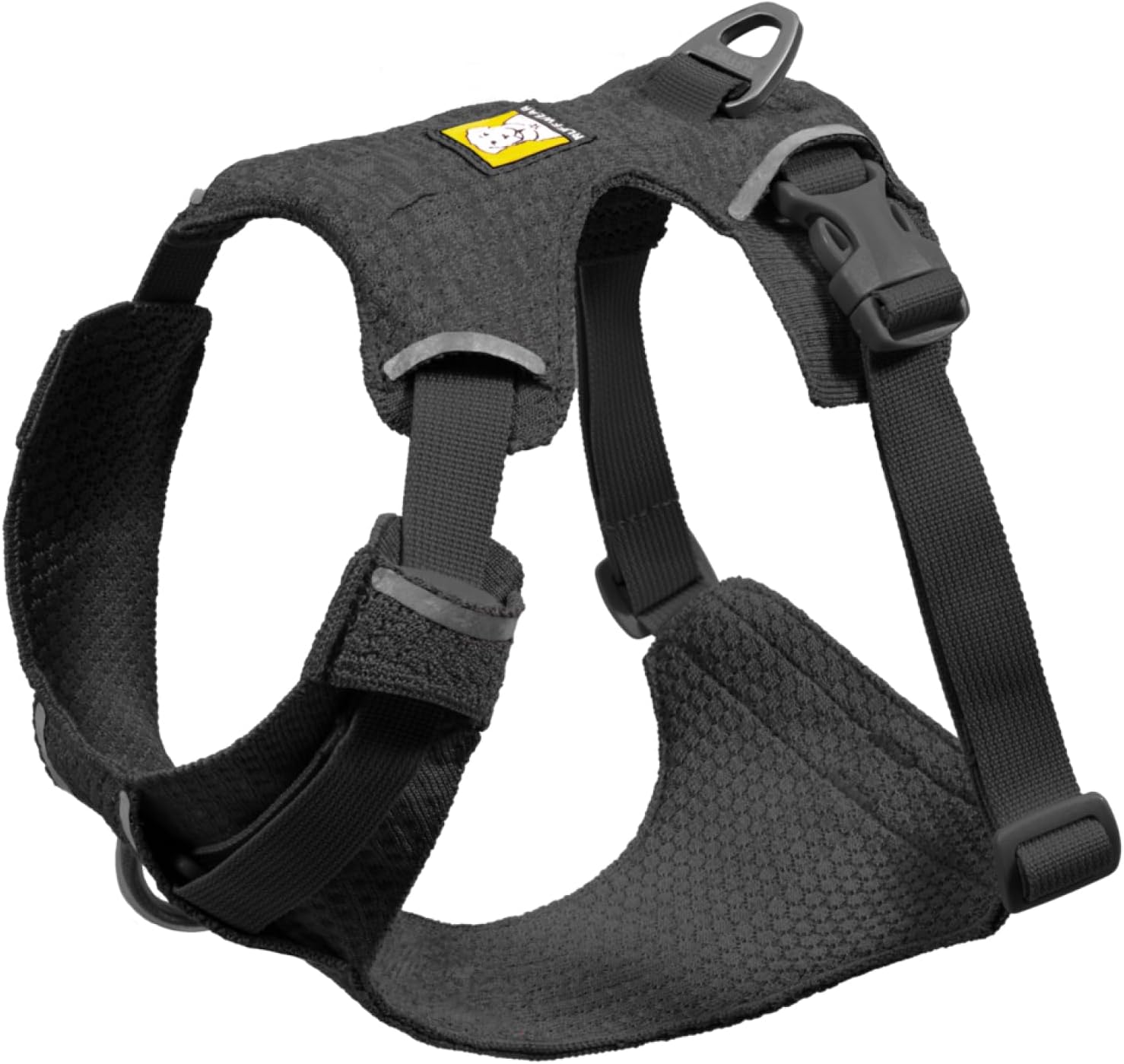 Visit on Amazon → Ruffwear Front Range Flex, Large/X-Large |
Big pullers and long walks | Training-brand build, chest attachment geometry | Highest price here, sizing is unforgiving between sizes |
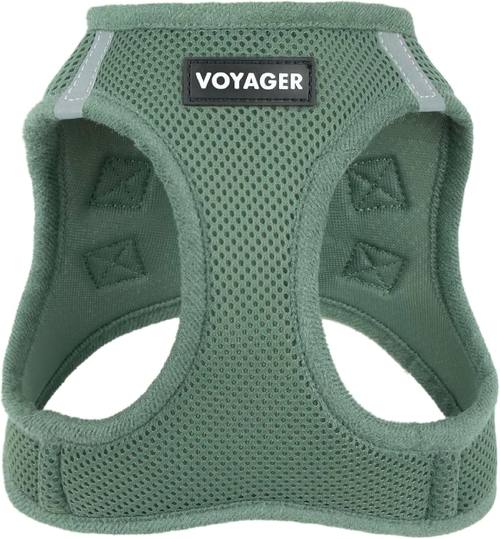 Visit on Amazon → Voyager Step-In Air, Small |
Small dogs, quick on and off | Light, simple, easy for stiff hands | Light webbing, not for a determined puller |
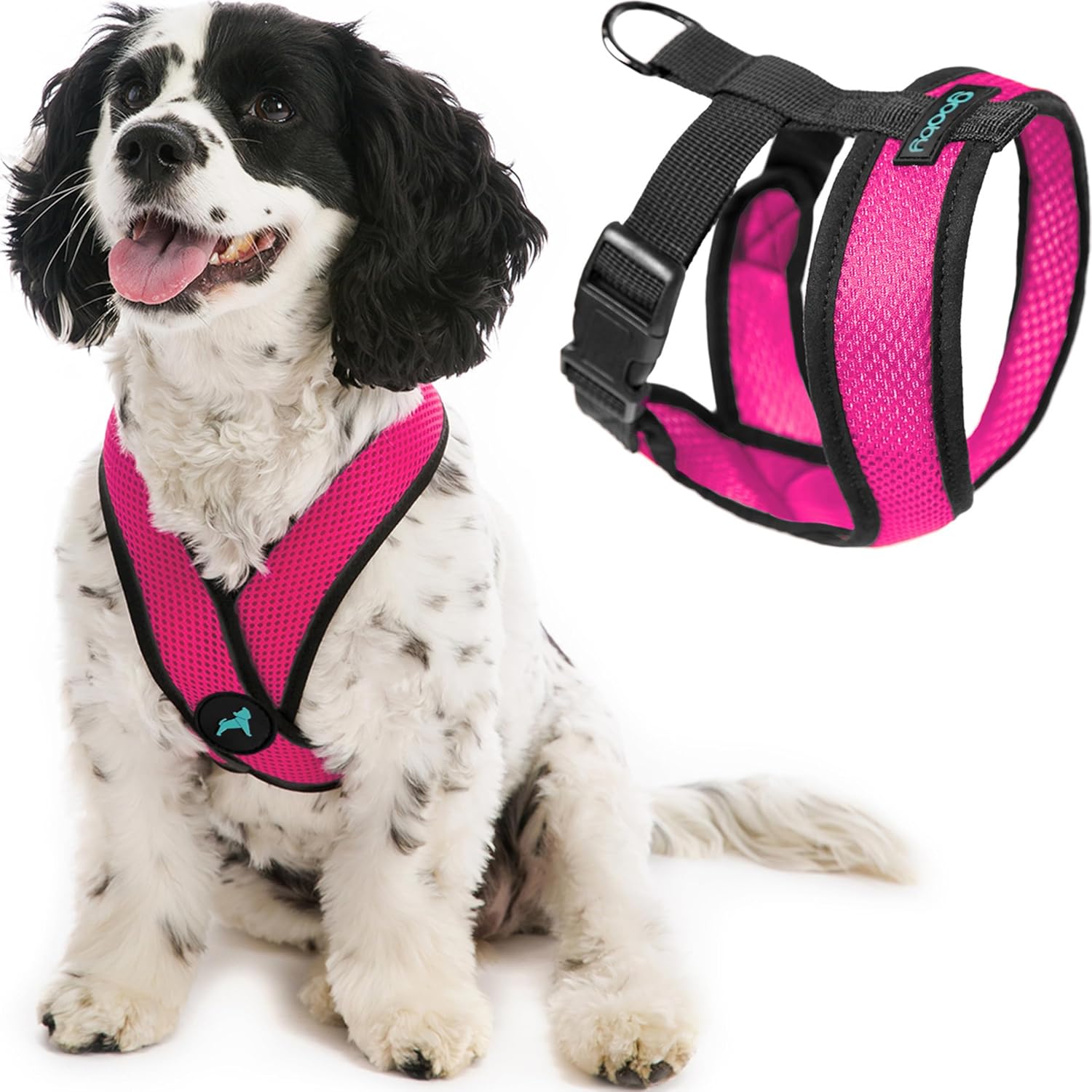 Visit on Amazon → Gooby Comfort X Head-In, Medium |
Small dogs that overheat under padding | Open X front, very little fabric on the dog | Head-in motion, so not for dogs that hate it |
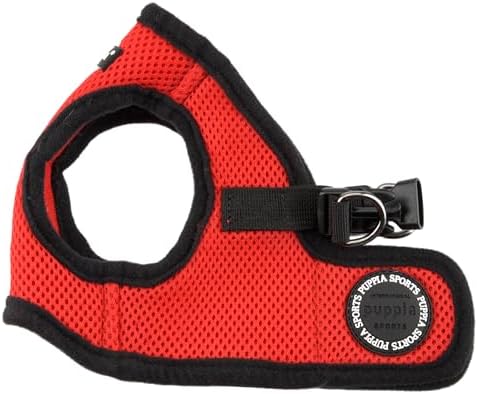 Visit on Amazon → Puppia Soft Vest, Medium |
Everyday walking on mild pullers | Padded mesh vest comfort | Padding can shift and rub if it migrates |
Read the table by column, not by row. The first column is the harness, the second is the job, and the last two are the honest part. If your dog is not the dog in the second column, the harness in the first column is not the one to buy, no matter how good it is.
Which harness for which dog
A small dog that walks politely and needs something light: the Voyager Step-In Air. It goes on in seconds and the price makes it an easy first harness.
A small dog that overheats or mats under a vest: the Gooby Comfort X Head-In, as long as your dog tolerates an overhead motion.
A small or medium dog that wears a harness all day on normal walks: the Puppia Soft Vest, with the padding checked every month.
A large dog that pulls hard: the Ruffwear Front Range Flex. Nothing else here is built for that job.
And if you are still deciding between a harness and training, buy both. The harness buys you control while the training does the actual work.
Should you buy the Ruffwear Front Range Flex?
Yes, if your dog pulls and weighs more than about 40 pounds. The chest attachment point gives you steering rather than plain restraint, and the build is the kind that survives years of hard use instead of one season. Measure the girth twice before you order, because the Large/X-Large sizing leaves you very little room on a dog that sits between sizes.
It is the most expensive harness in this article, and I recommend it anyway. I have seen too many cheap harnesses fail at the buckle on a big dog, and a buckle that lets go at the wrong moment is how dogs end up in the road.
Should you buy the Voyager Step-In Air?
Yes, for a small dog that walks politely or pulls only mildly. It goes on in seconds, it is light enough that most dogs forget they are wearing it, and it is the cheapest way here to get a decent step-in vest. If you have stiff hands or a dog that will not hold still for straps, that convenience is worth more than any feature.
Just do not ask it to do a job it was not built for. On a determined puller, the light webbing and hardware will let you down, and you will blame the harness instead of the size of the dog.
The bottom line
Fit first, then training, then the harness. Measure the girth, apply the two-finger rule, check the armpit clearance, and match the harness to the dog in front of you rather than to the one in the product photo. Do that and any of these four will do right by you. Skip it and even the best harness on this list will slide sideways and rub a raw spot by the end of the week.