Related: Best Dog Harnesses for Dogs That Pull
I keep more than 30 harnesses on a shelf in my training room, and most of them landed there because a client bought the wrong one. I have fitted over 3,000 dogs, first during eight years working with reactive and pulling dogs at a shelter and now in my own training business in Portland, and the pattern has not changed. The harness is rarely the problem. The fit is. So this is a no-pull dog harness guide built around four models I get asked about constantly, and around the fit points that decide whether any of them work on your dog.
Start with mechanics, because it explains everything else. A front clip redirects forward motion sideways, which is why it interrupts pulling. A back clip on a 70-pound dog that pulls is a sled dog setup. You have handed the dog a load to lean into, and it will lean. Front clip or nothing for a puller, and the clip itself should be metal. I have bent three plastic D-rings with my thumb, and I have watched a plastic buckle let go on a leash-pop. Buckle quality is the entire product, and it is the first thing I check when a harness comes out of the box.
The second thing is fit. Strap webbing that sits too low cuts into the armpit. A chest strap that rides too high crowds the throat. Padding that shifts after a month rubs raw spots, and a rubbed raw spot is worse than no padding at all. I measure strap width, I check whether the buckles are metal, and I watch how the padding behaves after the harness has been worn wet and washed. The four harnesses below are the ones I keep coming back to for different jobs.
Best for working and training setups: WINSEE Service Dog Vest Harness
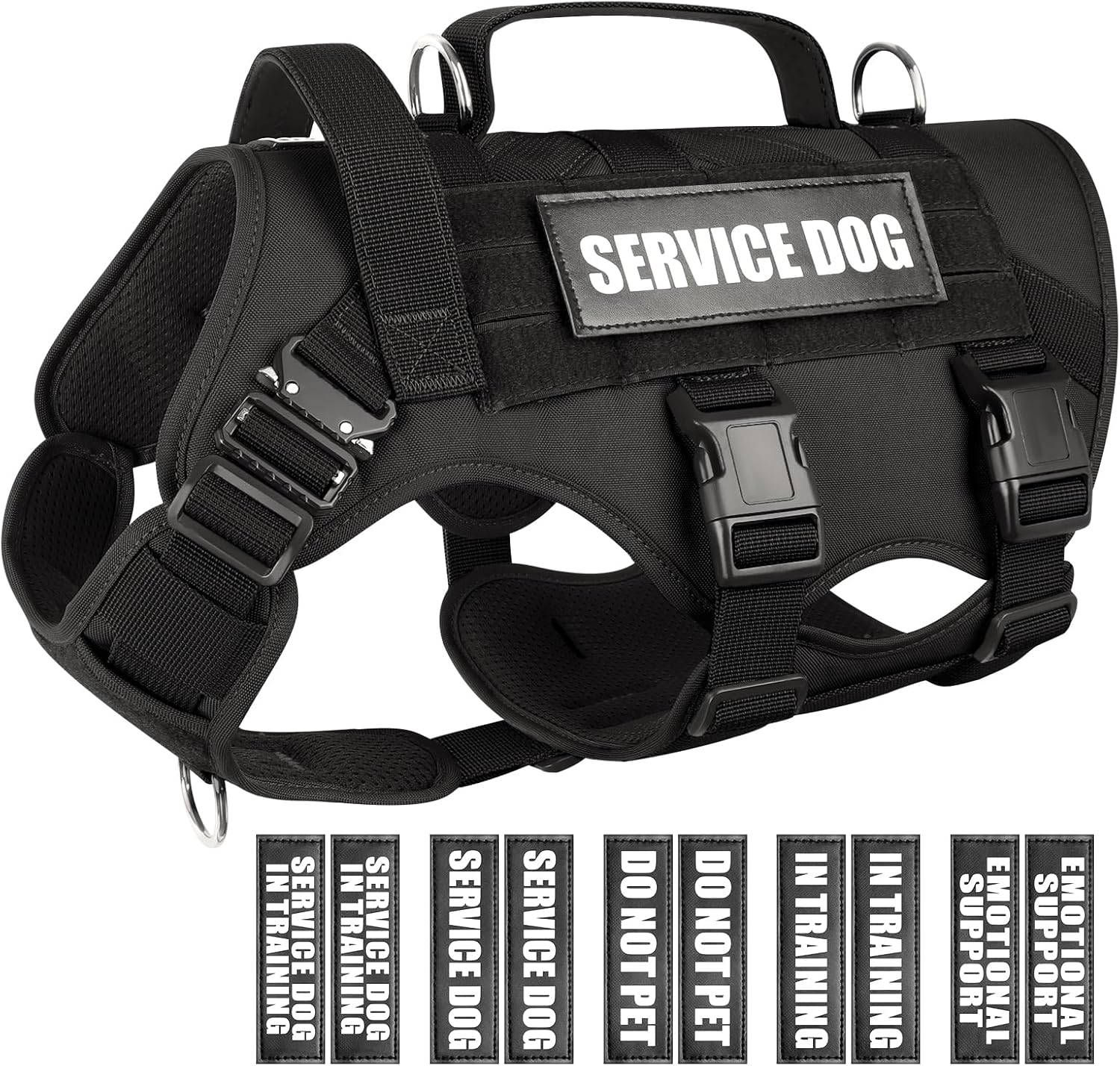
This is the harness I hand to people who are doing actual work with their dog: training sessions, long structured walks, and the kind of setup where a vest needs to carry something. The MOLLE webbing is the point. It lets you attach pouches and gear instead of stuffing treats in a jacket pocket, and it holds up to repeated loading better than the thin loop panels I see on cheap tactical vests.
The ten patches matter more than people admit. If you are training a service dog or a working dog, the patch panel is how the public reads your dog before you say a word, and having a set included means you are not hunting for patches separately. It is built for large dogs, and the construction is heavier than the price bracket suggests.
What to verify before you buy: check that the listing shows the attachment points you need, because no-pull only works if there is a front attachment to use. Measure your dog's girth and chest, not its weight. I have seen the same 60-pound shepherd fit two different sizes depending on chest depth, and a working vest that shifts is a vest that rubs.
Best value set: SlowTon No Pull Dog Harness and Leash Set
If a client tells me they want one purchase and they do not want to think hard about it, this is the one I name. You get the harness and a matching leash in one box, which solves the most common beginner problem, which is owning a harness that no leash clip quite fits comfortably. The padded construction is what keeps it on the list. Soft padding on the chest and girth is the difference between a dog that tolerates the harness and a dog that leans into it.
The $20 to $40 range has real winners now. I have said for years that the premium tier is often the same nylon with a better website, and this is the kind of set that proves it. Heavy duty stitching, padded panels, a leash included, and a price that means you can buy a second one for the car without feeling silly about it.
The honest caveat: padding that shifts is worse than no padding. Wash it, wear it wet, and check after a month whether the padding still sits where it started. If it bunches to one side, it will rub. That is true of every padded harness at every price, and it is the failure I see most often.
Best small dog pick: ShawnCo Basecamp Dog Harness
Small dogs get the worst gear. Most no-pull harnesses are scaled down from a large pattern, which means the straps are too wide, the hardware is oversized, and the whole thing sits like a backpack on a dog that weighs twelve pounds. This one is offered in a small, and that matters, because a no-pull vest on a small dog only works if the chest strap lands above the shoulder instead of across it.
The color is a small thing, but I will say it anyway: I live in the Pacific Northwest, and I have watched cheap dyes fade to gray in one winter. If you care about how the harness looks in February, that is worth thinking about. What I care about is whether the vest stays put when a small dog does its sudden sideways lunge at a squirrel, and whether the hardware is small enough not to bang against a thin chest.
Buy this for a small dog that pulls. Do not buy it for a large dog, because a size S vest on a 50-pound dog is a strap system with a fashion problem, and the fit points will all land in the wrong place.
Best budget tactical pick: Tactical Dog Harness and Leash Set with 10 Patches
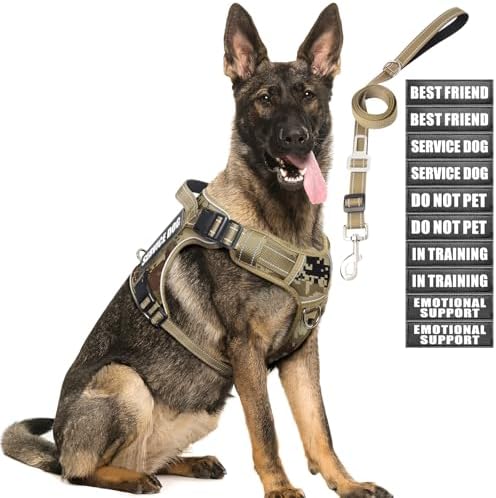
This is the second tactical option, and it comes with the leash and the patch set, which makes it the lower-commitment version of a working vest. If you want the look and the patch panel for training walks but you are not running a service dog, this is where I would start. It is sized for large dogs, and the set structure means you are not buying a leash separately two weeks later.
The reason I keep two tactical vests on this list is that they solve different problems. The first one is a working vest with MOLLE real estate for gear. This one is a training and walking setup with patches and a leash in the box. If your dog is a large breed that pulls on a flat collar and you want to move to a no-pull vest without spending a lot, this is the entry point.
Check the attachment points in the listing before you buy, and check the sizing chart against a real tape measure. A tactical vest that is one size too large slides forward on the shoulders, and once a vest slides, the front attachment point ends up under the armpit, which is exactly where you do not want a leash pulling.
How I test a harness
I run the same three-stage process on every harness that comes through my door, and I have run it on more than 30 that are still on the shelf.
Stage one is the fit bench. I measure strap width at the chest and girth, check whether the buckles are metal or plastic, and fit the harness on three body types: a deep-chested shepherd, a barrel-chested mix, and a slim sighthound build. If a harness only fits one of those, I note it. Fit is 80 percent of the outcome, and the best harness in the world fails on a dog it does not fit.
Stage two is the walk test. I take a reactive shepherd out on a busy Saturday and watch where the straps move under load. Does the chest strap stay above the shoulder? Does the girth strap stay behind the ribcage? Does the padding stay where it was put, or does it slide around the buckle? This is where padding that traps fur and mats it shows up, because matting happens under a panel that never stops moving.
Stage three is the durability run. I wash harnesses repeatedly, yank on leashes, and leave them wet. Buckle burst strength is not a number I can measure in my garage, but I can tell you which buckles feel like they will hold and which ones flex when I squeeze them. Plastic buckles on dogs over 40 pounds are a hard no from me, and I have watched enough of them fail to keep saying it.
What the fit points tell you
There are three places a harness has to be right, and if any one of them is wrong, the harness pulls, rubs, or both.
The chest strap should sit above the point of the shoulder, across the flat of the chest. If it sits on the shoulder joint, the dog's stride pushes it down and forward with every step.
The girth strap should sit behind the ribcage, two fingers behind the front legs. Too far forward and it pinches the armpit. Too far back and the harness rotates.
The back panel should sit flat, with the attachment point centered on the spine, not sliding toward one side. If the harness has a handle, it should sit above the shoulders where you can grab it without reaching.
The harness reference table
This is the table I keep in my fitting notes. Every row is a real product, and every entry is what the harness is for, not what it costs. Check the listing for current pricing and the full size range before you order, because sizes come and go.
| Harness | Best for | Sizing focus | Hardware notes | Price |
|---|---|---|---|---|
 Visit on Amazon → WINSEE Service Dog Vest Harness |
Working dogs, training, gear carry | Large dogs, measure girth | MOLLE panels, patch panel | $41.46 |
 Visit on Amazon → SlowTon No Pull Dog Harness and Leash Set |
First no-pull harness, everyday walks | Medium to large | Padded panels, leash included | $24.99 |
 Visit on Amazon → ShawnCo Basecamp Dog Harness |
Small dogs that pull | Size S, small frames | No-pull vest cut | $19.95 |
 Visit on Amazon → Tactical Dog Harness and Leash Set |
Budget tactical setup, training walks | Large dogs | Patch set, leash included | $27.98 |
What the table does not tell you
It does not tell you your dog's size. No table can. Get a soft tape measure, run it around the widest part of the ribcage, and compare that number to the listing chart. If your dog is between sizes, size up on a vest with thick padding and size down on a slim vest, because the padding takes up the slack.
It also does not tell you whether the front attachment point is metal. That is the one detail I would check on every single one of these before ordering, because a front clip is the mechanism that stops pulling, and a plastic front ring is a plastic front ring.
Car harnesses are a separate purchase
Most dogs need two harnesses: a walking one and a car one. The industry pretends one product does both, and it does not. A walking harness is built for load direction and comfort over miles. A restraint system in a vehicle is built for crash forces, and it needs its own testing. Buy the walking harness first, get the fit right, and treat the car as a second, separate decision.
Should you buy the WINSEE Service Dog Vest Harness?
Yes, if you have a large dog and you want a working vest with real gear capacity. The MOLLE webbing and the patch panel are what separate it from a plain no-pull vest, and the heavy duty build is aimed at exactly the kind of use that destroys lighter harnesses. It is the one I would pick for training sessions where the vest has to carry something.
The two things to do before you order: measure your dog's girth with a tape, and check the listing for the attachment points you plan to use. Get those right and this is a vest you will keep for years. Get them wrong and you will blame the harness for a sizing mistake, which is the most common thing I see.
Should you buy the SlowTon No Pull Dog Harness and Leash Set?
Yes, for most owners with a medium or large dog that pulls. It is a set, so you get the leash, the padding is soft enough for long walks, and the price sits in the range where I actually find winners. If you are buying your first no-pull harness and you want one decision instead of five, start here.
The thing it will not do is train your dog. A harness reduces the force you feel on the leash, and it takes pressure off the throat, which is why I recommend them. It does not teach loose leash walking. Owners who expect the harness to fix pulling end up with a well-equipped dog that still pulls, and that is a training problem, not a gear problem.
Should you buy the ShawnCo Basecamp Dog Harness?
Yes, if you have a small dog and you have been struggling to find a no-pull vest that is actually cut for a small frame. Size S is the whole reason this one is on the list. Pair it with a light leash, check the fit points, and skip it entirely if your dog is over about 25 pounds.