Related: How to Measure Your Dog for a Harness Without Guessing
A no-pull dog harness is a training tool, not a fashion accessory. If it does not change how your dog walks, it is a fancy collar with extra straps. I have fitted more than 3,000 dogs, first at a shelter working with reactive and pulling dogs, now through my own training business in Portland, and I keep a shelf of 30-plus harnesses that I have washed, yanked on, and handed to clients whose dogs drag them down the block.
This guide is the parking lot conversation I have five times a week. Four harnesses, what body type each one actually fits, and the fit points that decide whether the harness works before your dog takes a single step. Most people who come to me convinced their harness is broken are wearing the wrong size or the wrong clip position. Fix those two things and half the pulling problem disappears.
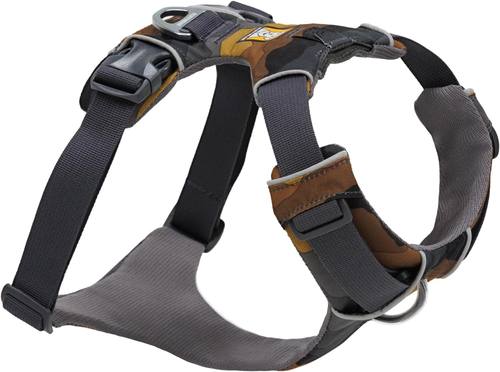
Best Overall: Ruffwear Front Range Dog Chest Harness
This is the harness I reach for when a client has a 60-pound adolescent that has learned the leash is a suggestion. Ruffwear earned its reputation in the training world, and the Front Range is the model I see most often on dogs that actually get walked every day rather than photographed once.
The reason is fit. The chest panel spreads pressure across the sternum instead of concentrating it on one strap, and the adjustment points stay where I set them. That last part is what separates a training brand from an Instagram brand. I have set harnesses for clients that crept loose over a two-mile walk, which means the dog is effectively walking in a different harness by the time you turn for home.
Medium fits a lot of dogs, but medium is not a size, it is a starting point. Measure the widest part of the chest, right behind the front legs, and compare that to the brand's chart. If your dog is between sizes, size up and tighten down rather than squeezing into the smaller one.
The Moonlight Mountains colorway is the kind of print that survives a Pacific Northwest winter without going gray. That matters more than it sounds. I have pulled harnesses out of the wash looking like faded dishrags after one season. This one still looks like the product photo. It is a walking harness, so pair it with a separate car restraint. No harness does both jobs well, no matter what the packaging claims.
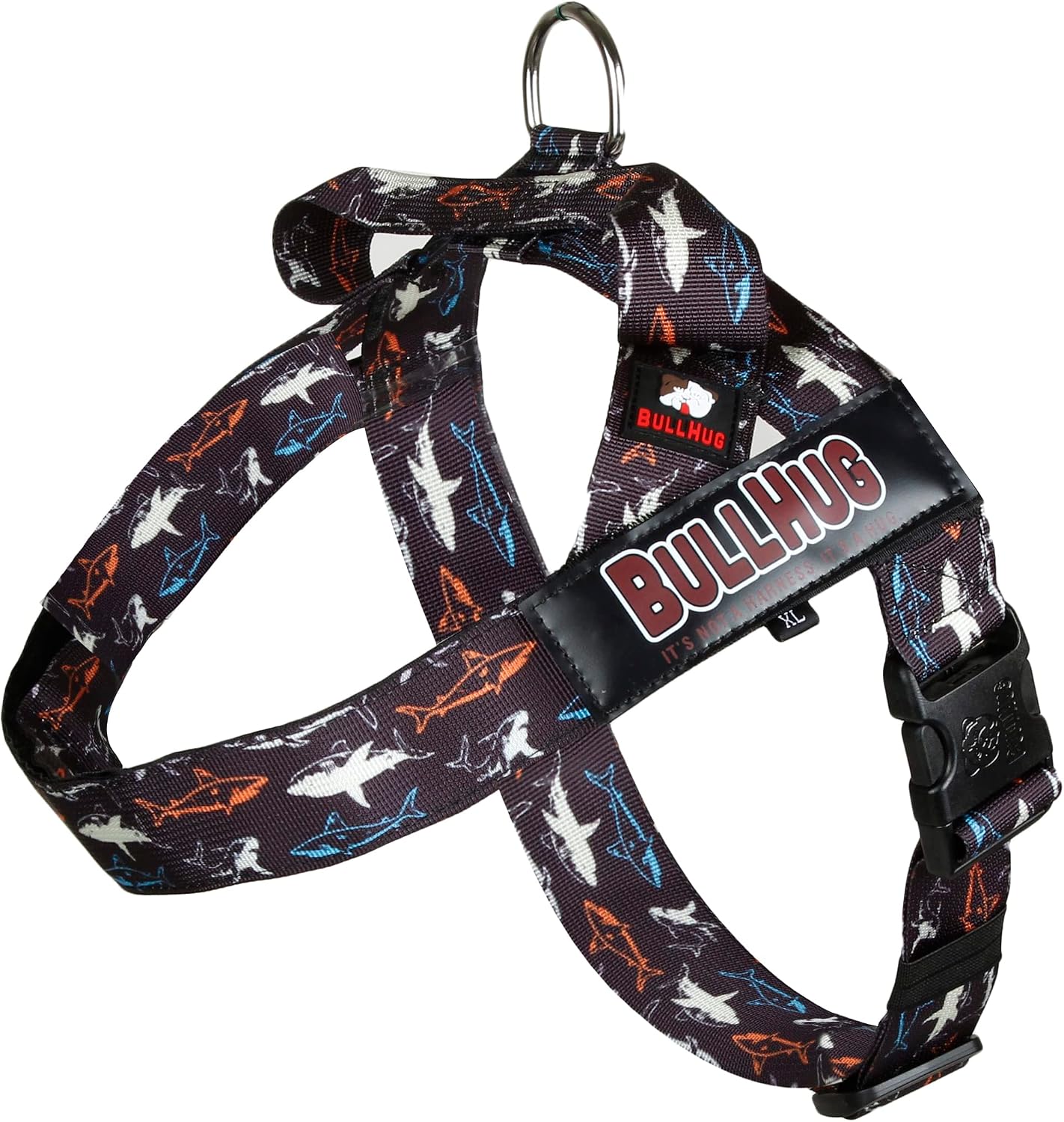
Best for Broad-Chested Breeds: BULLHUG Adjustable Dog Harness
Broad-chested dogs are the group most failed by generic harnesses. A bulldog or a pug has a chest that is wide and shallow, and a harness cut for a deep-chested retriever will slide forward until the strap sits in the armpit. That is where the rubbing starts, and it is why so many of these owners tell me harnesses "just do not work" on their dog.
The BULLHUG is cut for that shape. The adjustability is the entire product here, and it is what lets you pull the chest strap back off the armpit and shorten the girth so the whole thing stays put. Set it once, on a standing dog, with the dog's feet square under them. Then walk a lap of the living room and check whether anything has rotated. If it has, you are not done adjusting.
No-pull and no-choke claims are worth exactly as much as the fit behind them. A harness that stops pulling on a dog whose owner never taught a loose leash is doing half the job. What a good no-pull harness does is give you leverage when the dog hits the end of the line, and give you a way to steer rather than drag. The rest is training.
The Shark colorway is dark enough to hide trail dust, which is practical for a dog that walks in the rain six months a year. One caution I give every wide-chested client: check the strap webbing under the front legs after every walk for the first two weeks. That is where the fur mats if the padding shifts, and it is easier to fix an adjustment than a hot spot.
Best Budget Set: PUPTECK Dog Harness, Collar and Leash Set
The $20 to $40 range has real winners now, and this set is one of them for the right buyer. Getting a harness, a collar, and a leash in one box solves a problem new owners do not know they have: three separate purchases, three separate size charts, and three chances to order wrong.
I recommend it most often to two groups. People bringing home a puppy who will outgrow everything in four months, and foster homes where the dog might leave next week. Matching gear in one box at a price that does not hurt is genuinely useful, and it means you can buy two and keep one in the car.
What you are not getting is a harness built for a hard puller. For a small or medium dog who walks reasonably and mostly needs gear that fits, this does the job. For a 50-pound dog who lunges at squirrels, spend the money on structure instead.
Here is the check I give every budget harness owner. After the first month, look at the buckles where the straps fold, and look at the stitching where the leash attaches. Plastic buckles on dogs over 40 pounds are a gamble, and I have watched one explode on a leash pop. If the buckle flexes or whitens at the stress point, replace the harness. It is cheaper than a loose dog on a road.
Best for Small Dogs and Puppies: Step-in Breathable Vest Harness
Some dogs lose their minds when a harness goes over the head. It is one of the most common things I get called about, and the fix is usually not training, it is buying a step-in design. The dog puts their feet in, you close it, done. No wrestling, no head shyness, no dog backing away from the door when they see the gear.
That makes this vest the right choice for puppies in the middle of socialization, small dogs, and cats who walk on a leash. The breathable vest cut keeps it light enough for a dog who is still learning that a leash is not a snake, and the blue colorway is easy to spot in tall grass.
The tradeoff is structure. A vest style harness distributes a light load well and gives you a handle for lifting a small dog over a curb or into a car. It is not built to absorb a serious pull. If your dog is over about 25 pounds and leans into the leash, step up to something with a front attachment and more webbing.
Fit check for a step-in: the strap should sit two fingers behind the front legs, and you should be able to slide two fingers under the chest strap without forcing them. If you can fit your whole hand under it, the dog can back out of it. Escape risk is almost always a sizing problem, not a design flaw.
How I test harnesses
Every harness that comes through my door goes on the Fit Bench first. I fit it to three body types: a deep-chested shepherd, a wide-chested bulldog shape, and a small dog. I check the fit points in the same order every time.
Shoulder clearance. The harness should sit behind the shoulder blade, not on it. A strap that crosses the shoulder restricts the front leg's reach, and you will see a shortened stride within a block.
Armpit clearance. This is where broad-chested dogs get rubbed raw. Lift the front leg through its full range and watch whether the strap digs in.
Chest strap tension. Two fingers, no more. Loose enough to breathe, tight enough that the dog cannot back out.
Girth strap position. Well behind the ribcage's last rib, never on the soft belly.
Then the Walk Test. My reactive shepherd goes out on a busy Saturday morning, because a quiet street tells you nothing. That dog has a pulling force that has taken me off my feet before, and he is the honest test of whether hardware holds. I check buckle burst strength by watching the buckles under load, not by trusting a label. I check the martingale ring position on harnesses that have one, because a ring that sits too low puts pressure on the throat instead of the chest. And I check whether the padding is still where I put it after a mile.
Analysis and test results
Fit is about 80 percent of the outcome. The best harness in the world fails on a dog it does not fit, and a mediocre harness on a well-fitted dog usually walks fine. That is why I spend more time on the Fit Bench than reading spec sheets.
Front clip or nothing for pullers. A back-clip harness on a 70-pound dog that pulls is a sled dog setup, and you are the sled. Front attachment gives you steering. When the dog surges forward, the front clip turns them back toward you instead of letting them lean into the load. That is the entire mechanic, and no amount of padding changes it.
Hardware is where budget harnesses lose me. Front clips should be metal. I have bent three plastic D-rings with my thumb, which tells you what a determined dog does to one. Metal hardware below $30 is becoming standard, and I expect the plastic-buckle era to end within a couple of years as the factories upgrade.
Padding is a liar. Padding that shifts after a month is worse than no padding, because it bunches under the armpit and rubs a raw spot. On any harness, run your hand under the padding after a long walk and see whether it is still centered. If it is not, the harness is a return.
Colors fade. One Pacific Northwest winter turns a bright harness into gray felt. If you walk in rain and mud, buy the dark colorway and wash it by hand.
The harness reference table
This is the table I keep on my phone for client questions. Same four harnesses, sorted by who they fit. Match your dog's body type first, then your dog's pulling habit, then your budget. The order matters.
| Harness | Body type | Best for | Watch for |
|---|---|---|---|
 Visit on Amazon → Visit on Amazon →Ruffwear Front Range Dog Chest Harness |
Medium to large, deep-chested | Daily walks with a moderate to strong puller | Measure the chest, not the weight |
 Visit on Amazon → Visit on Amazon →BULLHUG Adjustable Dog Harness |
Wide, shallow chests | Bulldogs, French bulldogs, pugs and similar shapes | Set the adjustment on a standing dog, then recheck after a lap |
 Visit on Amazon → Visit on Amazon →PUPTECK Dog Harness, Collar and Leash Set |
Small to medium | New puppies, fosters, first-time owners | Inspect buckles and stitching after month one |
 Visit on Amazon → Visit on Amazon →Step-in Breathable Puppy Cat Vest |
Small dogs, puppies, cats | Dogs who hate a harness over the head | Light duty only, watch for escape on narrow chests |
Two harnesses per dog is not a sales pitch, it is how I run my own house. A walking harness for the street and a separate restraint for the car, because a harness that is comfortable for two miles is not the same thing as one that holds a dog in a crash.
Should you buy the Ruffwear Front Range Dog Chest Harness?
Yes, if you want one harness that handles real walks with a real puller. It is the one I stop worrying about, and the one I hand to clients who have already returned two cheap harnesses. Check current Amazon price before you decide it is too expensive, because the gap between this and a budget harness is smaller than most people assume.
The catch is sizing. Get the chest measurement right or you will blame the product for a fit problem. Measure, order, and spend the first walk adjusting rather than walking fast.
Should you buy the BULLHUG Adjustable Dog Harness?
Yes, if your dog has a wide chest and every other harness ends up in their armpits. It is the fix for a problem that most harness brands ignore, and the adjustability means you can actually solve the fit instead of settling for close enough.
Give it a proper setup session. Ten minutes on a standing dog, a lap around the living room, one more adjustment. Do that and it stays where you put it.
Should you buy the PUPTECK set or the step-in vest?
The PUPTECK set is the right first purchase for a small or medium dog, especially a puppy or a foster, because you get the harness, collar, and leash without three separate sizing gambles. Just check the buckles monthly.
The step-in vest is the answer for the dog who panics at a harness going over their head. Small dogs, puppies, cats, and any dog who backs away from the door when the gear comes out. Keep it for light duty, fit it snugly, and it will make your mornings easier than any training plan you try to run with a dog who is already stressed.