Related: How to Fit a Dog Harness: The Five Fit Points That Matter
I spent eight years at a shelter, and most of that time came down to one problem: a dog who pulled hard enough to take an adult off their feet. A no pull dog harness solves most of that, but only when it fits and only when the leash attaches where it should. The wrong harness turns a puller into a better puller, because now he has a strap across his back to lean into and a handle for you to grab while he drags you.
Here is what I tell clients in Portland before they spend anything. A harness is a training tool, not a fashion accessory. If it does not change the physics of pulling, it is a fancy collar with extra webbing. Fit is about 80 percent of the outcome, and the best harness in the world fails on a dog it does not fit.
The four harnesses below are the ones I keep coming back to for real pullers, plus the sizing and hardware details that decide which one goes on your dog.
PetSafe Easy Walk Harness: Best Overall for Most Pullers
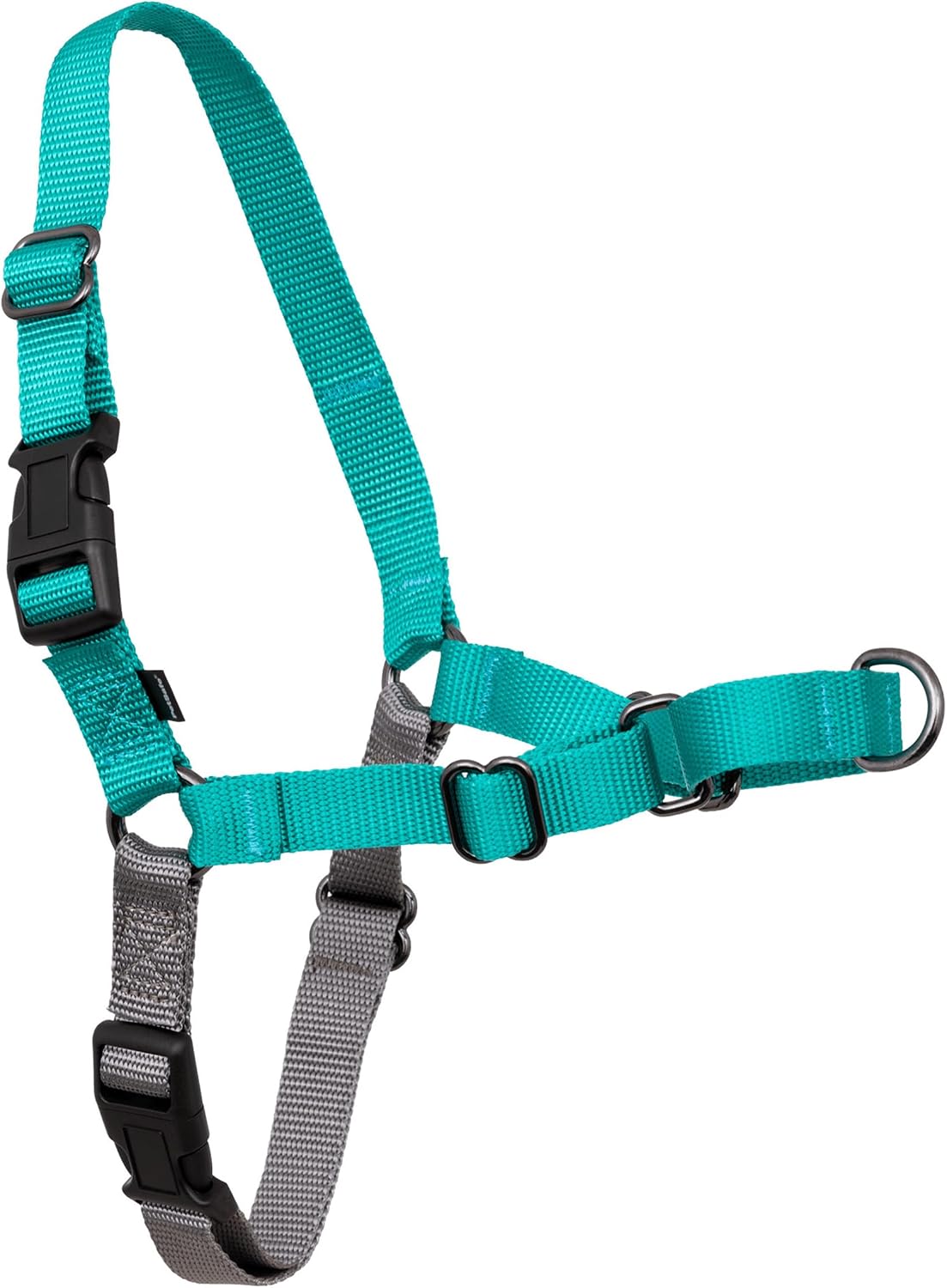
The Easy Walk is the harness I hand to a client whose dog has been walking them for three years. It is a front-clip design with a martingale loop across the chest, and that loop is the part most people miss. When a dog backs up or twists, the loop draws the chest strap snug instead of letting him slide an elbow out. That is the difference between a harness that stays put and one you re-fit four times a block.
The leash clips at the chest, not the shoulders. That single change is the whole point. A dog driving forward into a chest clip gets turned back toward you, and the pulling stops paying off. It is not magic and it is not training, but it buys you the two seconds you need to redirect.
What I like: four adjustment points, so it fits a deep-chested shepherd and a barrel-chested lab with the same medium. The teal webbing is easy to spot in tall grass. What I do not love: the straps are narrower than the heavy-duty market, and the padding is minimal. On a hard puller, a thin strap concentrates pressure. For a dog who pulls at a four out of ten, that is fine. For a dog who pulls at a nine, you want more surface area.
It is also a walking harness, full stop. Do not use it as a car restraint. PetSafe does not claim it is one, and neither will I.
WINSEE Escape Proof Dog Harness: Best for Dogs Who Slip Out
Some dogs are not pullers. They are Houdinis. A nervous rescue who backs out of anything around his chest is a different problem than a dog who leans, and the WINSEE is built for that dog.
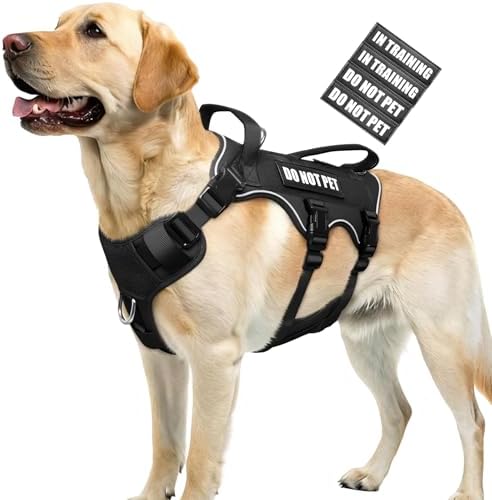
The escape-proof label is the whole pitch, and it holds up because of how the body is wrapped. The harness carries a double handle, which sounds like a gimmick until you are on a busy Saturday sidewalk and need to hold a dog close to your leg with one hand while the other hand manages a leash and a coffee. I use the top handle constantly on reactive dogs. It is the closest thing to a steering wheel you can put on a dog.
The four removable patches are a genuinely useful detail, and not for the reason the listing suggests. Yes, you can label a dog "IN TRAINING." More importantly, patches are a conversation stopper. People read them before they reach for your dog, and that matters with a dog who is working on his manners.
Fit notes: this is a harness that rewards careful measuring. Because it is designed to resist backing out, it sits snugger through the chest than a standard walking harness. Snug is not tight. You should still fit two fingers under every strap, and you should still check the girth strap after the first ten minutes of a walk, because nylon settles.
TagME No Pull Dog Harness for Puppy: Best Lightweight Starter
Puppies do not need a heavy harness. They need something light enough that they forget it is on, and they need it to be adjustable, because a puppy's chest changes shape every three weeks.
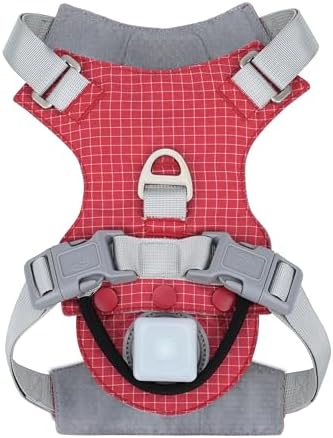
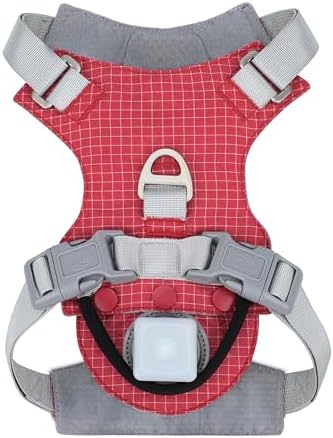
The TagME solves the two-clip problem elegantly. There are two leash attachment points, one at the chest and one at the back. That means you can start a puppy on the front clip while he learns not to lunge, then move to the back clip once he walks politely and you want a relaxed sniff walk. Most people buy two harnesses to get that progression. This is one.
The AirTag holder is the detail that sold me. A puppy is the most likely dog in your house to bolt through an open gate, and having a tracker pocket built into the harness instead of dangling from a collar ring is simply better design. It sits flat, it does not swing, and it does not rattle against the buckle.
The no-choke construction matters too. There is no tightening loop around the throat on the back-clip setting, so a puppy who suddenly hits the end of the leash does not get a neck correction. Melon red is loud, and I mean that as a compliment. A puppy in tall grass should look like a traffic cone.
TagME No Pull Dog Harness for Medium Dogs: Same Design, Grown-Up Sizing
This is the same harness as the one above, cut for a medium dog. I am listing it separately because sizing is where most buyers go wrong, and because a medium dog is a different mechanical problem than a puppy.
A 35-pound dog who pulls generates real force. The TagME handles it with the front clip and the same lightweight build, and the two-clip setup means you are not locked into a front-clip walk forever. The AirTag pocket carries over, which matters more on a medium dog than a puppy, since a grown dog can cover serious distance in a panic.
Two honest caveats. First, lightweight webbing is a trade-off. It is comfortable and it dries fast, which in a Pacific Northwest winter is not a small thing, but it is not the same strap stock as a heavy-duty trail harness. Second, melon red fades. Every bright nylon I have owned has gone soft pink to gray after a couple of wet seasons. If color longevity is your priority, that is a real consideration. If it is visibility on a dark morning, buy it and enjoy the first two years.
How I Evaluate a No-Pull Harness
I look at four things, in this order.
Fit points first. The chest strap should sit across the breastbone, not across the throat. The girth strap should land behind the ribcage, well clear of the armpit, because a strap that rides into the armpit rubs raw spots on a long walk. The shoulder should have full clearance so the front legs can extend without the harness catching. If those three points are wrong, nothing else about the harness matters.
Hardware second. Front clips should be metal. I have bent plastic D-rings with my thumb, and a leash-pop on a plastic buckle is how a dog ends up loose on a road. On a dog over 40 pounds, I will not recommend a plastic load-bearing buckle, period.
Padding third, and I am picky about it. Padding that shifts after a month is worse than no padding, because now you have a wad of foam bunching under one elbow. Look for padding that is stitched down or integrated into the panel.
Adjustment range last. A harness with four adjustment points fits three body types. A harness with two fits one, and if your dog is between sizes, you are out of luck.
One more thing I tell every client: the harness does not train the dog. It stops the pulling from being reinforced while you teach a loose-leash walk. If you skip the training, you have bought an expensive way to be dragged.
The no-pull harness comparison table
This is the short version. Fit each dog with a tape measure around the widest part of the ribcage before you buy.
| Harness | Attachment | Best for | Key detail | Price |
|---|---|---|---|---|
 Visit on Amazon → Visit on Amazon →PetSafe Easy Walk |
Front clip only | Most pullers, 25 lbs and up | Martingale chest loop, four fit points | $20.69 |
 Visit on Amazon → Visit on Amazon →WINSEE Escape Proof |
Double handle, escape-proof wrap | Dogs who back out of harnesses | Two handles, four removable patches | Check current Amazon price |
 Visit on Amazon → Visit on Amazon →TagME (Puppy) |
Front and back clip | Puppies and small dogs in training | AirTag holder, no-choke build | Check current Amazon price |
 Visit on Amazon → Visit on Amazon →TagME (Medium) |
Front and back clip | Medium dogs, everyday walks | Same build, medium sizing | $29.99 |
What about back-clip harnesses?
A back-clip harness is not evil. It is the right tool for a dog who already walks politely and for long sniff walks where comfort beats control. It is the wrong tool for a dog who pulls, because the attachment point sits directly above the strongest part of his drive. If your dog drags you on a back clip, you have built a sled dog rig. Move the leash to the chest.
What about car harnesses?
Different product, different job. A walking harness is engineered for comfort over an hour and for redirecting a pull. A crash-tested car harness is engineered to hold a body in a collision. Most dogs need both, and the industry pretends one harness does everything. It does not.
Should you buy the PetSafe Easy Walk Harness?
Yes, for the average puller. It is the least expensive way to change the physics of your walk, the martingale loop keeps it on a wiggly dog, and the four adjustment points cover a wide range of body types. If your dog is a 60-pound freight train who pulls at full speed for the first ten minutes of every walk, spend your money on a wider, padded harness instead. For everyone else, this is the one I would buy first.
Should you buy the WINSEE Escape Proof Dog Harness?
Yes, if your dog has ever backed out of a harness or a collar. The double handle is the feature you will use every single day, and the removable patches do more for a training dog than any label on a vest. Measure carefully, fit it snug, and recheck the girth strap after the first walk.
Should you buy the TagME No Pull Harness?
Yes, and which size depends entirely on your dog, not on the price. Buy the puppy sizing for a dog still growing, because you will replace it in a year anyway and the light build is what a young dog needs. Buy the medium sizing once your dog has stopped changing shape, because a snug harness on a grown dog beats a loose harness on a dog who is still filling out. Either way you get two leash clips, an AirTag pocket, and a harness that stays out of your dog's way.