Related: Front-Clip vs Back-Clip Harnesses: What Actually Stops Pulling
I fit harnesses for a living. Eight years at a shelter working with reactive and pulling dogs, then my own training business here in Portland, and somewhere north of three thousand dogs measured across my fitting bench. This dog harness buying guide is the version of that conversation I have with clients every week, because the same thing happens over and over: someone buys a harness that is genuinely well made, puts it on a dog it does not fit, and walks away convinced that all harnesses are junk.
Fit is about eighty percent of the outcome. The other twenty percent is hardware and design. Get both right and a harness can change how a walk feels. Get them wrong and you have spent money to make your dog pull harder.
Here is the part the industry does not like to admit: most dogs need two harnesses. A walking harness and a car harness are different jobs. A harness that holds a dog in a seat has to spread load across the chest and ribs. A harness that manages pulling needs a clip point at the chest, where a leash can redirect momentum instead of feeding it. I would rather you buy a modest walking harness and a modest car harness than one expensive thing that pretends to do both.
Everything below comes from the four harnesses I keep coming back to with clients, plus the fit rules I use on every dog that comes through my door.
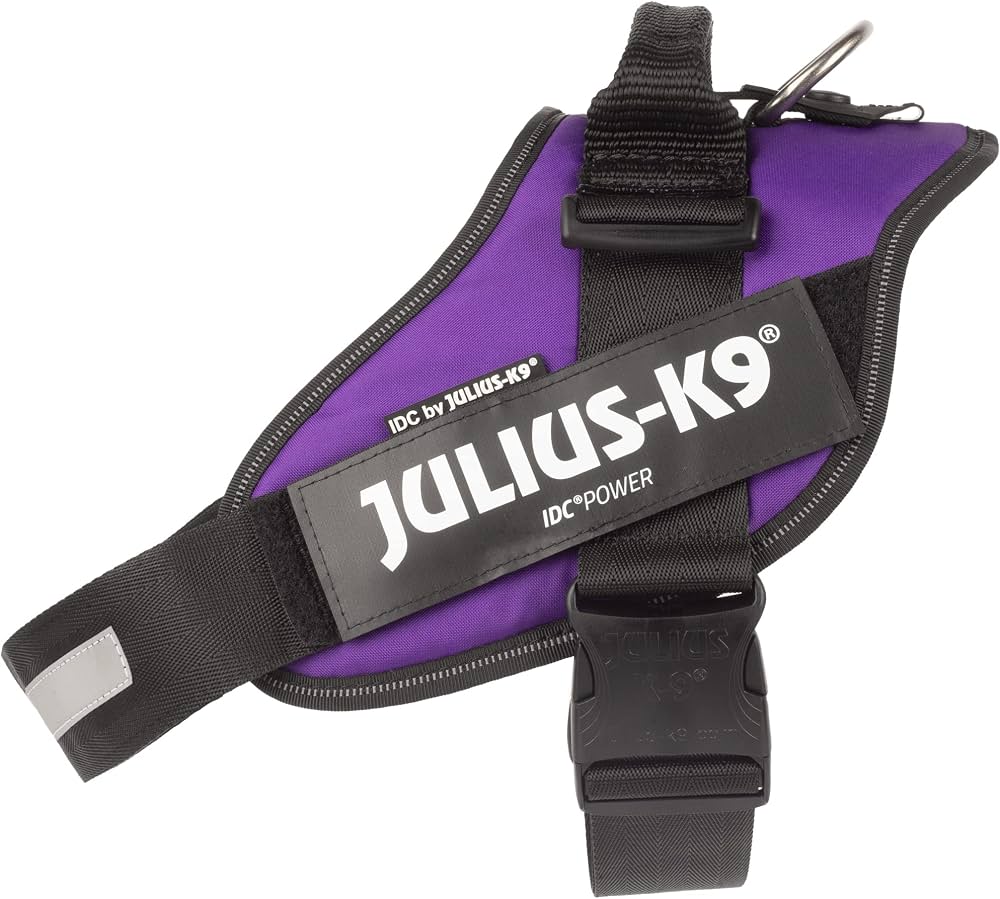
Best for Big Dogs and Handlers Who Need a Handle: Julius-K9 IDC Powerharness
This is the harness I reach for when a big dog needs to be steadied right now. The IDC Powerharness, in the XL/2 size in dark purple, is built around large, powerful dogs, and it has the one feature I use more than any other on a harness for that kind of dog: a handle at the top of the back. If you have ever tried to hold a ninety pound dog at a busy intersection with nothing but a leash, you know why that handle matters.
What it is not is a no-pull harness in the front-clip sense. The attachment sits on the back, and a back attachment gives a leaning dog leverage. That is physics, not brand loyalty. A back-clip setup on a hard puller is a sled dog arrangement, and the dog is the sled dog. So be honest with yourself about which dog you have.
If your dog walks reasonably well and you want something sturdy, comfortable, and easy to grab in an emergency, this is a serious piece of gear. If your dog launches at every squirrel, use it as part of a training plan, not as the fix. Check the sizing chart by chest girth before you order, because this is a European sizing scale and it does not map neatly onto American harness sizes.
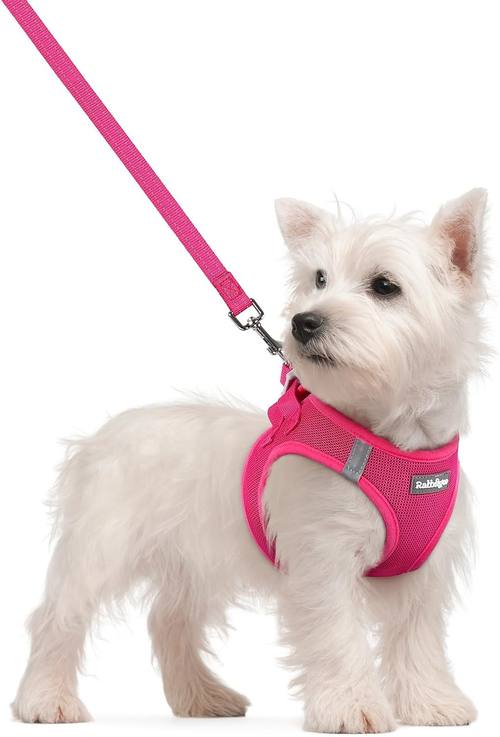
Best for Puppies and Small Dogs: rabbitgoo Step-In Harness and Leash Set
The rabbitgoo step-in vest is the harness I recommend most often for a puppy or a small dog, and the reason is the step-in design. The dog walks into the harness and you close it around the chest, instead of pulling a strap over the head. For a nervous puppy in the middle of socialization, that difference is everything. A harness that goes on over the head teaches a dog that hands near the face are a threat. A step-in harness teaches nothing scary at all.
It also arrives as a set with a matching leash, which is genuinely useful for a first-time owner who does not want to shop for two things and guess whether they work together. On a dog under forty pounds, the lighter hardware is a reasonable trade for the lower weight on the dog's back.
Two fit rules matter here. Size by chest girth, not by breed or by weight, because a pug and a Jack Russell of the same weight have completely different chests. And check that the chest strap crosses the breastbone, not the throat. A strap riding on the throat is the number one cause of the coughing and gagging people blame on harnesses.
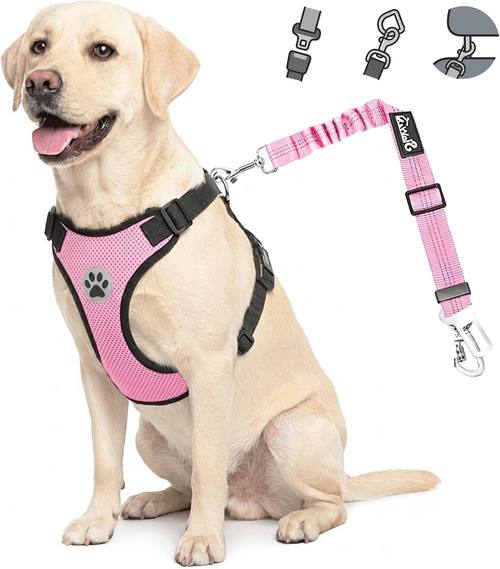
Best for the Car: Lukovee Dog Car Harness Seat Belt
The Lukovee car harness is the one on this list that solves a problem most people do not think about until it is too late. An unrestrained dog in a moving car is a projectile. At thirty miles an hour, a forty pound dog becomes roughly the weight of a small refrigerator in a sudden stop, and it does not matter how well trained the dog is. This harness pairs with a seat belt through a two in one buckle so the dog stays in its spot.
I want to be precise about what this does and does not do. It stops your dog from climbing into your lap, from being thrown into the windshield, and from bolting out of an open door at a rest stop. It is not a crash-tested crate, and no harness on a seat belt is. Treat it as a restraint and an anti-ejection device, which is exactly what most people actually need.
Fit it snug against the body without pinching, and keep the seat belt slack short enough that the dog can sit and lie down but not stand and turn around. If the harness twists when the dog shifts, it is too loose. Check current Amazon price before you commit, because car harness pricing moves around more than walking harness pricing.
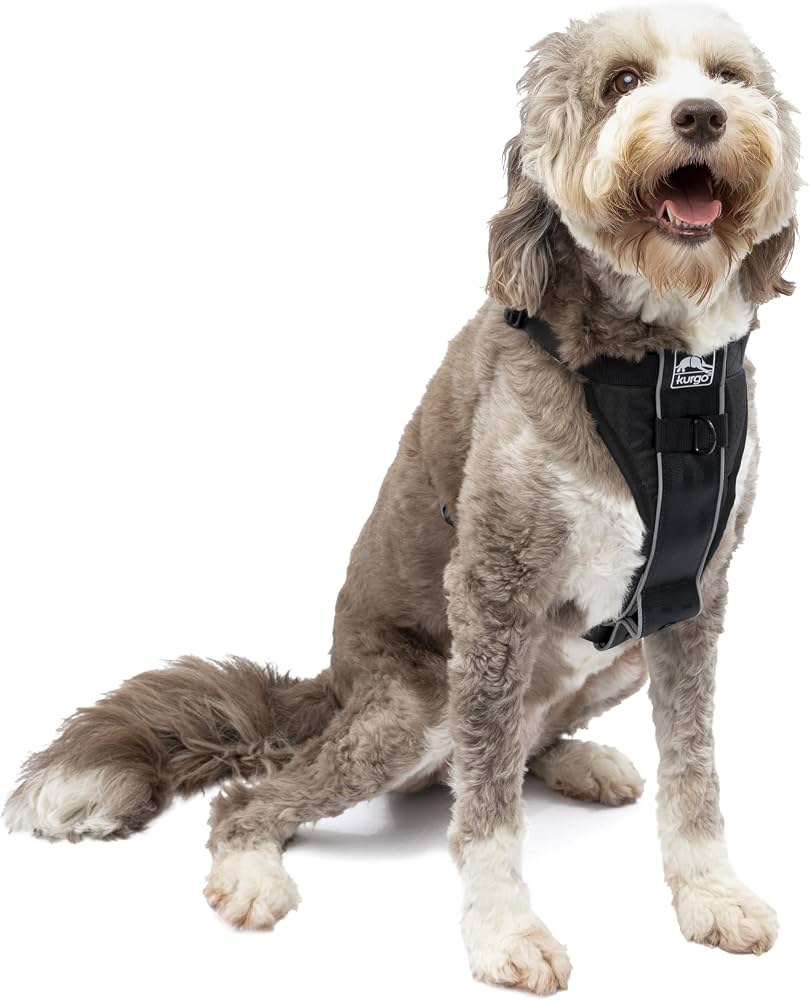
Best All-Rounder for Medium and Large Dogs: Kurgo Tru-Fit Smart Harness
Kurgo is one of the training world brands that earned its place, and the Tru-Fit Smart Harness in black, size Large, is the one I hand to owners of medium and large dogs who want a single harness for daily walks. It is a padded walking harness first, which is the right priority. Padding that stays where it is put is worth more than padding that looks thick in the product photo.
This is also the harness I recommend when someone wants a walking harness that can double as a car restraint in a pinch, with the understanding that a walking harness used in a car is a compromise. If your dog rides twice a week, buy the dedicated car harness above. If your dog rides twice a year, this is fine.
The fit rules for a large dog are the same as for a small one, just with more consequence. Two fingers should slide under the girth strap and no more. The chest strap should sit on the breastbone. The harness should not slide toward the shoulders when your dog lowers its head to sniff, because a harness that shifts forward on every sniff will end up under the armpit and rub. Size Large covers a wide range of dogs, so measure the girth at the widest part of the chest and check the chart rather than trusting the label.
How I judge a harness
I look at four things, in this order.
Buckles first. Buckle quality is the entire product. I have watched a plastic buckle explode on a leash pop, and I have bent three plastic D-rings with my thumb alone. On a dog over forty pounds, metal hardware at the load-bearing points is not a luxury. On a small dog, lighter hardware is a reasonable trade, which is why the step-in set above still makes this list.
Strap webbing second. I check how the webbing is stitched and whether it holds its shape when you pull it hard. Cheap webbing stretches and the harness loses the fit you spent twenty minutes getting right.
Fit points third. There are three that matter: the girth strap behind the front legs, the chest strap across the breastbone, and the distance between the two. If any one of them is wrong, the harness will rub, and a rubbing harness is worse than no harness at all.
Clip placement fourth. For a puller, the leash attachment needs to be at the chest, because that is the point where a leash can redirect the dog's weight sideways instead of forward. For a dog that already walks politely, the attachment point matters far less.
The harness reference table
This is the table I keep for clients. It is organized by job, not by price, because the job is what determines whether a harness works for your dog.
| Harness | Best for | Sizing in this listing | Walking or car | Price |
|---|---|---|---|---|
 Visit on Amazon → Visit on Amazon →Julius-K9 IDC Powerharness |
Large, strong dogs that need a handle at the back | XL/2, dark purple | Walking | $64.99 |
 Visit on Amazon → Visit on Amazon →rabbitgoo Step-In Harness and Leash Set |
Puppies and small dogs, first harness | Small sizes | Walking | $14.97 |
 Visit on Amazon → Visit on Amazon →Lukovee Dog Car Harness Seat Belt |
Keeping a dog in one spot in the car | Adjust to chest girth | Car | Check current Amazon price |
 Visit on Amazon → Visit on Amazon →Kurgo Tru-Fit Smart Harness |
Daily walking for medium and large dogs | Large, black | Walking, car in a pinch | $24.95 |
What the table tells you
Read the third column before the first. The single most common mistake I see is an owner buying the right harness in the wrong size, then blaming the harness. A harness that is too loose lets the chest strap drop onto the throat. A harness that is too tight restricts the shoulder. Neither problem shows up in a product photo, and both show up on the third walk.
The second pattern is buying one harness for two jobs. The Lukovee is a car harness, and it is good at that. The Kurgo is a walking harness, and it is good at that. If you ask either one to be the other thing full time, you will be disappointed, and you will blame the brand instead of the plan.
Third, think about your dog's body type. A deep-chested dog and a barrel-chested dog of the same weight need different sizes. This is why I tell clients to ignore breed-based size charts and measure the chest girth twice.
Should you buy the Julius-K9 IDC Powerharness?
Yes, if you have a large, strong dog and you want a handle you can grab without thinking. The build is aimed at exactly that dog, and the XL/2 size in dark purple covers a lot of German shepherd and similar frames. Just do not expect it to teach your dog to stop pulling, because a back attachment will not do that. Use it with training, or pick a front-clip design if pulling is the whole problem.
Should you buy the rabbitgoo Step-In Harness and Leash Set?
Yes, for a puppy or a small dog. The step-in design avoids the over-the-head struggle, and the matching leash means you are not guessing at compatibility. Size by chest girth, keep the chest strap on the breastbone, and check the fit again in a month, because puppies change shape fast and a harness that fit at twelve weeks will not fit at twenty.
Should you buy the Lukovee car harness or the Kurgo Tru-Fit?
Buy the Lukovee if your dog rides in the car regularly. It is the dedicated tool for that job, and it is the difference between a dog that stays put and a dog that ends up in your lap at the worst possible moment. Buy the Kurgo Tru-Fit if you want one padded walking harness for a medium or large dog that can also handle the occasional car trip. If you can afford both, buy both. That is the honest answer, and it is the one I give my clients.