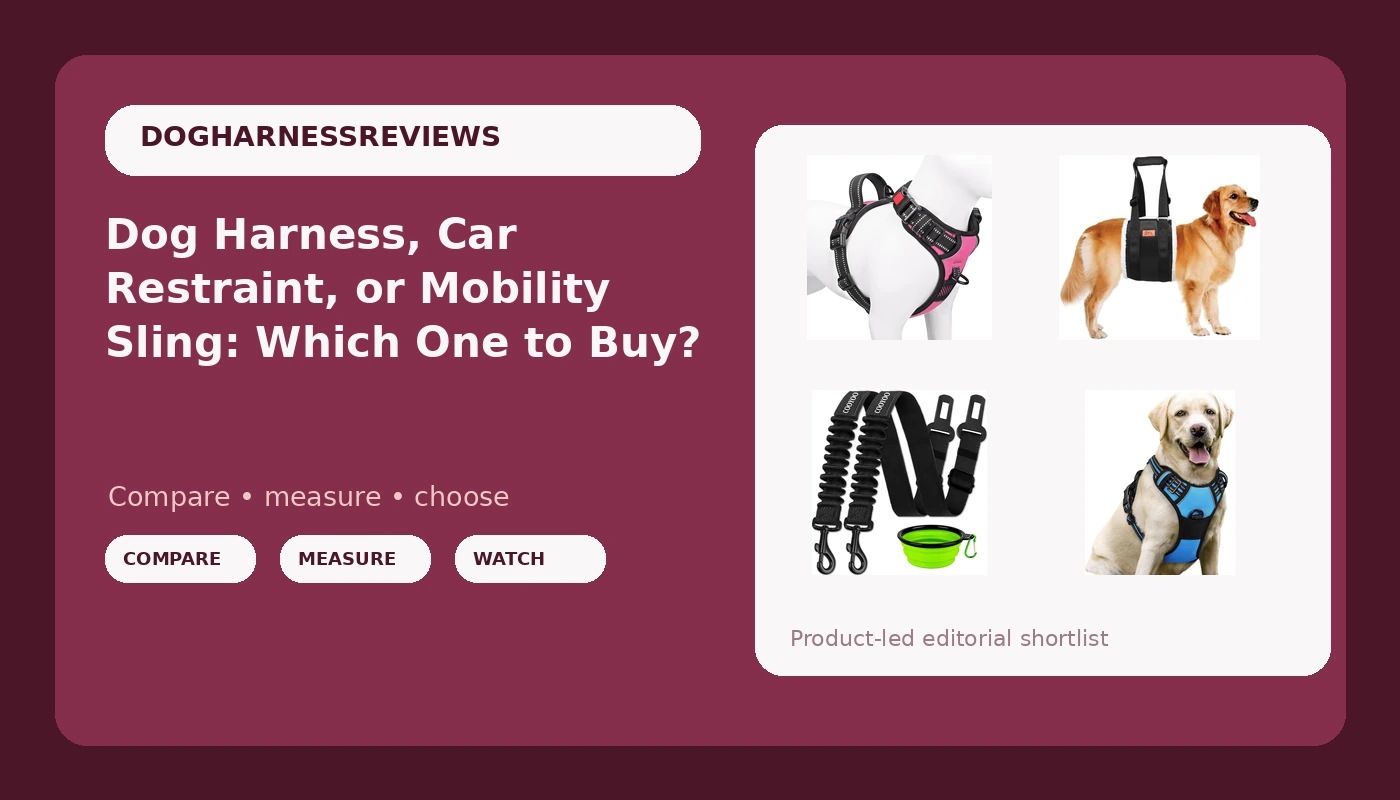
Most people who ask me about a pulling dog are not really shopping for a harness. They are shopping for a solution to one specific problem, and the harness is just the shape that solution happens to take. A ten pound terrier that backs out of a back-clip harness, a seventy pound shepherd that drags a grown adult down the sidewalk, an older lab whose hind legs give out on the back steps, and a dog that rides loose in the back seat are four different problems. A no-pull dog harness addresses one of them. The others call for a mobility sling, a car restraint, or an honest look at fit, and mixing them up is how people end up with a drawer full of gear that never worked.
Related: How to Fit a No-Pull Dog Harness: The Five Fit Points That Matter →
Quick answer
For a dog that pulls on leash, start with a front-clip no-pull harness sized to that dog's chest, not to its weight. For a large dog whose hind legs need help on stairs or getting in and out of a car, a support sling is the right tool and a walking harness is not. For travel, use a restraint that connects the dog to a seat belt. None of these replaces the others, and no harness should be called a crash protection device unless the maker publishes that evidence.
Four useful options
| Model | Best fit | What stands out |
|---|---|---|
| PHOEPET No Pull Dog Harnesses for Small Dogs Reflective Adjustable | Small dogs that pull or slip | Front-clip no-pull design with reflective trim and adjustable straps |
| rabbitgoo Dog Harness, No Pull for Large Dogs with 2 Leash Clips, Pet Vest | Large dogs that pull | Two leash attachment points on a vest-style body |
| Adjustable Dog Sling for Large Dogs Hind Leg Support Weak Legs Mobility Aid | Large dogs needing hind-end support | Adjustable sling built to support the hind legs |
| COOYOO Dog Seat Belt, 3 Piece Set Retractable Dog Car Harness Adjustable Dog Seat Belt for Vehicle Nylon Pet Safety Seat Belts Heavy Duty & Elastic | Car travel | Three-piece retractable tether set in nylon with elastic give |
The small-dog walker: PHOEPET No Pull Dog Harnesses for Small Dogs Reflective Adjustable
Small dogs are the group most often failed by generic harnesses, because a harness scaled down from a large pattern does not sit on a small dog's chest the same way. The straps land in the wrong place, the chest panel rides too low, and the dog learns within a week that backing up is a reliable escape. A harness made for small dogs is not a marketing nicety, it is the difference between a tool that works and a tool that gets returned. Reflective trim is a real feature rather than decoration if you walk before sunrise, which in a Pacific Northwest winter is most of the year.
The large-dog puller: rabbitgoo Dog Harness, No Pull for Large Dogs with 2 Leash Clips, Pet Vest
Two attachment points matter more than most buyers realize. A front clip changes the physics of a pull by turning the dog's forward momentum into a sideways redirect, which is why front-clip or nothing is my rule for a dog that leans into the leash. A back clip on a seventy pound dog that pulls is a sled dog setup, and no amount of padding changes that. Having both clips on one harness lets you use the front point for training walks and the rear point for a decompression sniff walk where you are not asking for a tight heel. The trade off is that a vest body covers more of the dog, which means more surface area to check after every walk in burr season.
The mobility aid: Adjustable Dog Sling for Large Dogs Hind Leg Support Weak Legs Mobility Aid
This is the product people most often buy by mistake, because they search for "harness" when what they need is a handle. A sling takes weight off the hind end while the dog walks, climbs a step, or gets into a vehicle. It is not a leash attachment, it is not for a dog that pulls, and it is not a substitute for a veterinary assessment of why the hind legs are weak in the first place. Used correctly, it is a short-term or long-term aid for an aging or recovering dog, and it lets you support rather than lift. Used incorrectly, as a walking harness, it does nothing at all.
The car restraint: COOYOO Dog Seat Belt, 3 Piece Set Retractable Dog Car Harness Adjustable Dog Seat Belt for Vehicle Nylon Pet Safety Seat Belts Heavy Duty & Elastic
Most dogs need two harnesses, a walking one and a car one, and the industry pretends one does both. A tether like this one keeps a dog from climbing into the front seat or landing in a lap during a hard stop, which is worth having on its own. Whether it performs like a crash-tested restraint is a separate question, and one you should answer by reading what the maker actually claims rather than what a listing title implies. Elastic give is a comfort feature for everyday driving, and it is also the reason I would not treat a basic tether as equivalent to a purpose-built, independently tested car harness.
Prices and availability may change. Product images, names, and retailer links are matched to verified listings. No current price, rating, stock status, or measured result is stated here without current evidence.
Fit points decide the outcome
Fit is roughly eighty percent of whether a harness works, and it is the part buyers skip. Four points do most of the work. The chest strap should sit across the breastbone, not across the throat, because a strap that rides into the windpipe will make a dog pull harder to get away from the pressure. The girth strap should sit a hand's width behind the front legs, in the narrowest part of the rib cage, so it cannot slide forward into the armpit on a tight leash. The shoulder should be clear enough that the dog can extend a front leg without the strap cutting into the joint. And the whole harness should be snug enough that you can fit two fingers, not a fist, under any strap.
Padding is where cheap harnesses quietly fail. A padded panel that shifts after a month of wear is worse than no padding, because the padding bunches, the strap underneath rubs, and you end up with a raw spot under one armpit. The same goes for buckles. Plastic buckles on dogs over forty pounds are a gamble, and I have watched a side-release buckle pop open on a leash correction on a dog that weighed less than I do. Metal hardware is becoming standard below the thirty dollar mark, and that shift is long overdue.
Why a walking harness and a car restraint are different jobs
A walking harness is designed around a dog that is upright, moving forward, and attached to a person on the other end of a leash. A car restraint is designed around a dog that is sitting or lying in a moving vehicle, attached to a seat belt anchor, and it has to survive forces that never occur on a sidewalk. The geometry, the anchor point, and the load path are all different. That is why a harness that fits beautifully for walks can be the wrong thing in a car, and why a tether that keeps a dog in the back seat is not something you clip a leash to.
Five steps for choosing:
- Name the problem in one sentence. Pulling, slipping, hind-leg weakness, or car travel. Only one of these is a walking harness problem.
- Measure the dog's chest at the widest point behind the front legs, then measure again. Compare that number to the maker's size chart, not to the dog's weight.
- Decide whether the dog needs a front clip, a rear clip, or both. A dog that leans into the leash needs a front attachment.
- If the dog needs hind-end support, buy a sling and talk to your vet about the cause before you buy anything else.
- If the dog rides in a car, buy a restraint for the car and keep it in the car. Do not improvise with the walking harness.
Practical guidance before you buy
- Measure, then re-measure. Sizes vary between makers, and a medium in one line is a large in another.
- Check every strap for a metal D-ring or buckle if your dog is over forty pounds.
- Walk the dog around the house for five minutes in any new harness before you take the tags off.
- Wash the harness the way you would wash it normally and check whether the padding has shifted before you trust it on a long walk.
- Keep the car restraint in the car and the walking harness by the door. Gear that lives in two places gets used correctly.
Which option should you choose?
Choose the PHOEPET No Pull Dog Harnesses for Small Dogs Reflective Adjustable when you have a small dog that pulls or slips out of a back-clip harness and you want reflective trim for early or late walks. Choose the rabbitgoo Dog Harness, No Pull for Large Dogs with 2 Leash Clips, Pet Vest when you have a large dog that leans into the leash and you want the option of switching between a front and a rear attachment. Choose the Adjustable Dog Sling for Large Dogs Hind Leg Support Weak Legs Mobility Aid when the problem is hind-leg weakness rather than pulling, and you need to support the back half of a large dog. Choose the COOYOO Dog Seat Belt, 3 Piece Set Retractable Dog Car Harness Adjustable Dog Seat Belt for Vehicle Nylon Pet Safety Seat Belts Heavy Duty & Elastic when the job is keeping a dog settled and contained during car travel.
The honest caveat is that none of these listings publishes the kind of independent, repeatable testing that would let me rank them against each other with confidence. What I can tell you is what each product is built to do, based on the maker's own description, and where that purpose fits in a training plan. A harness that fits and a harness that does not are different products even when the box is identical, so the size chart matters as much as the model name.
The bottom line
Buy for the problem you actually have. If your dog pulls on leash, a properly fitted no-pull harness with a front attachment is the place to start, and small dogs and large dogs need different patterns. If your dog's hind legs are giving out, that is a mobility aid and a vet conversation, not a harness. If your dog rides in a car, that is a restraint that stays in the car. Two harnesses for two jobs beats one harness doing neither job well, and the fit points matter more than the logo on the box.