Most people who call me after a surgery ask the same question: can one harness do everything? No. A dog car harness and a support sling are two different tools with two different jobs, and the reason so many owners end up with a sore dog and a harness stuffed in a drawer is that they bought one piece of gear and tried to make it do both.
I have fitted more than 3,000 dogs over eight years of shelter work and my own training business, and the pattern never changes. The dog comes home from the vet with a hind leg issue, the owner straps on whatever harness is in the closet, and within a week there is a raw spot behind the front legs or a dog who plants its feet and refuses to get in the car at all.
The fix is not a better harness. It is order of operations. Fit the car harness on the ground, use the sling only for the walk to and from the car, and never let either piece of gear become the whole recovery plan. Here is exactly how I do it.
Why you should trust me
I am a certified dog trainer in Portland, Oregon. I spent eight years at a shelter working almost exclusively with reactive dogs and hard pullers, and I now run my own training business. Fitting harnesses is half of what I do. I have put gear on more than 3,000 dogs, and I keep a shelf of 30-plus harnesses that I have washed, yanked on, and handed to my own two German shepherds until something failed.
What I care about is narrow and boring. Strap webbing that does not roll under load. Metal hardware instead of plastic on dogs over 40 pounds. Padding that stays where it was sewn instead of shifting into the armpit after a month. Fit points that stay clear of the shoulder joint. If a harness cannot pass those four checks, the color and the logo do not matter to me.
How I picked these two
The two products below do not compete with each other, and that is exactly why both are here. One is a restraint for the car. One is a mobility aid for a dog that needs help holding up its hind end. I picked them because they answer the two questions I get most from clients whose dogs are recovering from a knee or ACL issue and still have to travel to vet appointments.
The criteria I apply to any harness, in order: does the webbing stay flat when the dog pulls, is the hardware metal where it counts, does the padding sit on the chest rather than in the armpit, and can I adjust the girth without wrestling the harness off the dog. For a sling, the criteria are different. I want adjustable straps, a handle I can hold without hunching over, and a strap width that spreads load across the belly instead of cutting into it.
Neither piece is expensive. Neither piece is a substitute for training, for a crate, or for the rehab plan your veterinarian wrote. They are tools that make a hard month easier.
The car harness: what it is actually for
A car harness is a seat restraint, not a walking harness. Its job is to keep your dog from becoming a projectile or a distraction while you drive, and it should always be paired with a seatbelt or a secured tether, never a collar. Clip a seatbelt to a collar and you have built a neck injury waiting for a hard brake.
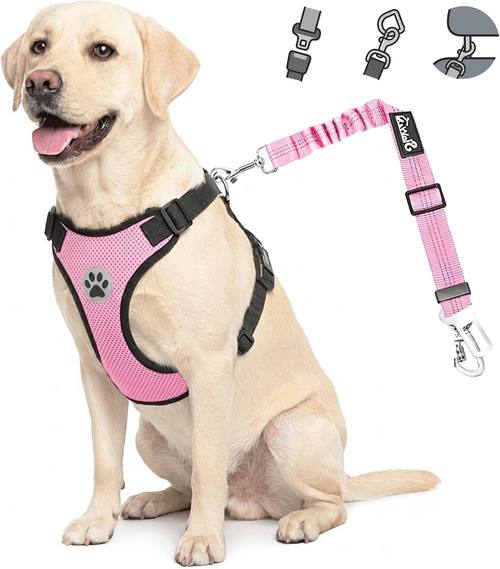
Our pick: Lukovee Dog Car Harness Seat Belt, Harness & Seatbelt with 2 in 1 Buckle
 Visit on Amazon →
The name tells you what the piece does. It is a harness and a seatbelt connection in one, with a 2 in 1 buckle that lets you either clip the included tether to the harness or buckle the harness directly into the seatbelt receiver, depending on your car. That flexibility matters more than it sounds, because seatbelt receivers sit at different heights and angles in every vehicle, and a tether that runs too long lets the dog stand up, turn around, and tangle itself in the back seat.
Check current Amazon price. Before I trust any car harness on a 70-pound dog, I look at three things: the metal on the attachment points, the webbing width across the chest, and whether the adjustment sliders hold their position after a few trips. A car harness that loosens itself by the second drive is a car harness that is not doing its job.
Flaws but not dealbreakers: A harness that buckles into the seatbelt receiver depends on where your receiver actually sits. In some back seats it is buried under the cushion, which makes the direct connection awkward. That is when you switch to the tether clipped to the harness loop. Also worth saying plainly: a fabric harness is not chew-proof, and a dog who destroys straps needs a crate, not a better harness.
This is for the owner who drives with a dog loose in the cabin right now and wants one less moving object in the car.
The support sling: what it is actually for
A sling is not a harness at all, which is where most owners get confused. It is a strap that goes under the belly, just in front of the hind legs, and takes part of the dog's weight while it walks. Done right, it buys a recovering dog a short, controlled walk to the yard or the car without the hind end collapsing halfway there.
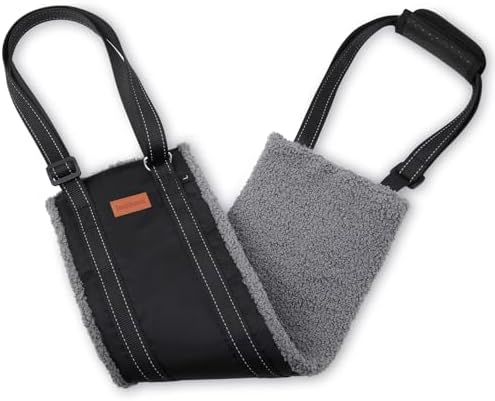
Our pick: LOOBANI Adjustable Dog Sling for Large Dogs Hind Leg Support ACL Recovery
 Visit on Amazon →
This one is built for the exact situation in the name: a large dog with hind leg weakness, an ACL injury, or post-surgical restrictions. The adjustable straps let you set the handle to your own hip height, so you are not hunched over dragging your dog sideways across the yard while your back takes the load instead. Check current Amazon price.
Here is the part people get wrong. The strap goes under the belly, in front of the hind legs, not around them. You hold the handle with a loose grip and let your dog carry its own weight until it actually needs help. The sling supports. It does not lift. If you are carrying the dog's entire back end off the ground, you have turned a walking aid into a stretcher, and that is a different tool for a different day.
Flaws but not dealbreakers: A sling is only as good as its position. Set it too far forward and it rides up into the ribcage, which most dogs hate. Too far back and it does nothing for the hind end. And no sling replaces the rehab plan your vet gave you. Short walks, on a schedule, with the sling as backup, is the entire point.
This is for the owner of a large dog who needs a hand for two to eight weeks and does not want to improvise with a towel.
The order of operations
This is the sequence I walk clients through. It takes about twenty minutes the first time.
Step one: fit the car harness at home, on the ground. Do not do this in a parking lot with the engine running. Put the harness on the floor, put the dog in it, and adjust the girth and the chest straps while the dog is standing still.
Step two: check the armpit clearance. Slide two fingers under the strap where it crosses behind the front legs. If you cannot fit them, the harness is too tight. If your whole hand slides through, it is too loose and the dog will back out of it.
Step three: set the girth with the two-finger rule. Same check at the widest part of the ribcage. A harness that is snug but not tight will not rub.
Step four: check the shoulder. The front of the harness should sit on the chest, not on the point of the shoulder. Straps that sit on the shoulder joint restrict the front leg's range of motion, and that is how you get a dog who short-strides.
Step five: decide tether or seatbelt receiver. Buckle the harness directly into the receiver if the geometry of your back seat allows it. If not, clip the tether to the harness and buckle the tether in. Either way, the dog should be able to sit and lie down, but not stand and pace.
Step six: practice in a parked car. Engine off, doors closed, treat for calm. Then a two-minute drive around the block. Do not make the first trip the one to the vet.
Step seven: fit the sling in the living room, not the driveway. Same principle. Put it on a standing dog, adjust the straps so the handle lands at your hip height, and take three steps.
Step eight: position the sling under the belly, in front of the hind legs. Support only as much as the dog needs. A dog that is using its own legs is a dog that is getting stronger.
Step nine: take the sling off before the car ride. A seated dog does not need hind-end support, and loose straps in a moving car are a hazard. Sling on for the walk out, sling off at the door, harness and seatbelt for the drive.
Caveats that matter more than the gear
Do not leave a harness on an unattended dog. Straps catch on crate bars, furniture, and fence posts. This is the single most common cause of harness injuries I see.
Check the straps weekly. Look for fraying at the attachment points, salt and mud packed into the webbing, and padding that has migrated. A car harness that lives in the car gets checked every time you wash the car.
A car harness is a restraint, not a guarantee. For a dog who panics, chews, or rides in a small car, a secured crate is the safer answer. I say that as someone who sells harness fittings for a living.
A sling is a mobility aid, not a treatment. If your dog is knuckling over, dragging a hind paw, or refusing to bear weight, that is a call to your veterinarian, not a gear upgrade.
Wash according to the label and air dry. Heat is what kills webbing and padding. A dryer is how a good harness becomes a stiff, rubbing strap.
What this setup does not do
It does not stop pulling. That is a front-clip walking harness and a training plan, and a car harness is not that. A dog that pulls on a back-clip harness is a sled dog setup, and no amount of padding fixes the physics.
It does not replace a crate for a dog who chews through straps or panics in the car. Some dogs are crate dogs, and that is a safety fact, not a training failure.
It does not replace your vet's rehab schedule. The sling gets your dog to the yard and back so the rehab can happen. It is not the rehab.
What this all costs
I am not going to print prices here, because they move and because the number that matters is cost per use, not cost per box. Both pieces sit in the budget tier of the gear I recommend to clients, and both get used every day for the weeks when a dog is recovering and every week after that if you keep riding with your dog.
Check current Amazon price on both before you order. Then do the math on how many car trips and how many short walks you will get out of them over two years. It is not a close call.
That is the job. Fit the harness on the ground, use the sling for the walk, and let your dog do the healing.