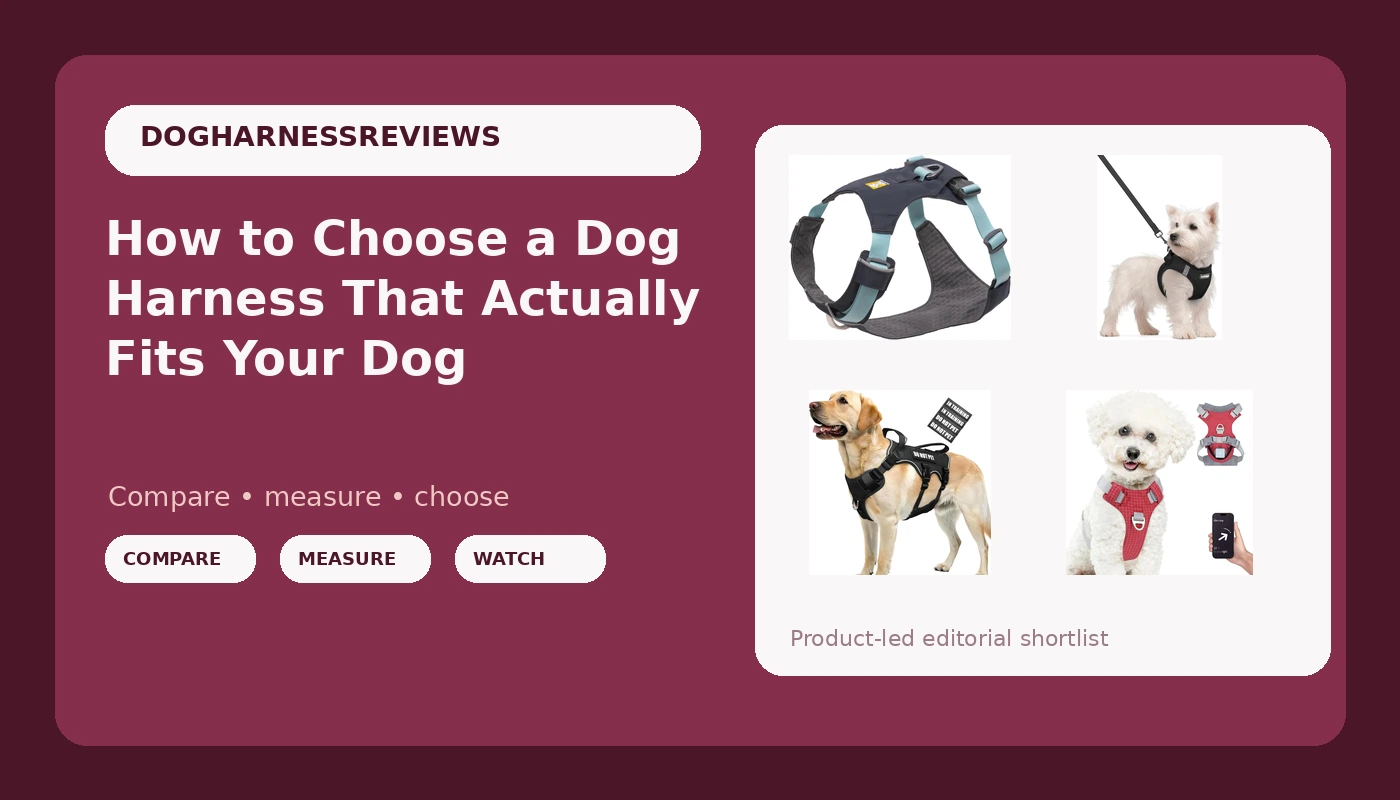
Most people buy a harness because their dog pulls, and then blame the harness when the pulling continues. In practice, the harness is doing exactly what its geometry allows. A back-clip vest hands a committed puller leverage. A front-clip no pull dog harness redirects that force sideways and buys you a half second to ask for a different behavior. A step-in puppy vest that fits a four-month-old will not fit the same dog at ten months. The four harnesses below cover four different jobs, and the right answer depends on your dog's body, age, and leash manners more than on the logo stitched onto the side.
Related: How to Measure Your Dog for a Harness in Three Minutes →
Quick answer
Match the harness to the job instead of the label. If your dog pulls on a flat collar or a back-clip vest, look for a design with a front leash attachment and metal hardware at the stress points. If you are raising a puppy, a step-in vest sold with a matching leash keeps your setup simple while your dog grows through sizes. If your dog has ever backed out of a harness, prioritize adjustability and a build meant to stay on. If you want one harness for ordinary neighborhood walks, a light vest with more than one leash clip gives you room to change how you handle the leash. None of these four is best in the abstract; each answers a specific problem.
Four useful options
| Model | Best fit | What stands out |
|---|---|---|
| Ruffwear, Hi & Light Dog Chest Harness, Basalt Gray, Small | Lightweight daily wear for small dogs | A low-weight chest harness in a small size and basalt gray colorway |
| rabbitgoo Dog Harness Small Sized and Leash Set, Step-in Puppy Pet Vest | Puppies and small dogs still growing | Step-in vest design that arrives with a matching leash |
| WINSEE Escape Proof Dog Harness with Double Handle+4 Removable Patches | Dogs that back out of standard vests | Two handles plus four removable patches for a custom look |
| TagME No Pull Dog Harness with 2 Leash Clips,Lightweight & Visible for All-Day Walking,No Choke Pet Vest Includes AirTag Holder for Puppy,Melon Red | Pullers whose owners want clip options | Two leash clips, an AirTag holder, and a melon red colorway that is easy to spot |
Lightweight pick: Ruffwear, Hi & Light Dog Chest Harness, Basalt Gray, Small
Weight matters more than most owners expect. Every strap and buckle sitting on the chest changes how freely the shoulder can extend, and a heavy harness on a small dog shows up as a shortened stride on the third mile. A harness sold as light and built as a chest piece is aimed at dogs that wear it for hours, on pavement and on trail. The trade-off is that lighter webbing and a single small size leave less room for adjustment, so measure both the girth and the chest depth before you commit. If your dog sits between sizes, sizing up on a light harness usually costs you a snug fit at the ribcage.
Puppy starter: rabbitgoo Dog Harness Small Sized and Leash Set, Step-in Puppy Pet Vest
Puppies are a moving target. Between four and twelve months a dog can gain more girth than any single harness will accommodate, which is why a step-in vest bundled with a leash makes sense as a first setup. Step-in designs also go on faster with a wiggly dog, and that matters at six in the morning in the rain. The trade-off is that step-in vests put the leash attachment over the shoulders, so they do very little to reduce pulling once your puppy finds its strength. Treat this as a training-phase harness rather than a lifetime solution, and plan to replace it when the chest strap stops sitting flat against the sternum.
Escape-proof option: WINSEE Escape Proof Dog Harness with Double Handle+4 Removable Patches
Backing out of a harness is a specific problem with a specific cause. A dog plants its front feet, drops a shoulder, and reverses, and a loose harness with a single belly strap comes off in that moment. A design sold as escape proof usually adds adjustment points and a snugger chest wrap, which is exactly what a Houdini dog needs. Two handles help as well, one over the shoulders for steadying a dog at the vet's door and one lower down for lifting a small dog over an obstacle. Removable patches are cosmetic, but they let you label a dog in training without buying a second harness.
No-pull walker: TagME No Pull Dog Harness with 2 Leash Clips,Lightweight & Visible for All-Day Walking,No Choke Pet Vest Includes AirTag Holder for Puppy,Melon Red
For a dog that pulls, clip placement is the entire conversation. A front attachment turns forward momentum into a sideways turn, which is why trainers reach for it with adolescent shepherds, huskies, and anything over forty pounds with an opinion. A second clip on the back lets you switch to a long line or a two-point setup when you are working on a cue, and it gives you a place to attach the leash for sniffy, low-pressure stretches of the walk. An AirTag holder is a small feature that saves a big afternoon if your dog ever slips a gate, and a bright colorway helps you spot your dog in tall grass. The trade-off is that a front clip only helps when the harness fits snugly across the chest. A loose front clip swings to the side and does nothing at all.
Prices and availability may change. Product images, names, and retailer links are matched to verified listings. No current price, rating, stock status, or measured result is stated here without current evidence.
Why clip placement changes how a harness feels on the leash
A leash attachment point is a lever. A clip on the back sits above the dog's center of gravity, roughly at the shoulders, so a dog that leans forward converts leash tension into forward drive. The harder you hold, the more the dog pulls. That is the physics behind a sled-dog setup, and it is why a back-clip harness on a strong puller can feel like it makes things worse rather than better.
A clip on the chest sits in front of the shoulders. When the leash goes taut, the dog's front assembly rotates toward you instead of away, so the dog has to break stride and reorient. That gives you a moment to mark and reward a check-in. It does not teach loose-leash walking by itself, and a determined dog can still drag you with a front clip if the harness is loose. What it does is make the behavior you want easier to reward and the behavior you do not want less rewarding.
Dual-clip designs exist because neither point is right for every moment of every walk. Front clip for the pulling-heavy stretch, back clip for sniffing and for long-line work where the dog needs full shoulder extension. Being able to change attachment points mid-walk is a training tool, not a gimmick.
Fit points that decide whether a harness stays put
Harnesses fail in predictable places, and most of those failures are sizing failures rather than manufacturing failures. Work through these five checks with the dog standing on a level floor.
- Measure the girth at the widest point of the ribcage, just behind the front legs, and write the number down.
- Check the chest strap. It should cross the sternum, not press on the throat and not sit under the armpit.
- Two fingers should slide under every strap, no more, and the straps should not shift when the dog shakes.
- Watch the shoulder. If a front strap crosses the point of the shoulder, the dog will shorten its stride to avoid the pressure.
- Recheck the fit after the first few walks, because webbing relaxes and coats thicken with the season.
Practical guidance for the first two weeks
- Introduce the harness with treats and no leash, then with the leash dragging, before you clip a lead onto anything.
- Attach the leash to the front clip for the first walks and keep sessions short enough that your dog can succeed.
- Pair every taut leash with a change of direction. A front clip creates the opening; your timing creates the habit.
- Never leave a harness on a dog in a crate. Straps catch on crate bars and on furniture.
- Wash webbing by hand and air dry it. Padding that traps fur and mats against the skin rubs dogs raw.
- Recheck the girth monthly on a growing dog, and after every bath on an adult dog with a thick coat.
Which option should you choose?
Choose the Ruffwear, Hi & Light Dog Chest Harness, Basalt Gray, Small when you have a small dog that needs low-weight gear for long, easy walks and trail time. Choose the rabbitgoo Dog Harness Small Sized and Leash Set, Step-in Puppy Pet Vest when you are outfitting a puppy or a small dog that is still growing and you want a complete walking setup in one purchase. Choose the WINSEE Escape Proof Dog Harness with Double Handle+4 Removable Patches when your dog has backed out of a harness before, or when you want handles for lifting and steadying. Choose the TagME No Pull Dog Harness with 2 Leash Clips,Lightweight & Visible for All-Day Walking,No Choke Pet Vest Includes AirTag Holder for Puppy,Melon Red when your dog pulls and you want the option to move between a front attachment and a back attachment during a single walk.
The descriptions above come from the manufacturers' product information, not from laboratory testing or from measurements taken for this article. Fit and behavior outcomes depend on your dog's build, coat, age, and training history, so treat the sizing chart and your own tape measure as the deciding evidence.
The bottom line
A harness is a training tool with a job description. Front-clip geometry helps with pulling, a step-in vest gets a puppy walking today, extra adjustment keeps an escape artist attached, and light webbing keeps a small dog comfortable on long walks. Pick the design that matches the problem in front of you, measure your dog instead of guessing, and plan on replacing a puppy harness before the first birthday. If your dog still pulls in a well-fitted front-clip harness, the next step is leash mechanics and reward timing, not another purchase.