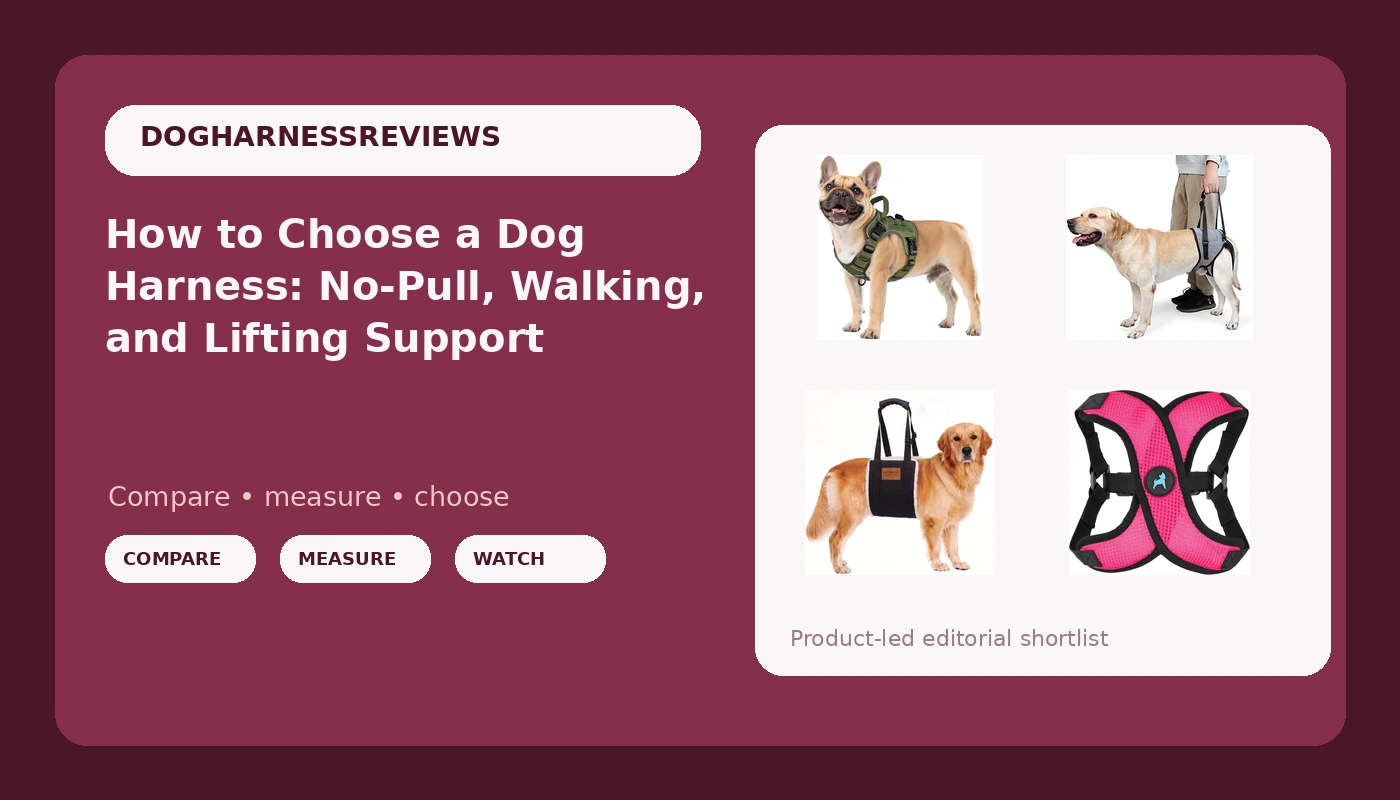
Most harness complaints trace back to a mismatch, not a defect. Someone buys a padded walking harness for a small dog that lunges at everything on the sidewalk, or a step-in harness for an aging shepherd who needs help getting up off the kitchen floor, and then decides the product was junk. This dog harness buying guide starts with the job the gear has to do, because that is the only place the choice makes sense. A harness is a handling and training tool. If it does not change how the dog moves or how much of the load you carry, it is decoration with straps. The options below cover two very different jobs: small-dog walking and no-pull work, and large-dog hind-leg support.
Related: How to Measure Your Dog for a Harness →
Quick answer
Match the harness to the job before you compare anything else. For a small dog that walks politely, a lightweight step-in walking harness is the simplest answer. For a small dog that pulls, a harness the maker positions as no-pull gives you a leash attachment that redirects forward motion instead of feeding into it. For a large dog with weak hind legs, the right product is a support sling that carries part of the rear-end weight, not a walking harness. Confirm sizing against the current listing before you buy, since size charts and hardware can change.
Four useful options
| Model | Best fit | What stands out |
|---|---|---|
| Gooby Comfort X Step-in Lite Harness, Flamingo Pink, Small | Small dogs on everyday walks | Step-in design with a choke-free build, listed in small in a Flamingo Pink colorway |
| WINGOIN Green Tactical Dog Harness for Small Dogs, No Pull | Small dogs that pull | Positioned by the maker as a no-pull harness, green tactical styling, sized for small dogs |
| Dotoner Dog Sling for Large Dogs, Hind Leg Support (L, Grey) | Large dogs needing rear-end support | Listed for elderly dogs with weak hind legs, injuries, arthritis, and ACL recovery, in size L |
| Adjustable Dog Lifting Harness, Large Dog Hind Leg Support Sling | Large dogs where a fixed size will not fit | Adjustable strapping on a hind-leg support sling |
Everyday walking: Gooby Comfort X Step-in Lite Harness, Flamingo Pink, Small
Step-in harnesses are the fastest thing to put on a wiggly small dog. There is no paw threading, no lifting a leg through a loop, and no wrestling match on the front step. The trade-off is adjustability. A step-in design typically has fewer straps to tune than a multi-point harness, so the fit window is narrower and your girth measurement matters more. Small dogs also have shallow chests, which means a harness built for a medium dog tends to sit too low and drift toward the armpit, where it rubs. Check the two-finger rule at the chest strap and again behind the front legs. The choke-free construction is the part worth caring about here, because a small dog's trachea does not tolerate pressure the way a large dog's does. A light colorway will also show dirt sooner than a dark one, which matters if you walk in a wet climate.
No-pull option: WINGOIN Green Tactical Dog Harness for Small Dogs, No Pull
No-pull describes a mechanical idea, not a promise. Two details on the listing decide whether the idea actually holds: where the leash attaches, and what that attachment point is made of. A front attachment redirects the dog's forward momentum sideways, so the dog ends up angled toward you rather than leaning into the leash. A back attachment on a dog that pulls hands the dog a lever, which is why a back-clip harness on a committed puller turns a walk into a sled run. Before you buy, look at the product photos and confirm the attachment layout and the hardware material. Then treat the harness as a training aid rather than a fix. If the dog has never been taught to yield to leash pressure, a no-pull harness mostly makes the pulling less damaging to the throat. That is worth something. It is not the same as teaching the dog anything.
Rehab support: Dotoner Dog Sling for Large Dogs, Hind Leg Support (L, Grey)
This is a different category of product, and mixing it up with a walking harness is a common and expensive mistake. A support sling carries part of the rear-end weight so the dog can take steps that it cannot take unaided: out to the yard, up a shallow ramp, through a vet visit. It is a handling aid. It is not a leash-walking harness, and using it as one puts your back in a bad position and the dog in an unstable one. The listing names the situations this sling is built around, including weak hind legs, injuries, arthritis, and ACL recovery, which tells you the intended use is short, assisted movement rather than a trip around the block. Fit matters as much here as anywhere: the support strap needs to sit under the belly at the right spot for your dog's shape, and a size that is too large will slide forward and lose the lift. Post-surgical use should follow whatever your veterinarian has told you about weight bearing.
Adjustable support: Adjustable Dog Lifting Harness, Large Dog Hind Leg Support Sling
Adjustability is the reason to consider this one over a fixed-size sling. If your dog falls between two sizes, or if the dog's weight and shape are changing during recovery, straps you can lengthen and shorten do more work than a chart you guessed at. The same rules apply as with the sling above: short assisted sessions, a strap position that actually carries the load, and a rehab plan that comes from your vet rather than from a product page. A sling that is too loose will slide and stop helping. One that is too tight will dig into the belly on every step. Test the position with the dog standing still before you ask for movement, then adjust.
Prices and availability may change. Product images, names, and retailer links are matched to verified listings. No current price, rating, stock status, or measured result is stated here without current evidence.
Front clip versus back clip: how no-pull actually works
A dog pulls because forward motion is rewarding. Every step the dog takes while the leash is tight teaches the same lesson: lean, and the world moves. A no-pull harness does not remove that reward, it changes the geometry so the reward is harder to collect.
With a back attachment, the leash runs from the middle of the dog's back. When the dog leans forward, the pressure lands along the top of the body, roughly in line with the direction of travel. That is a comfortable position for a dog to pull from, and it is why a back-clip harness on a strong puller can make the problem worse rather than better.
With a front attachment, the leash runs from the chest. When the dog leans forward, the pressure rotates the body sideways. The dog has to choose between pulling and staying pointed at the thing it wants. That is the whole trick, and it is mechanical, not magical. It works better on some dogs than others, and it works far better when it is paired with actual training: rewarding the dog for staying near you, and stopping when the leash goes tight.
Hardware matters more than most buyers expect. A front attachment point takes the full force of a lunge at an angle, and plastic D-rings are the first thing to deform under that load. On any dog with real pulling power, check what the attachment ring is made of before you trust it. Buckle material matters for the same reason. A plastic side-release buckle that holds fine on a calm walk can fail under a sudden pop, and the failure is not gradual.
Strap width is the last piece of the mechanics. Wider webbing spreads pressure over more surface, which helps on a large dog and is unnecessary weight on a small one. On a small dog, a strap that is too wide for the chest just sits crooked.
The fit points that decide whether a harness works
Fit is most of the outcome. A well-built harness on the wrong dog rubs, shifts, and teaches the dog to back out of it. Four points do most of the work.
The chest strap should cross the sternum, not the throat. If it rides up onto the neck, you have recreated a collar with extra steps, and you have lost the trachea protection that is the main reason to use a harness on a small dog.
The girth strap sits behind the front legs, across the ribcage at its widest point. This is the measurement that decides your size. It should be snug enough that you cannot pull the harness sideways over the shoulders, and loose enough that you can slide two fingers under the strap without forcing them.
The armpit clearance is where cheap harnesses fail. If the strap edge sits in the armpit, it will rub when the dog trots, and the rub will get worse as the strap collects fur and grit. There should be a gap, and the gap should stay after ten minutes of walking.
The attachment point should sit where you expect it when the leash goes tight. On a front-clip harness, that means the ring stays on the chest when the dog turns. If it slides around to the side under load, the harness is too loose.
Here is the sequence I would walk a client through:
- Measure the girth behind the front legs at the widest point, and measure chest depth from the sternum to the top of the shoulders. Write both numbers down.
- Compare those numbers to the size chart on the current listing, not to a chart you remember from last year. If you land between sizes, check whether the smaller size has enough strap adjustment to reach your measurement.
- Put the harness on and apply the two-finger rule at every strap, one at a time. Adjust the chest strap before the girth strap.
- Watch the dog move: a walk, a trot, a sit, and a set of stairs if you have them. Look for the harness shifting sideways or the chest strap climbing toward the throat.
- Check for rub marks after ten minutes, and again after a week. A red line under the armpit means the fit is wrong, not that the dog needs to get used to it.
Practical guidance before you order
- Measure your dog rather than guessing from breed or weight. Weight tells you almost nothing about girth.
- Decide the job first: everyday walking, no-pull work, or hind-leg support. The three do not overlap.
- On a small dog, prioritize a light build and a chest strap that stays off the throat.
- On a pulling dog, confirm where the leash attaches and what that ring is made of before you buy.
- For a support sling, treat it as short-session equipment and follow your vet's guidance on how much weight the dog should bear.
- Recheck the fit after the first week. Straps stretch, fur compresses, and a harness that fit on day one can sit differently by day seven.
Which option should you choose?
Choose the Gooby Comfort X Step-in Lite Harness, Flamingo Pink, Small when you have a small dog that already walks without much pulling and you want something light and quick to put on. Choose the WINGOIN Green Tactical Dog Harness for Small Dogs, No Pull Dog Harness when your small dog pulls and you want a harness the maker positions as a no-pull design, alongside training rather than instead of it. Choose the Dotoner Dog Sling for Large Dogs, Hind Leg Support (L, Grey) when you have a large dog with weak hind legs, an injury, arthritis, or ACL recovery, and the listed size L matches your dog's measurements. Choose the Adjustable Dog Lifting Harness, Large Dog Hind Leg Support Sling when you need the same rear-end support but want adjustability, either because your dog falls between sizes or because its shape is changing during recovery.
None of these descriptions substitute for checking the current listing. Size charts, hardware, and colorways change, and a harness that fits one dog of a given girth may sit differently on another with a deeper chest or a thicker coat. If a product arrives and the chest strap will not stay off the throat, the answer is to return it, not to tighten it and hope.
The bottom line
Two categories of product, two sets of rules. Walking harnesses for small dogs are about a light build, a chest strap that stays off the throat, and a girth measurement you took yourself. No-pull designs are about attachment geometry and hardware, and they work as training aids, not as replacements for training. Hind-leg support slings are handling equipment for assisted movement, and they belong in a rehab plan rather than on a walk. Get the fit right at the chest, the girth, and the armpit, check the hardware before you trust it with a lunging dog, and recheck everything after a week. That is what separates a harness that helps from one that ends up in a drawer.