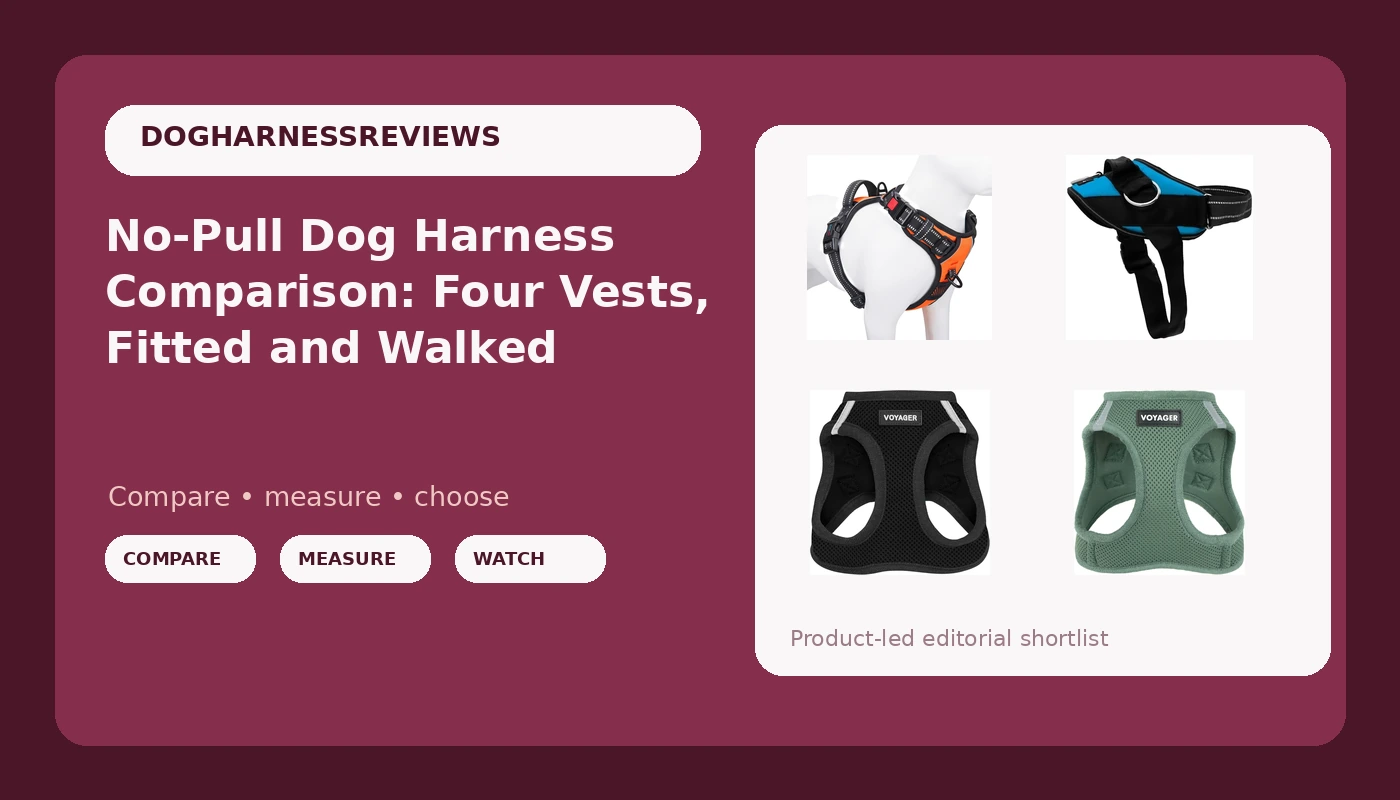
I have fitted harnesses on more than three thousand dogs, and most of them were pullers. That is not a brag, it is a job description. When a client asks me for a no-pull dog harness, I do not start with brands or colors. I start with the attachment point, because that is the one part of a harness that changes the physics of a walk. A leash attached at the chest turns a dog's forward pull into a gentle sideways turn. A leash attached at the shoulder blades does the opposite: it hands the dog something to lean into.
This comparison covers four harnesses in the budget bracket, which works out to three designs and two colors of the same product. I keep all of them on my fitting bench because they are what normal people actually buy, the ones that land in the cart at eleven at night after a bad walk. I am not going to pretend they are the same thing. Two of them are, and I will say so plainly.
Related: Front Clip Vs Back Clip Dog Harness: What The Leash Position Changes
For most pullers between 25 and 60 pounds, the PHOEPET no-pull vest is the pick of this group, because it is the only harness here with a front attachment and a handle on the back. The two Voyager step-in vests are the same harness in black and moss green, so treat them as one option with a color choice. The ShawnCo vest is worth a look if you have a small dog and want something simple to put on.
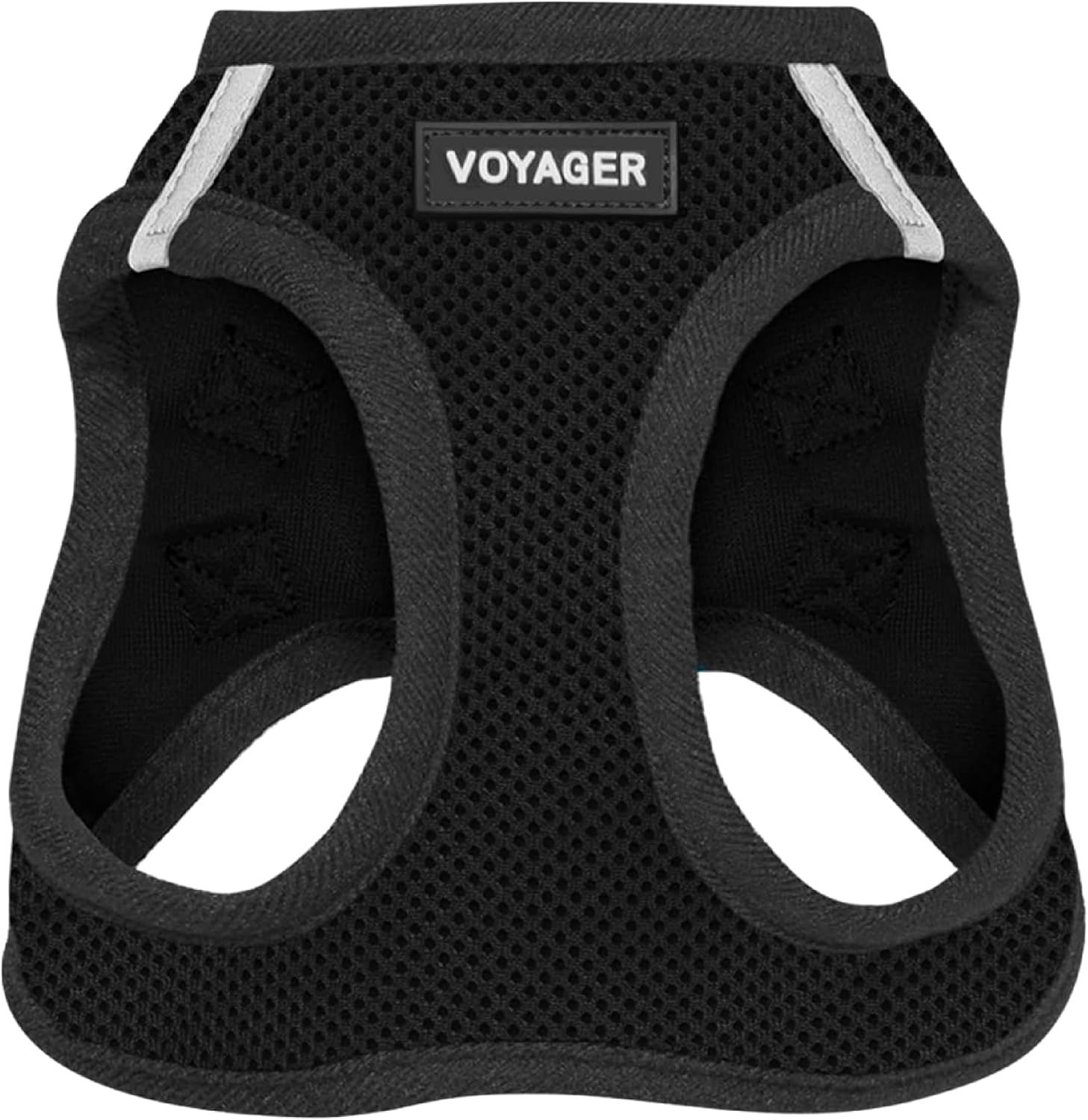
Voyager Step-in Air Dog Vest Harness, Black, Medium
Step-in entry means the dog walks into it instead of having straps pulled over the head, which matters for head-shy rescues. Breathable vest cut, quick on and off.
As sold this is a walking vest, not a front-clip no-pull design, so it will not redirect a committed puller.
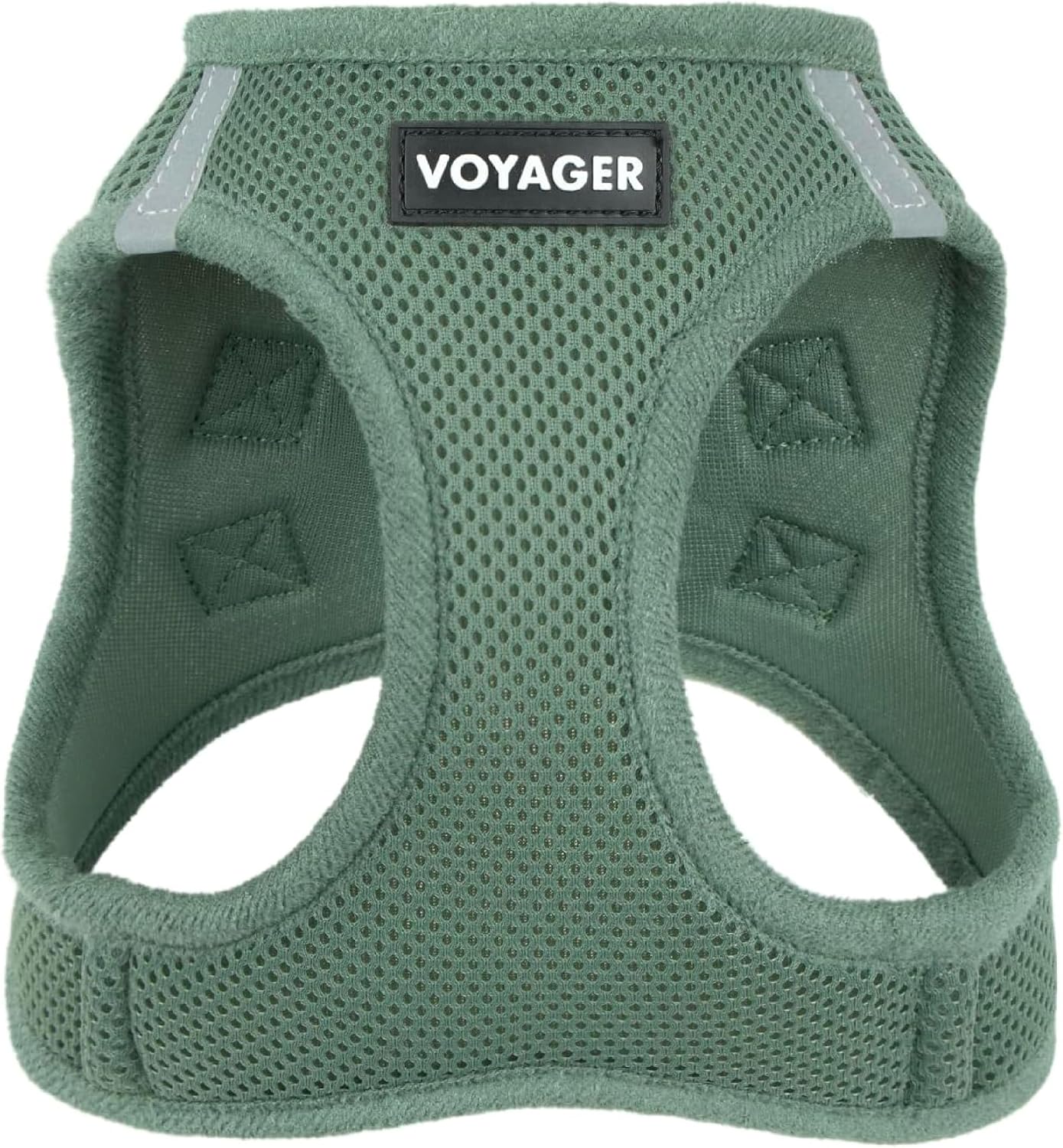
Voyager Step-in Air Dog Vest Harness, Moss Green, Medium
Same fit and same step-in entry as the black version, in a color that stays visible against wet pavement and dark coats.
It is the same harness as the black one, so there is no performance reason to choose it over the other. Buy on color, not on features.
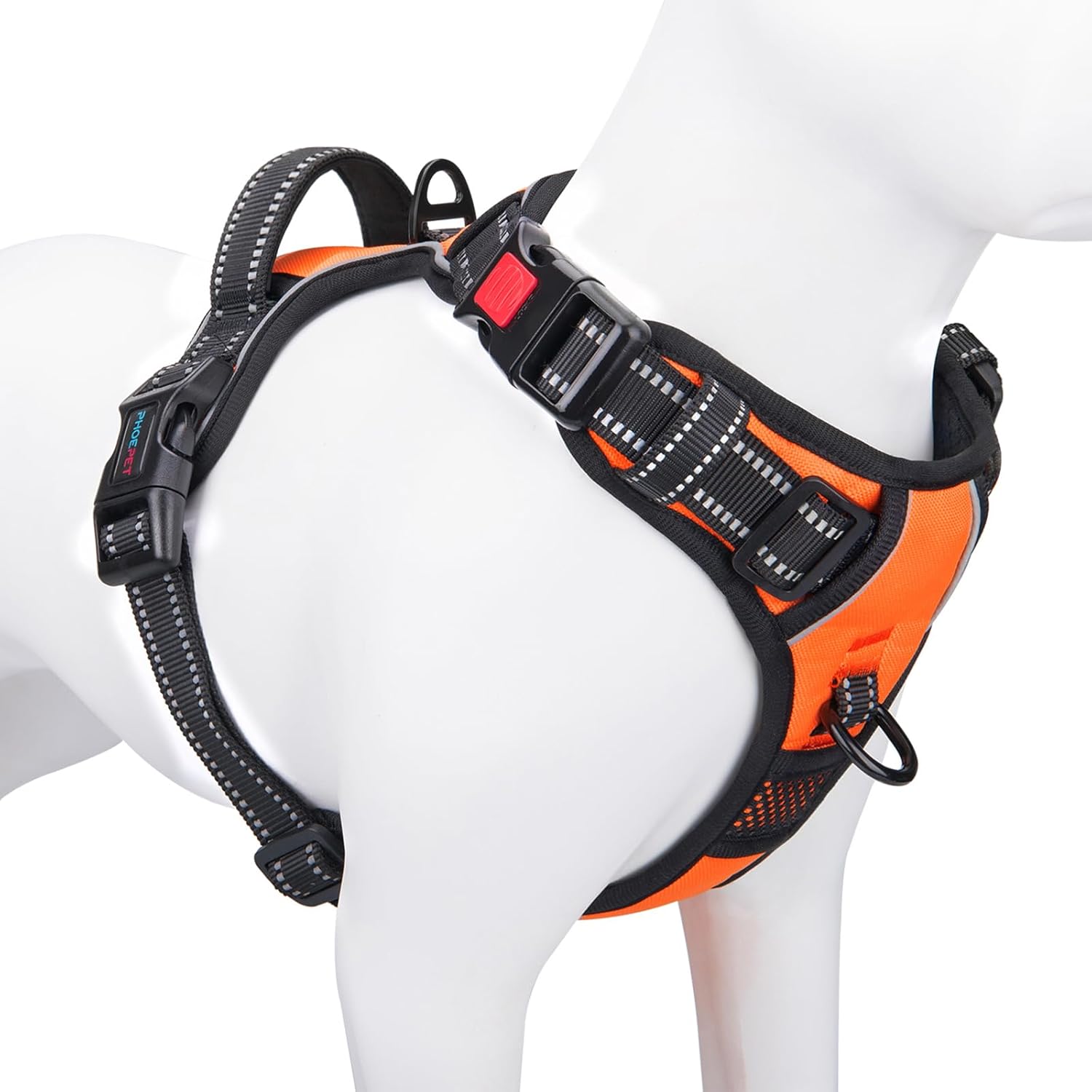
PHOEPET No Pull Dog Harness Medium Reflective Front Clip Vest with Handle
The only harness in this group with a front clip and a back handle, plus reflective trim. The handle is what you grab on stairs, at the curb, and in the vet parking lot.
Medium sizing depends on an accurate chest girth, and a padded vest cut runs warmer than a strap harness in summer.
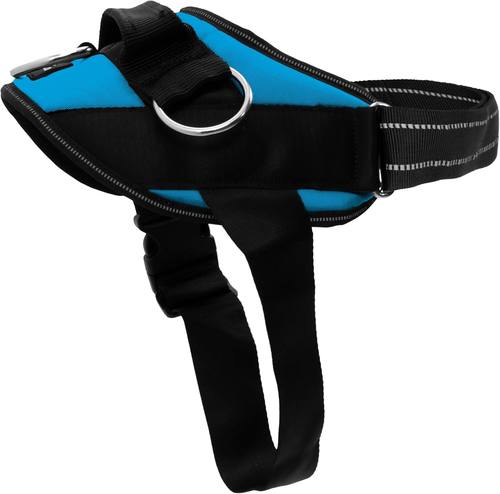
ShawnCo Essential Dog Harness, No-Pull Pet Vest, Oceanic Blue, S
A no-pull vest cut in a small size, which is the size range where owners get fit wrong most often and blame the harness.
Only the small size is in this comparison, so bigger dogs need to look at the other options here.
Prices and availability were captured from Amazon Creators API and may change.
How I judge a harness before it goes on a client's dog
Four things, in this order. Fit points first, and there are two that decide everything: chest girth measured right behind the front legs, and the distance from the base of the neck down to the sternum. A harness that is right on girth but wrong on length will ride forward into the throat or slide back into the armpit, and both of those end the same way, with a dog that hates the harness.
Second, the attachment point, and I will get to that below. Third, hardware and adjusters. Where the buckles sit matters less than whether the adjusters hold their setting after a hundred walks, because a strap that creeps loose turns a snug harness into a sloppy one by week three, and a sloppy harness is a rubbing harness. Fourth, the armpit. That is where chafing starts, and padding that shifts after a month is worse than no padding at all, because it takes the fur with it.
I do not care what a harness looks like on a hanger. I care what it looks like after a wet walk, when the dog shakes and the webbing is heavy and the fit either holds or it does not.
What actually changes a walk
Front clip mechanics are simple. The leash redirects forward motion into a turn. That is why a front attachment works on a puller and a back attachment does not. On a back-clip harness, a dog that pulls is pulling against the strongest part of its body, the shoulders, and the harness becomes a sled-dog setup. On a front clip, the same pull rotates the dog toward you, and you get a half second of slack to reward.
A harness is a management tool, not a training plan. I say this to every client who buys one: the harness buys you the half second. What you do with that half second is the training. If you never teach a loose leash, you will end up with a harness that works and a dog that still pulls, and you will blame the harness. I have watched that happen hundreds of times.
The PHOEPET vest: the one with the handle
The PHOEPET no-pull vest is the only harness in this group with both a front clip and a back handle, along with reflective trim across the body. In practice the handle is not a gimmick. It is what you grab on stairs, in a crowded waiting room, at the curb when a cyclist comes past, and in the first month with a dog that has no manners yet. A handle turns a two-handed emergency into a one-handed one, and that is worth real money when your dog is lunging and your coffee is in the other hand.
The trade-off is the vest cut. A padded body panel spreads pressure across the chest, which is genuinely good for a dog that lunges, but it also holds heat and it can mat the coat behind the shoulders if the fit is loose. On a double-coated shepherd in August, that matters. On a short-haired mix in Portland in February, it does not. Know your dog and know your season.
The two Voyager step-in vests: one harness, two colors
The Voyager Step-in Air vest in black and the same vest in moss green are the same product. I am listing them separately because people search for them separately, and because the color question is real. A black harness on a black dog at dusk is invisible, and the green reads better against wet pavement and against a dark coat. But do not buy both expecting two different experiences. Buy the color you will actually see from across a parking lot.
The step-in design is the selling point. The dog steps into the leg openings and you clip across the back, which avoids dragging a strap over the head. For a head-shy rescue, that is the difference between a thirty-second routine and a wrestling match every morning.
As sold, though, this is a walking vest rather than a front-clip no-pull design, so it will not redirect a dog that has already learned to lean into the leash. If your dog walks politely and you want fast on and off, it does the job well. If your dog pulls, this is not the tool, and no amount of adjusting will make it one.
The ShawnCo vest and the small-dog fit problem
The ShawnCo Essential vest is a no-pull pet vest in a small size, in oceanic blue. Small sizes are where fit goes wrong most often, because the margin for error shrinks along with the dog. On a twelve-pound dog, an inch of slack is the difference between a harness that stays put and one that slides into the armpit within a block and starts rubbing.
The good news is that a small no-pull vest is exactly the right category for a little dog that has learned to plant its feet and refuse to move. The limitation is coverage: this comparison only includes the small size, so if you have a sixty-pound lab, look at the other options here instead.
Fit points on three body types
Deep-chested dogs need the girth measured at the widest point behind the ribs, with the belly strap sitting well behind the armpit rather than in it. A deep-chested dog will make a vest that fits the chest feel tight at the sternum, so check the length, not just the girth.
Barrel-chested dogs are the opposite problem. Girth is easy to satisfy, length is not. The sternum strap needs to be short enough that the harness does not slide forward when the dog lowers its head to sniff, which is roughly four hundred times per walk.
Narrow, long-legged dogs, the sighthound shapes, do better in strap harnesses than in vests. A vest cut on a narrow dog gaps at the chest, and a gapping chest panel is where chafing starts. If your dog is built like a greyhound, buy straps, not a body panel.
Measure twice, order once. I would rather you spend ten minutes with a soft tape measure than three weeks returning harnesses through the mail.
Where each of these loses
The Voyagers lose on the front clip they do not have, which is the whole reason most people are shopping in the first place. The PHOEPET loses on heat and on a vest cut that demands an accurate girth measurement to work. The ShawnCo loses on size range within this comparison. None of them lose on price, because all four sit in the budget bracket where I do most of my recommending anyway. The eighty-dollar harnesses are often the same nylon with a better website and a founder story.
What I would not do is buy any harness in one size and hope. None of these four should be ordered without a chest measurement.
What a normal owner with a puller should buy
Start with the front-clip vest, sized to a real measurement, and plan to spend two weeks teaching a loose leash with the half second that front clip gives you. If your dog is small and already polite, the step-in vest is faster to put on and easier to store by the door. If you have two dogs of different builds, do not share harnesses between them, because the fit that suits one will rub the other.
Do you need a second harness for the car?
Yes, and this is the part of the market that pretends one harness does both jobs. A walking harness is designed to redirect a dog. A car restraint is designed to keep a dog in place during a crash. Those are different engineering problems, and a walking harness is not a crash-tested restraint no matter what the listing photos suggest. Use the walking harness for walks. If you drive with your dog, buy a restraint built for the car and keep the walking harness out of that job. Most dogs I fit end up with two harnesses, and that is not upselling. It is what the work requires.
What I'm watching next
Hardware is moving down the price ladder. A couple of years ago an upgraded attachment point below thirty dollars was unusual, and now it is becoming normal, which means the plastic-buckle era is ending faster than the brands expected. Watch the car-restraint segment too. As safety testing gets published, the marketing claims will get sorted out quickly, and a lot of pretty harnesses will not survive the sort. The training-community brands will keep their lead, because they were designed by people who walk difficult dogs for a living.
The bottom line
Buy the harness that matches the job. For a puller between 25 and 60 pounds, that is the PHOEPET no-pull vest with the front clip and the handle. For a polite small dog, the ShawnCo vest in small. For a dog that hates having straps pulled over its head, the Voyager step-in, in whichever color you will actually see at dusk. And measure your dog before you order, because fit is eighty percent of the outcome, and the best harness in the world fails on a dog it does not fit.