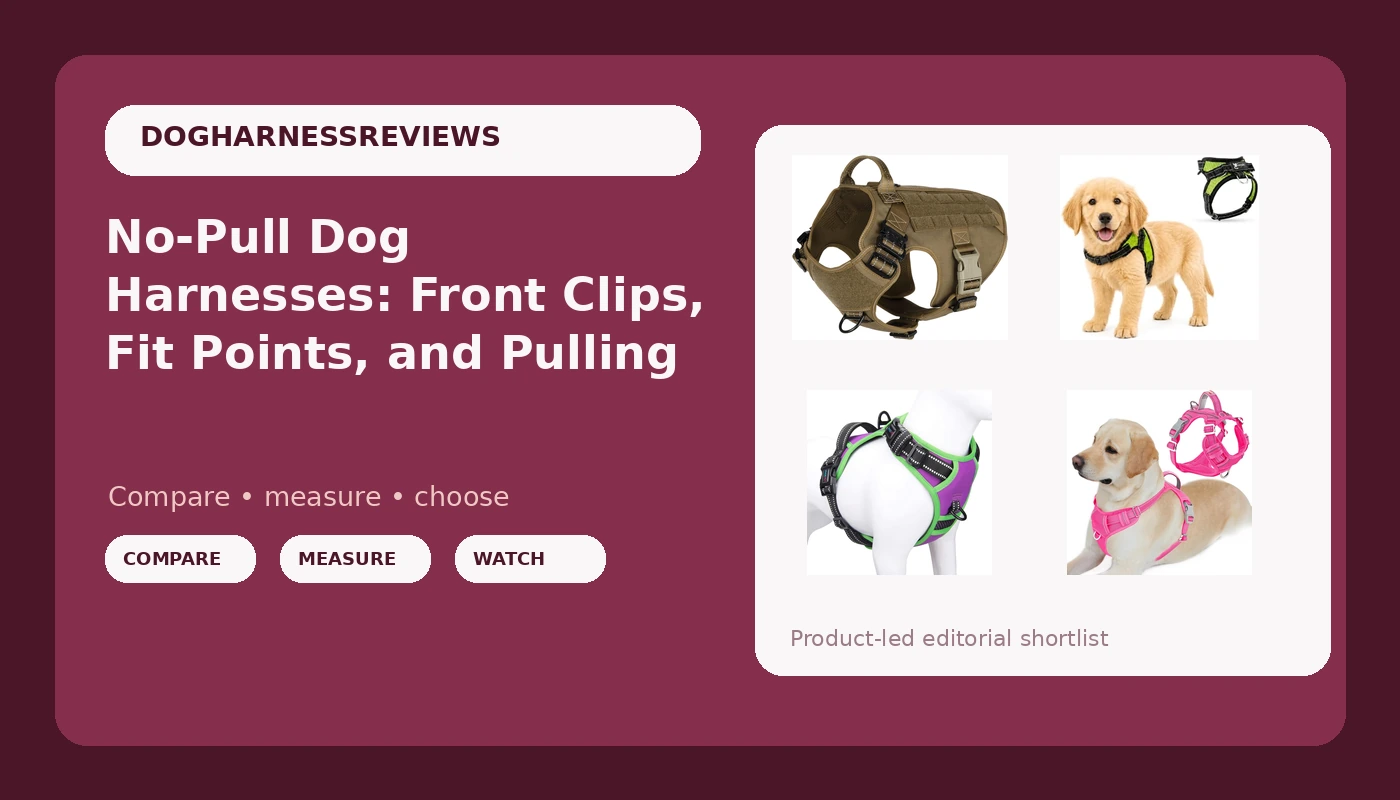
A no-pull dog harness is the most requested piece of gear in my training business, and it is also the one people get wrong most often. The problem is not that good harnesses are hard to find. It is that the listings look identical: same black nylon, same reflective piping, same promise on the box. What separates them is where the leash attaches, how the straps are cut around the shoulder, and whether the size range covers a real dog's chest girth. Get those three things right and an inexpensive harness outperforms a premium one. Get them wrong and the dog keeps pulling, the owner blames the product, and the harness ends up in a drawer. This explainer covers how no-pull geometry works, which fit points to measure, and four current listings that map to the most common situations.
Related: How to Fit a Dog Harness So It Stops Rubbing →
Quick answer
A no-pull dog harness reduces pulling by giving you a second steering point, and that only happens when the leash clips to the chest rather than the back. Look for a front attachment, straps that clear the shoulder joint, and a size chart you can match to a measured girth. The four listings below cover the common cases: a large-dog tactical vest, an easy-on mesh harness for smaller and softer-bodied dogs, a low-cost front-clip vest for medium dogs, and a heavy-duty large-dog option with an ID pocket built in.
Four useful options
| Model | Best fit | What stands out |
|---|---|---|
| ICEFANG Tactical Dog Harness for Large Dogs,Reflective No Pull Dog Vest | Large dogs that pull hard on walks | Tactical vest cut for large dogs with reflective trim and a no-pull design |
| No Pull Reflective Adjustable Dog Harness with Handle- Comfortable Soft All Weather Mesh, Easy On Puppy Harness for Small Medium and Large Dogs (Green) Small | Small dogs, puppies, and owners who want soft mesh | All-weather mesh construction, adjustable straps, a built-in handle, and an easy-on shape, listed in green in size Small |
| PHOEPET No Pull Dog Harness Medium Reflective Front Clip Vest with Handle | Medium dogs and everyday walking on a tight budget | Reflective front-clip vest with a handle for close control |
| BARKBAY Dog Harness No Pull with ID Tag Pocket - Heavy Duty, Reflective, Easy Control for Large Dogs(Pink,L) | Large dogs, and owners who want identification storage on the harness | Heavy-duty build with a dedicated ID tag pocket, listed in pink in size L |
The large-dog workhorse: ICEFANG Tactical Dog Harness for Large Dogs,Reflective No Pull Dog Vest
The trade-off with a vest-style harness on a big dog is coverage versus heat. More surface area means better load distribution when the dog surges, which matters on a seventy-pound dog, but it also means more material against the coat. In a Portland summer or on a long hike, that is worth thinking about before you buy. The other consideration is that a vest shape needs to sit correctly behind the shoulder blades; if it drifts forward, the front leg loses range of motion and the dog shortens its stride. Measure girth first, then check the size range on the listing against that number.
The easy-on option: No Pull Reflective Adjustable Dog Harness with Handle- Comfortable Soft All Weather Mesh, Easy On Puppy Harness for Small Medium and Large Dogs (Green) Small
Mesh is the right call for a dog that is still growing, because it is light and rarely causes the chafing that stiff webbing can on a puppy's coat. The trade-off is durability under hard load. A soft mesh harness is a walking harness for a dog that is not yet a serious puller. If you have a ninety-pound dog that lunges at squirrels, mesh is the wrong material choice regardless of how well it fits. Note also that this listing spans small through large sizes, so the size you select matters more than the product line itself. A size Small on a medium dog is a common and avoidable mistake.
The budget front-clip vest: PHOEPET No Pull Dog Harness Medium Reflective Front Clip Vest with Handle
Front clip is the phrase to look for if your dog pulls, and this listing puts it at the lower end of the price range. The caveat is that a front-clip harness changes the direction of force, not the dog's motivation. You still have to teach the dog what to do when the leash goes tight. Used well, a front attachment turns a hard pull into a gentle rotation toward you, which is a far easier thing to reward and shape. Used as a substitute for training, it becomes a harness the dog learns to lean into. I recommend pairing any front-clip harness with a few weeks of loose-leash work, and keeping the back ring free for a tag or a second leash rather than the main attachment.
The large-dog option with ID storage: BARKBAY Dog Harness No Pull with ID Tag Pocket - Heavy Duty, Reflective, Easy Control for Large Dogs(Pink,L)
An ID pocket sounds like a small thing until you have watched a tag ring wear through a strap or listened to metal tags clack against a buckle for an hour. It also keeps identification on the dog when the collar comes off for a bath or a vet visit. The limitation here is sizing and color: this listing is specified as large and pink, so it does not cover every dog or every taste. Check the size chart carefully, because a heavy-duty harness that is one size too small will rub at the armpits and one size too large will slide sideways on a walk.
Prices and availability may change. Product images, names, and retailer links are matched to verified listings. No current price, rating, stock status, or measured result is stated here without current evidence.
How a front clip actually changes pulling
A dog pulling on a back-clip harness is doing what the equipment allows. The leash runs over the shoulders, the dog leans forward, and the geometry rewards the lean. Opposition reflex does the rest: pressure on the chest and shoulders makes a dog push into it. That is why a back-clip harness on a strong dog feels like a sled dog setup. You are not holding the dog back so much as giving it a better anchor point.
Move the attachment to the chest and the physics change. A leash pulling from the front turns the dog's body toward the handler instead of away. The dog can still move forward, but every tight moment redirects it slightly sideways, which breaks the straight-line pull. That is the whole mechanism, and it is why front clips are the standard recommendation for pullers in the training world.
Two practical notes. First, a front clip works best with a fixed-length leash, not a retractable one, because a retractable leash keeps constant tension on the attachment and the dog learns to lean against it. Second, a front-clip harness is a management tool and a training aid at the same time. It buys you the seconds you need to mark and reward a loose leash. Without that reward, the dog simply finds the angle where pulling still works.
The fit points that decide everything
Fit is where most harness purchases fail, and it is almost always a measurement problem rather than a product problem. Three numbers matter: chest girth at the widest point behind the front legs, the distance from the base of the neck to the top of the shoulder, and the neck opening. If a harness is tight at the shoulder, the dog's stride shortens. If it is loose at the chest, the whole thing rotates under load. Both problems look like the dog dislikes the harness when the real issue is the size.
Then there is the strap layout. Straps that cross the shoulder joint restrict movement. Straps that sit too far back, near the armpit, rub. A well-cut harness has a clear gap behind the shoulder and padding that stays where it is placed rather than migrating under the front leg after twenty minutes of walking. When you check a harness on the dog, look for two fingers of slack at the chest and no gap that lets you lift the harness away from the back.
- Measure chest girth at the widest point behind the front legs with a soft tape, and write the number down.
- Measure from the base of the neck to the top of the shoulder to check the chest panel length.
- Compare both numbers to the listing's size chart rather than to the size your last dog wore.
- Fit the harness at the loosest adjustment, then tighten until you have two fingers of slack and no rotation.
- Walk the dog for ten minutes and re-check the strap positions, then adjust once more before a longer walk.
Practical guidance before you order
- Choose a front attachment for a dog that pulls; use a back attachment only for a dog that already walks politely.
- Match the harness class to the dog's strength. Mesh suits puppies and small dogs, heavy-duty webbing suits large dogs that surge.
- Expect to own two harnesses if your dog rides in the car, because a walking harness is not a crash-tested restraint.
- Wash a harness before you judge the fit, since some padding shifts after the first wash and reveals rub points.
- Re-measure a growing puppy every three weeks, because a harness that fit at twelve weeks will not fit at six months.
Which option should you choose?
Choose the ICEFANG Tactical Dog Harness for Large Dogs,Reflective No Pull Dog Vest when you have a large dog that pulls and you want a full-coverage vest with reflective trim. Choose the No Pull Reflective Adjustable Dog Harness with Handle- Comfortable Soft All Weather Mesh, Easy On Puppy Harness for Small Medium and Large Dogs (Green) Small when you have a puppy or a small dog and you want soft mesh and an easy-on shape. Choose the PHOEPET No Pull Dog Harness Medium Reflective Front Clip Vest with Handle when you have a medium dog, you want a front clip, and you want to stay at the low end of the price range. Choose the BARKBAY Dog Harness No Pull with ID Tag Pocket - Heavy Duty, Reflective, Easy Control for Large Dogs(Pink,L) when you have a large dog and you want heavy-duty construction with a place to keep identification.
The limitation worth repeating: I am describing the features each listing states, not measuring them on your dog. Sizing varies between brands, and a size that fits one manufacturer's large will not fit another's. No harness replaces loose-leash training, and none of these listings should be treated as a crash-tested car restraint.
The bottom line
A no-pull dog harness is a steering tool, and it earns its price when the leash attaches at the chest, the straps clear the shoulder, and the size matches a girth you measured rather than guessed. Of the four listings here, the ICEFANG and BARKBAY options target large dogs, the PHOEPET is the front-clip budget pick for medium dogs, and the mesh harness is the gentle starting point for puppies and small dogs. Measure first, pick the attachment point second, and plan on a few weeks of training alongside the gear. That combination is what actually stops the pulling.