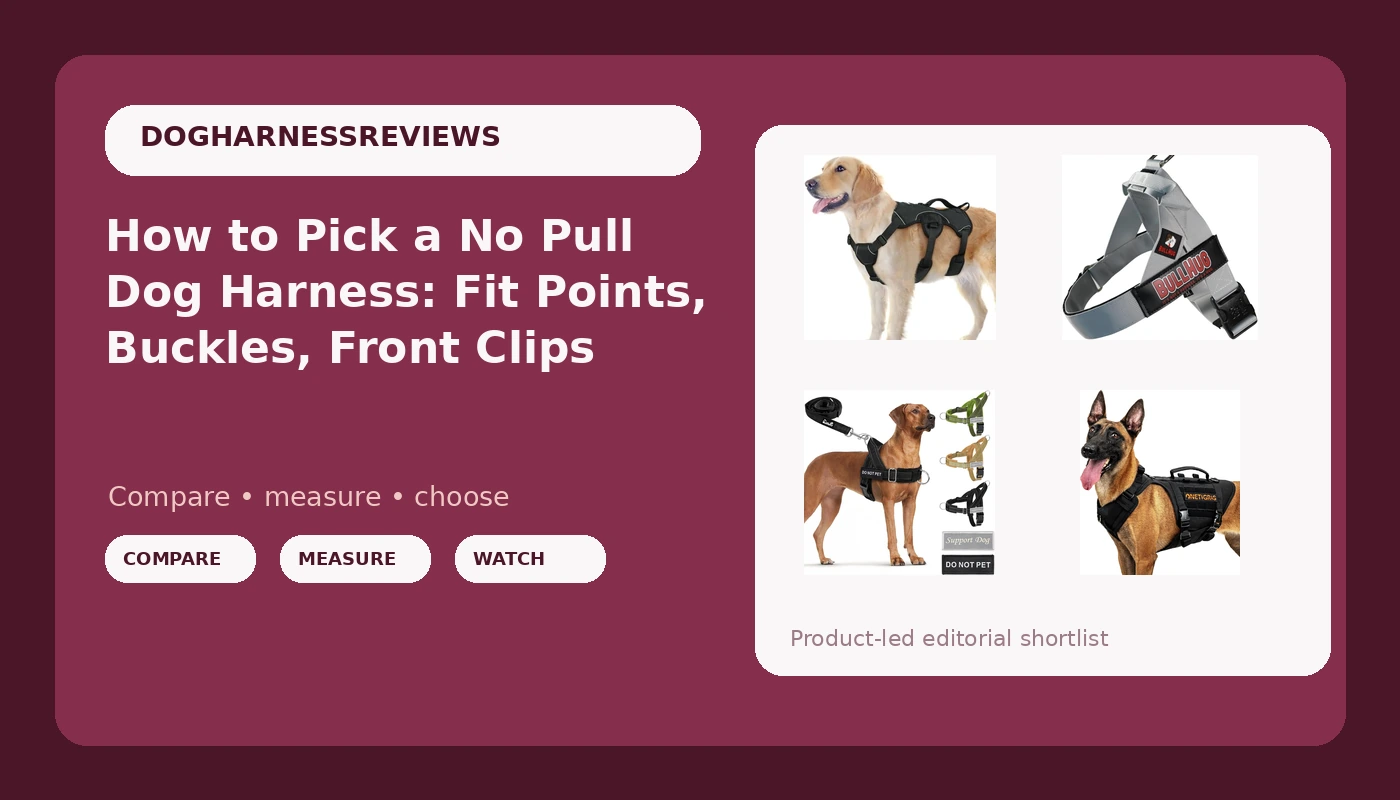
A no pull dog harness is the most useful piece of walking gear most owners will ever buy, and also the one most likely to be bought wrong. The category splits along three fault lines: where the leash attaches, how the straps spread pressure across the ribcage, and whether the buckles and rings hold when a dog hits the end of the leash at speed. Get all three right and a harness turns a hard pull into a manageable redirect. Get one wrong and you own a strap that chafes, slips, or gives way.
The four harnesses below are not variations on one design. They solve different problems for different body types, so the useful question is not which one wins but which one fits the dog standing in front of you.
Related: How to Measure Your Dog for a Harness →
Quick answer
A no pull harness changes the physics of a walk by adding an attachment point at the chest. When the dog surges forward, a front clip redirects that momentum sideways instead of letting the dog lean into the pressure, which is exactly what a back-clip harness invites. For a large dog that pulls, three things are worth paying for: front-clip attachment, metal hardware at the load points, and a chest strap that crosses the breastbone rather than the throat. None of that replaces training. A harness makes a loose-leash habit possible, not automatic. The four options here differ mainly in fit and in hardware, and each one suits a different dog.
Four useful options
| Model | Best fit | What stands out |
|---|---|---|
| rabbitgoo Escape Proof Dog Harness for Large, No Pull with Lift Handle | Large dogs that back out of standard harnesses | Escape-proof shape plus a lift handle for steadying a dog |
| OneTigris Metal Buckles Durable Tactical Dog Harness for Large Dogs, No Pull Dog Vest Harness, Heavy Duty Dogs Harnesses with Handle, Large Hook and Loop Panels for Patch & Molle (Black, Large) | Large dogs that need heavy hardware and gear panels | Metal buckles, a carry handle, and hook-and-loop panels for patches and MOLLE |
| BULLHUG Adjustable Dog Harness, No Pull, No Choke, for English Bulldogs, French Bulldogs, Pugs & Broad-Chested Breeds, Easy, Safe Walks (Silver, Large) | Broad-chested, short-backed breeds | Adjustable no-pull, no-choke layout cut for wide chests |
| SlowTon No Pull Dog Harness and Leash Set - Heavy Duty, Soft Padded | Owners who want the harness and leash matched | Heavy-duty no-pull harness with soft padding, sold with a matching leash |
The escape-risk pick: rabbitgoo Escape Proof Dog Harness for Large, No Pull with Lift Handle
A dog that escapes a harness is almost never being dramatic. It is exploiting a neck opening that is too large and a girth strap that sits too far back, so a single backward step lets the whole thing slide over the shoulders. An escape-resistant design closes that gap by keeping the neck opening smaller and the strap line higher, which means the dog has to work much harder to get free. The lift handle is the second half of the value here: it gives you a grab point for helping a dog over a log, up a step, or onto a vet's scale without hauling on the straps or the collar. Treat the handle as a handling aid, not as a crash-tested restraint, and it will earn its place.
The heavy-hardware pick: OneTigris Metal Buckles Durable Tactical Dog Harness for Large Dogs, No Pull Dog Vest Harness, Heavy Duty Dogs Harnesses with Handle, Large Hook and Loop Panels for Patch & Molle (Black, Large)
Buckle material is the least glamorous spec on a harness listing and the one most likely to end a walk early. Plastic hardware can fail under a hard leash pop, and a failure at the closure point means the harness comes off the dog at the worst possible moment. Metal buckles are the straightforward answer for dogs over roughly forty pounds, and this harness commits to that approach. The vest-style body and MOLLE panels are the trade-off to think about honestly: extra fabric holds heat in summer and takes longer to dry after a wet Pacific Northwest walk, and patch panels are only useful if you actually carry patches, pouches, or a small trail kit. If you want gear capacity, this is the one that has it.
The broad-chest pick: BULLHUG Adjustable Dog Harness, No Pull, No Choke, for English Bulldogs, French Bulldogs, Pugs & Broad-Chested Breeds, Easy, Safe Walks (Silver, Large)
Most harness patterns are drafted around a dog with a deep chest and a long back, which is why they behave so badly on a bulldog or a pug. The girth strap creeps forward, the chest strap rides up toward the throat or slides back into the armpit, and the dog spends the walk being rubbed in the same two spots. A pattern built for a wide chest and a short back puts the straps where they belong and uses adjustability to take up the difference. The no-choke claim matters here too: with a flat-faced breed, pressure across the front of the throat is the last thing you want when the dog is already working harder to breathe. Fit still decides the outcome, so measure before ordering rather than guessing at the size label.
The matched-set pick: SlowTon No Pull Dog Harness and Leash Set - Heavy Duty, Soft Padded
The quiet failure mode of a mismatched setup is a heavy leash clip on a small D-ring, which twists the ring and eventually wears through it. Buying the harness and leash as one set removes that variable. Padding is the other thing to watch in this category, and the standard is simple: padding that stays where it was sewn is useful, padding that migrates after a few weeks is worse than none at all because it bunches under the strap and rubs. Soft padding on a heavy-duty body is a reasonable combination for a dog that pulls hard but has thin coat and sensitive skin. The trade-off is that a set locks you into one leash length and one colorway, so if you prefer a longer training leash or a different handle style, buy the pieces separately.
Prices and availability may change. Product images, names, and retailer links are matched to verified listings. No current price, rating, stock status, or measured result is stated here without current evidence.
Front-clip mechanics: why the attachment point decides the walk
A harness does not teach a dog anything. What it does is change the direction of the force you apply when the dog pulls, and that is a mechanical question, not a moral one.
On a back-clip harness, the leash sits over the shoulder blades. A dog that leans forward into that pressure gets a stable, comfortable pushback, and leaning is exactly what a dog does when it feels tension behind it. This is why a back-clip harness on a seventy-pound dog that pulls behaves like a sled-dog setup: you have given the dog a pulling surface with good weight distribution.
Move the attachment to the chest and the geometry inverts. Forward motion now rotates the dog's front end toward you instead of driving into a solid anchor. Most dogs find this confusing in a useful way, and the pull loses its bracing quality. Some front-clip designs also include a martingale ring that tightens slightly across the chest when the dog pulls backward, which addresses the escape problem without a choke chain.
Two honest caveats. First, a front clip can alter a dog's gait if the chest strap sits too low or too tight, so watch the dog walk and check the strap line. Second, a front clip is a training aid that makes a loose leash achievable, not a device that produces one. Owners who skip the training half of the equation usually end up with a harness that works for a month and then stops.
Fit points that decide whether a harness works
Fit is the variable that decides whether a good harness performs like a good harness. There are five checkpoints worth running through on any dog:
- Measure the girth at the widest part of the ribcage, just behind the front legs, with the dog standing, and write the number down before you look at any size chart.
- Measure the neck opening or chest circumference at the point where the harness will actually sit, which on a broad-chested breed is not the same place a collar sits.
- Check strap width against the dog's size. Wider webbing spreads load, but on a small or medium dog, webbing that is too wide can bunch at the shoulder.
- Fit the harness with the dog standing, then slide two fingers under every strap that crosses the body. If you cannot fit two fingers, it is too tight; if you can fit a whole hand, it is too loose.
- Recheck after the first ten minutes of walking. Straps settle once a dog moves, and the girth strap is the one that usually needs a second adjustment.
Hardware checks you can make from the product listing
- Look for metal at the load-bearing points: the closure buckles and the leash attachment rings. This matters most on dogs over forty pounds.
- Read whether the design is front-clip, back-clip, or dual-attachment. A dual-attachment harness lets you use the front clip for training walks and the back clip for hikes.
- Check the handle. A top handle is a handling aid for lifting, steadying, and holding a dog at the vet, and it is not a crash-tested car restraint.
- Consider how much fabric the harness covers. A padded vest holds heat; a minimal strap design breathes better on a dog that runs hot.
- Look at how many adjustment points the harness has. A harness with adjustment at the neck, chest, and girth will fit far more body types than one with a single adjustment.
Which option should you choose?
Choose the rabbitgoo Escape Proof Dog Harness for Large, No Pull with Lift Handle when your dog has already backed out of a standard harness and you want a handling handle as well. Choose the OneTigris Metal Buckles Durable Tactical Dog Harness for Large Dogs, No Pull Dog Vest Harness, Heavy Duty Dogs Harnesses with Handle, Large Hook and Loop Panels for Patch & Molle (Black, Large) when you want metal buckles and gear panels for patches, pouches, or trail kit. Choose the BULLHUG Adjustable Dog Harness, No Pull, No Choke, for English Bulldogs, French Bulldogs, Pugs & Broad-Chested Breeds, Easy, Safe Walks (Silver, Large) when your dog has a wide chest and a short back and standard harness patterns keep sliding into the armpit. Choose the SlowTon No Pull Dog Harness and Leash Set - Heavy Duty, Soft Padded when you would rather buy the harness and leash together and know the clip fits the ring.
One limitation applies to all four: a harness is a fitting tool before it is a training tool. A harness that fits badly will rub, twist, or slip regardless of how good the hardware is, and no listing photo tells you whether the straps will land correctly on your dog. Measure first, adjust after the first walk, and expect to move at least one strap.
The bottom line
The useful distinction in this category is not price tier but fit and hardware. A front-clip attachment with metal load points gives you the mechanical advantage that makes loose-leash training possible on a dog that pulls, and the four options here cover the four fit problems that show up most often: escape artists, dogs that need gear capacity, broad-chested breeds, and owners who want a matched harness and leash. Whichever you pick, treat the first walk as a fitting session, check the straps again after ten minutes, and keep the training going. The harness buys you leverage; the walking habit is still yours to build.