A no-pull dog harness is a lever, and a lever only works when it is anchored in the right place. Put a front clip on a dog whose chest strap sits two inches too low and you have built a machine that levers the dog sideways instead of stopping forward motion. Fix the no-pull dog harness fit and the same dog, in the same harness, stops pulling with one finger on the leash. Same product. Different outcome.
I have fitted harnesses on more than 3,000 dogs. Most of them were shelter dogs with no leash manners at all, and the ones that left with a properly fitted front-clip harness were the ones that got adopted. I run a training business in Portland, Oregon now, and the shelf in my garage holds more than 30 harnesses that my own two German shepherds have worn, washed, and yanked on.
When a client tells me their harness "doesn't work," it usually does work. It is fitted wrong, or it is the wrong style for that dog's body. This is the fitting procedure I hand to clients, plus the two harnesses I recommend most often for dogs that pull.
Why you should trust me
I spent eight years at a shelter before I opened my own training business, and fitting harnesses was the first skill I had to learn properly. A shelter dog in a bad-fitting harness lunges harder, and a dog that lunges harder does not get adopted. Since then I have fitted thousands of dogs, from a nine-pound terrier to a 140-pound mastiff. I measure strap webbing, check whether the attachment rings are metal or plastic, and watch how long padding stays where it was sewn.
I do not sell harnesses. I fit them, then I tell owners what to buy, and I tell them when the honest answer is "nothing, adjust what you already own." That is where this article comes from.
What a no-pull harness actually has to do
A standard back-clip harness gives a pulling dog something to lean into. The leash pulls from above the shoulders, the dog's weight goes forward, and you have effectively built a sled dog setup. That is not a training failure. It is physics.
A front-clip harness changes the direction of the force. The leash attaches at the chest, so when the dog surges forward, the pressure turns the front end back toward you. The dog either stops or turns. Most dogs stop, because pulling into a front clip is self-correcting.
Two things make that work. The chest strap has to sit at the sternum, and the girth strap has to be snug enough that the whole harness does not rotate when the dog hits the end of the leash. Miss either one and the harness becomes a fancy collar with extra steps.
The two harnesses I fit most often
There are two shapes worth knowing: a simple nylon front-clip harness and a padded vest with a front clip. Both work. They work for different dogs, and the difference comes down to coat, body type, and how much surface area the dog will tolerate across the chest.
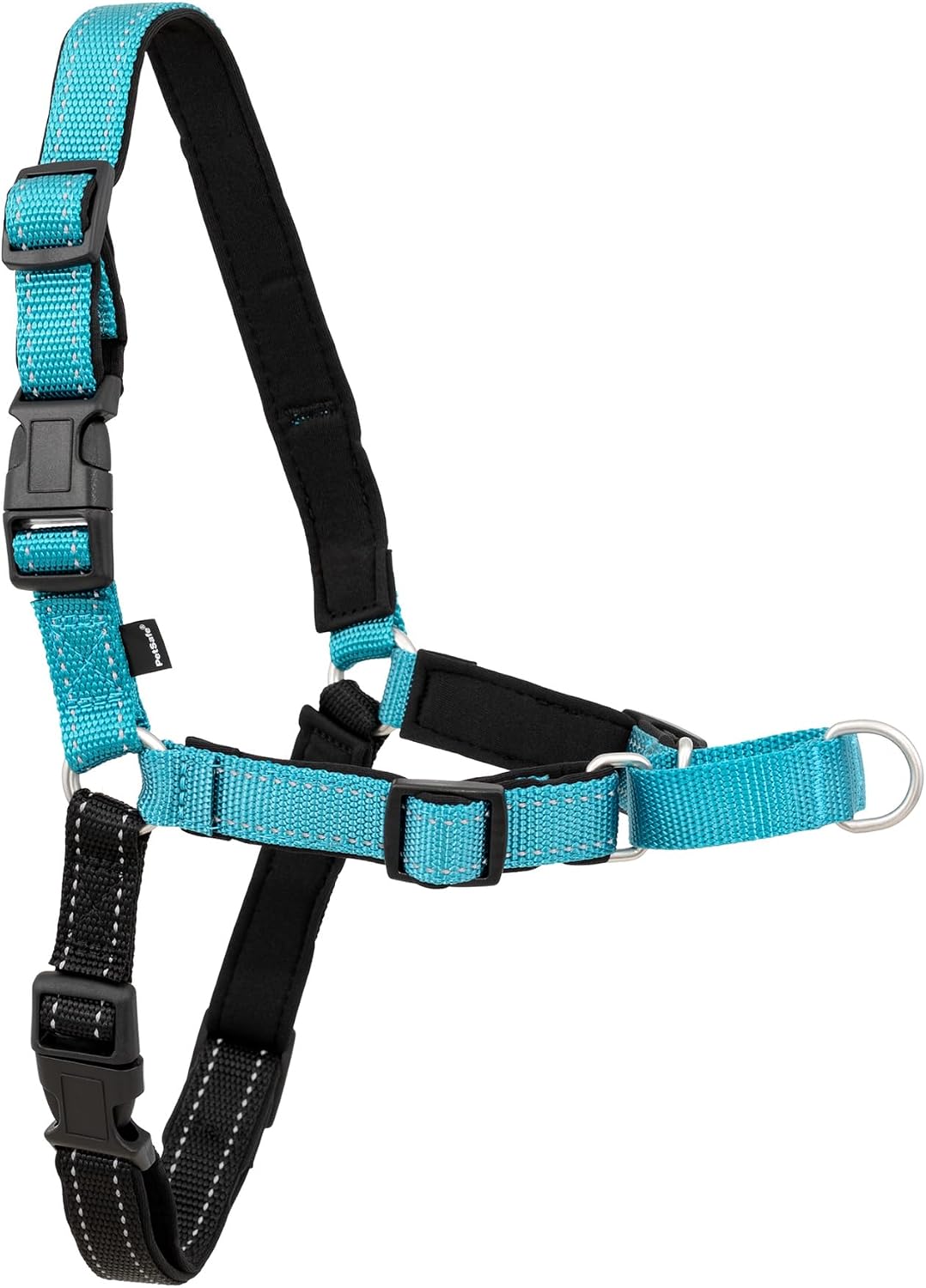
Front-clip pick: Petsafe Deluxe Easy Walk Harness, Large, Ocean Blue, EWH-D-HC-L-OCN
 Visit on Amazon →
This is the harness I hand to an owner whose dog has never worn a front-clip harness. The design uses a martingale-style loop across the chest: the leash attaches at a front ring, and as the dog pulls, that loop tightens just enough to bring the chest around. It is the simplest version of the no-pull idea, and for a lot of dogs it is all they will ever need.
The first thing I check on any front-clip harness is the attachment point. Here the leash ring is metal, which matters, because a plastic front ring will deform under a hard leash-pop on a big dog. The webbing is flat nylon, and the chest strap and girth strap adjust independently, which is the feature that makes a correct fit possible at all.
Flaws but not dealbreakers: the padding is minimal. On a short-coated dog, a chest strap that sits too tight will rub a bald patch behind the front legs within a couple of weeks, and that is a fit problem, not a product problem. Run two fingers under the strap every few walks, especially after the dog has been swimming or the webbing has been wet and dried.
Sizing is the other thing to know. The Easy Walk is sold by girth measurement, and a large here is not a large everywhere. Measure before you order, and if your dog lands between sizes on a front-clip harness, size down. A slightly snug girth strap is what keeps the front ring centered.
This is the right first harness for most pullers, and it is the one I would buy for a dog under 60 pounds.
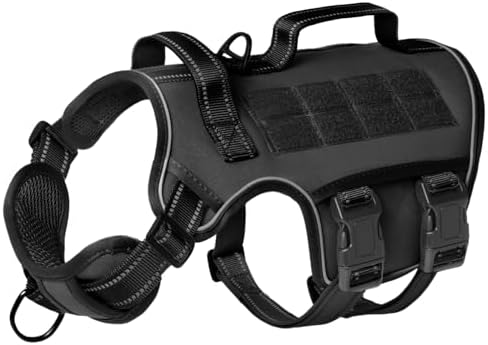
Budget vest pick: Dog Harness for Large Dogs, No Pull Tactical Vest with Front Clips
 Visit on Amazon →
Vests solve one specific problem: pressure. A wide padded panel spreads load across the chest instead of concentrating it on two half-inch straps. For a dog with thin skin, a long coat that mats, or a chest that nylon webbing has already rubbed raw, a vest is the better answer.
This one has a front clip for no-pull work, a back attachment, a top handle, and several adjustment points. The handle is useful for steadying a dog getting into a car or holding a dog still at the vet. It is not a lifting handle for a dog that is fighting you, and it is not a substitute for a leash.
What to check before you trust a vest: the front ring, because on a dog over 40 pounds that ring takes the entire pull force, and it needs to be metal. Then check the straps. A vest with more straps has more places for the fit to drift, so you will re-check it more often than a simple nylon harness. The panels should sit flat against the chest without buckling, and the shoulder straps should clear the point of the shoulder so the dog's stride stays long.
Flaws but not dealbreakers: the extra material holds heat, so a dog working hard in July will be happier in the nylon harness. And a vest that is even slightly loose will rotate under load, which is the one failure mode that convinces people front clips do not work.
Buy this one if your dog has sensitive skin, a thick coat, or a chest that other harnesses have rubbed.
The six-point fit check
Do these in order. It takes about five minutes the first time and thirty seconds after that.
Step one: measure the girth, not the weight. Run a soft tape around the deepest part of the ribcage, right behind the front legs, and write the number down. Weight charts lie across body types. A deep-chested shepherd and a barrel-chested lab can weigh the same and need different sizes.
Step two: set the chest strap at the sternum. The front ring should sit on the breastbone, roughly a palm's width below the throat. If it rides up on the throat, the dog will pull into it and cough. If it sits too low, near the belly, the harness levers the dog sideways instead of stopping forward motion. Adjust the chest strap, then the girth strap, in that order.
Step three: two fingers under every strap. You should be able to slide two flat fingers under each strap and no more. Loose straps are how a harness rotates. On a front-clip harness the girth strap is the one that matters most, because a loose girth strap is exactly why the front ring swings off to one side under load.
Step four: clear the shoulder. The shoulder blades have to move free. Put a hand on the shoulder and walk the dog toward you. If a strap crosses the point of the shoulder, it will rub, and the dog will shorten its stride to avoid the pressure. That shortened stride is the first sign a harness is sitting too far back.
Step five: load test in the driveway. Clip the leash to the front ring and stand still. Let the dog hit the end of the leash a few times. Watch where the harness moves. If the whole thing slides around the ribcage, tighten the girth strap one notch. If the front ring drags the chest strap up toward the throat, the harness is too big, not too loose.
Step six: re-check after ten minutes of walking. New webbing settles. So does padding. A harness that was perfect in the driveway is often a notch loose after a mile, and that is normal. Re-tighten, then leave it alone.
Sizing, the part that sends people back to the store
Sizing is where most returns happen, and almost all of it comes from trusting the letter on the box. A medium in one brand is a small in another, and a "large" meant for a greyhound's deep chest will hang off a bulldog.
Three rules I give clients. Measure the girth and compare it to the chart, not to your dog's weight. If the dog is between sizes on a front-clip harness, go down, because the snug girth strap is what keeps the front ring centered. And if you have a puppy, measure every three weeks until the dog stops growing, because a harness that fit at five months will sit wrong at eight.
Mistakes that make a good harness fail
The most common one is clipping the leash to the back ring on a dog that pulls. A back clip gives a puller leverage. Use the back ring for a dog that already walks politely, and the front ring for a dog that does not.
The second is a plastic buckle on a dog over 40 pounds. I have watched a buckle let go on a leash-pop, and it happens at the worst possible moment, usually near a road. Metal hardware at the load points is not a luxury.
The third is a harness with only one adjustment point. If you cannot set the chest strap and the girth strap separately, you are choosing between a strap that is too tight at the chest and too loose at the ribs. Skip those.
The fourth is padding that migrates. Padding that shifts after a month is worse than no padding, because it bunches and rubs raw spots. Check the panels after every wash.
The fifth is heat. A thick vest on a hard-working dog in summer is a problem you can prevent by keeping a lighter nylon harness for warm-weather walks.
The training half of the job
A front-clip harness gives you leverage. It does not teach the dog anything. That is the part owners skip, and it is why some people end up with a dog that pulls in a harness just as hard as it pulled in a collar.
The drill is simple. When the leash goes tight, stop. Stand still, say nothing, wait. The moment the dog turns back toward you and the leash goes slack, mark it and walk on. Ten minutes of that, twice a day, teaches the dog that forward motion lives on a loose leash. The harness makes those ten minutes survivable for both of you, especially with a reactive dog on a busy street.
If your dog lunges at other dogs, that is a separate project. A harness keeps a lunging dog from choking itself, which matters, but the training is the training.
What this costs
Two harnesses is the honest answer for most households: a walking harness and a car harness. The vest with the top handle does double duty for car rides, which is why so many clients end up buying that shape first and the simple nylon front-clip second. Check current Amazon price on both before you decide, because the gap between them is smaller than most people assume.
Add the cost of replacing a harness when the webbing frays or a buckle cracks, and one session with a trainer who will fit the harness on your actual dog and show you the load test in person. That session is the highest-value money in this entire article, because fit is 80% of the outcome and a trainer can see what a size chart cannot.
The short version
Measure the girth. Set the chest strap at the sternum. Two fingers under every strap. Clear the shoulder. Load test before you leave the driveway. Re-check after ten minutes.
Then pick the shape that matches your dog: the nylon front-clip harness for a straightforward puller, the padded vest for a dog with sensitive skin or a heavy coat. Either one, fitted correctly, will change your walks. Either one, fitted wrong, will end up in a drawer while you blame the product.
The harness was never the problem. The strap position was.